How you remove Outlook from Windows 10 depends on which Outlook you have. The new Outlook for Windows is a separate app, and you can uninstall it like any other from Settings > Apps. Classic Outlook that comes with Microsoft 365 is part of the Office installation and can’t be removed on its own from Settings. You can hide it, stop it running, or uninstall all of Office. Older Office versions such as Office 2016 let you remove just Outlook by changing the installation. Here’s how to handle each.
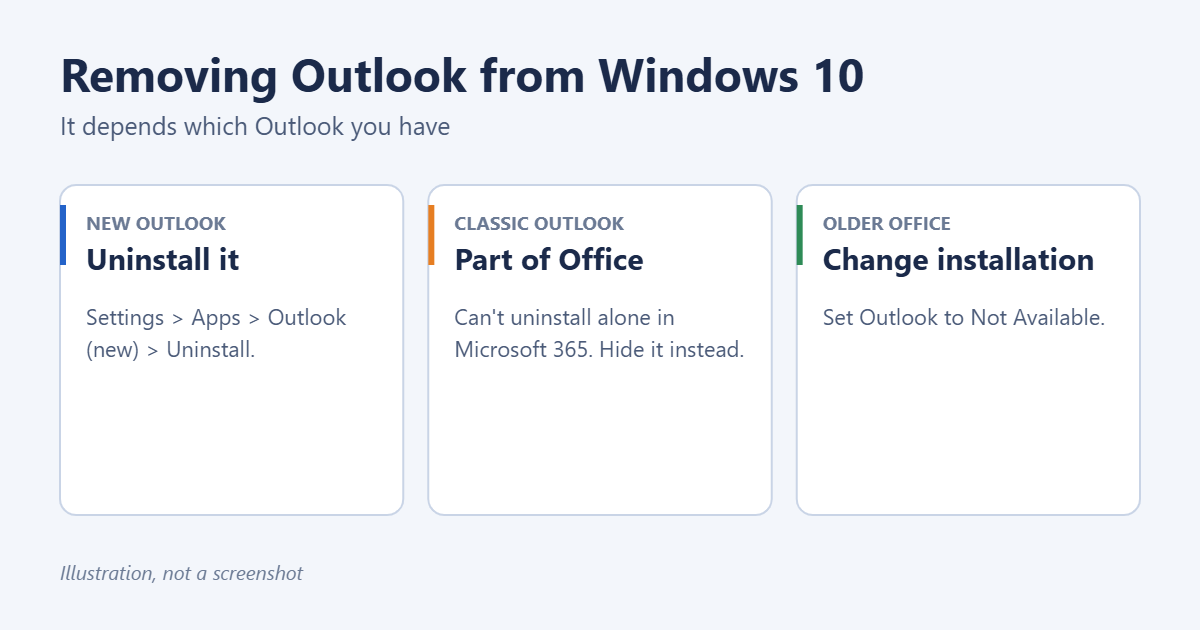
Which Outlook do you have?
Go to Settings > Apps > Apps & features and search for “Outlook.”
- Outlook (new) or Outlook for Windows listed on its own is the new Outlook app.
- If you only see Microsoft 365, Microsoft Office, or Office 2021 (or similar), Outlook is part of that suite.
Remove the new Outlook for Windows
- Open Settings > Apps > Apps & features.
- Find Outlook (new), click it, and choose Uninstall.
- Click Uninstall again to confirm.
Microsoft has been installing the new Outlook automatically on many Windows 10 PCs, so it may come back with a later update. If it does, uninstall it again the same way. Your email stays on the mail server, so nothing is deleted from your account.
Classic Outlook in Microsoft 365
Microsoft 365 installs Word, Excel, PowerPoint, Outlook, and the rest as one package, and Settings doesn’t let you remove a single app from it. Your options:
- Hide it: right-click Outlook on the taskbar and choose Unpin from taskbar. In the Start menu, right-click it and choose Unpin from Start.
- Stop it starting automatically: open Task Manager (Ctrl + Shift + Esc), go to the Startup tab, and disable Outlook if it’s listed.
- Remove your email from it: open Control Panel > Mail (Microsoft Outlook), click Show Profiles, select the profile, and click Remove. This deletes the copy of your mail on this PC, not your email account.
- Uninstall all of Office: if you don’t need any Office apps on this PC, uninstall Microsoft 365 from Settings > Apps. See how to uninstall Microsoft Office in Windows 10.
IT administrators can install Microsoft 365 without Outlook using Microsoft’s Office Deployment Tool, but that’s an advanced setup.
Older Office versions (2016, 2019, and similar)
Some older, volume-licensed Office versions let you remove individual apps:
- Go to Control Panel > Programs and Features.
- Select your Office version and click Change.
- Choose Add or Remove Features and click Continue.
- Click the drop-down next to Microsoft Outlook, choose Not Available, and click Continue.
If you only see Quick Repair and Online Repair, your version doesn’t support removing single apps.
Before you remove Outlook
- Back up local data. If you use a POP account or old .pst archive files, export them first with File > Open & Export > Import/Export.
- Set up another email app. You can use Outlook on the web, Gmail in a browser, or another email program.
- Note: the old Windows 10 Mail and Calendar app was retired at the end of 2024, so it’s no longer an alternative.
Troubleshooting
Outlook (new) isn’t listed
It isn’t installed. The Outlook you see is part of Office.
Uninstall is greyed out
On a work or school PC, IT may control which apps you can remove.
Frequently asked questions
Will removing Outlook delete my email?
No, not for Microsoft 365, Outlook.com, Gmail, or other IMAP and Exchange accounts. The mail stays on the server. Only local POP or .pst data needs backing up.
How do I get Outlook back?
Install the new Outlook from the Microsoft Store, or reinstall Office. See how to install Outlook on Windows 10.
How do I just sign out of Outlook?
See how to sign out of Outlook on Windows 10.
Summary
Uninstall the new Outlook from Settings > Apps. Classic Outlook in Microsoft 365 can’t be removed alone, so unpin it, stop it starting up, or uninstall Office entirely. For older Office versions, use Change > Add or Remove Features and set Outlook to Not Available.

Matt Jacobs has been working as an IT consultant for small businesses since receiving his Master’s degree in 2003. While he still does some consulting work, his primary focus now is on creating technology support content for SupportYourTech.com.
His work can be found on many websites and focuses on topics such as Microsoft Office, Apple devices, Android devices, Photoshop, and more.