You removed an Outlook account, yet the address still shows up somewhere on your PC. That usually happens because Windows 11 can hold the same account in three places: the new Outlook for Windows app, classic Outlook, and Windows Settings itself. Remove it from each place where it appears. Removing an account only unlinks it from this computer; the mailbox, its email, calendar and contacts stay on the server.
Find out where the account is connected
Before you click anything, work out which of the three places is still holding the account. Each one keeps its own list, so removing an address from one does not remove it from the others.
| What you see | Where the account lives | Section to use |
|---|---|---|
| Settings open in a separate Settings window (View > View settings) with an Accounts section | New Outlook for Windows | Remove it from new Outlook |
| Outlook has a File tab that opens a backstage page with Account Settings, and may show a Try the new Outlook toggle in the upper right | Classic Outlook (Microsoft 365 desktop app) | Remove it from classic Outlook |
| The address appears in Windows Settings under Accounts, or Windows apps keep offering it at sign-in | Windows 11 itself | Remove it from Windows 11 Settings |
A quick way to tell the two Outlook apps apart: classic Outlook has a full File menu with Info, Account Settings and Options, while new Outlook keeps everything inside one Settings window. If you have both installed, check both.
What removing does not do. It does not close or delete the email account. Microsoft states that removing an account from classic Outlook does not deactivate it, and you can still sign in on the web or another device. Closing an Outlook.com or Microsoft account is a separate task with different consequences, and it is not covered here.
Remove the account from new Outlook for Windows
New Outlook comes preinstalled on new Windows 11 PCs and on recent Windows 11 versions, so it may be on your PC even if you never installed it. Its account list lives in the Settings window, under Accounts.
- Open new Outlook. On the View tab, select View settings. (You can also open the File tab and select Account info.)
- In the Settings window, select Accounts, then Your accounts. Every connected mailbox is listed here.
- Find the account you want to remove and select Manage beside its name.
- Select Remove. Outlook asks whether to remove the account from this device only or from all devices. Choose this device if you still use the account in Outlook on another computer.
- Close the Settings window. The account and its folders disappear from the folder pane.
Example: Priya added an old Gmail address to new Outlook on her home PC and on her laptop. She wants it gone only from the home PC, so she picks this device. On the laptop, the Gmail folders stay exactly where they were.
Microsoft documents these steps on its page on adding or managing an email account in new Outlook. The same Manage menu also has Set as primary account, which matters if Remove will not work (see the troubleshooting section below).
Remove the account from classic Outlook
Classic Outlook stores offline copies of your mail on the PC, so it shows a warning before it removes anything. Read the warnings below first, then follow the steps.
Before you start: If the account is a POP account, the Outlook Data File (.pst) on this PC may hold the only copy of older messages, because many POP setups download mail and remove it from the server. Copy the .pst file somewhere safe, or export it, before you remove the account. For Outlook.com, Microsoft 365 and other IMAP or Exchange accounts, the server keeps the mail, so only the local cache is lost.
- In classic Outlook, select File in the upper left corner.
- Select Account Settings, then Account Settings again from the drop-down.
- Select the account you want to delete, then select Remove.
- Outlook warns that all offline cached content for this account will be deleted. That cache is only the copy stored on this computer. Select Yes to confirm.
If the account is the last or only one in classic Outlook, Outlook will not remove it right away. It tells you to create a new location for your data first, which means adding another account or a new Outlook Data File. Microsoft explains this on its classic Outlook account removal page, which applies to the Microsoft 365 version of classic Outlook.
Removing the whole profile instead. If you want to clear every account at once, for example before handing the PC to Jordan, remove the Outlook profile. In classic Outlook, select File > Account Settings > Manage Profiles, select Show Profiles, pick the profile and select Remove. This deletes all accounts stored in that profile. According to Microsoft’s Remove a profile page, .pst files tied to the profile stay on your computer, and online mailboxes are not lost. For a full fresh start, see how to reset Outlook to its default settings.
Remove the account from Windows 11 Settings
Windows keeps its own list of accounts that built-in apps and Microsoft Store apps can use. An Outlook.com address can sit here even after you remove it from both Outlook apps, which is the most common reason it “comes back”.
- Press Windows + I to open Settings.
- Select Accounts in the left pane, then Email & accounts.
- Under Accounts used by email, calendar, and contacts, select the Outlook address. Depending on the account, you will see Manage or Remove.
- If you see Manage, select it and choose the option to delete the account from this device, then confirm. If you see Remove, select it and confirm.
- Back on the Email & accounts page, look further down at the list of accounts used by other apps. If the same address is listed there, select it, choose Remove and confirm.
The second list is easy to miss. Alex, for instance, removed his Outlook.com address from the first list, but Microsoft Store apps kept suggesting it because it was still in the other apps list. Clearing both lists stopped the prompts.
Microsoft’s guide to managing accounts in Windows confirms where Email & accounts and the email, calendar and contacts list sit. The exact wording of the remove buttons can shift between Windows 11 updates, so if a label differs slightly, look for the closest match on the same page.
Example: Your Accounts on a Current Build
On a Windows 11 laptop with current updates, the page this guide calls Email & accounts was labeled Your accounts under Settings > Accounts, with the description Add or manage accounts used in Windows.
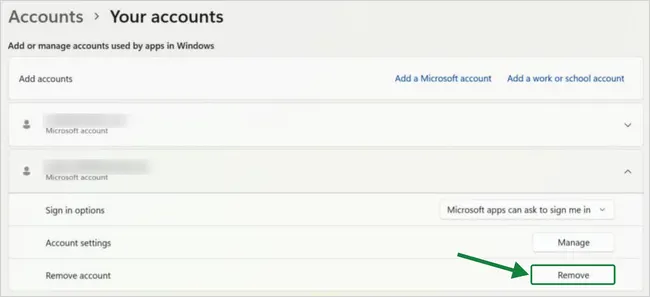
It listed each account with a chevron. Expanding one showed Sign in options, Account settings with a Manage button and Remove account with a Remove button. I did not remove anything for this screenshot.
When Remove is missing or greyed out
If you cannot remove the account, one of these situations usually explains it.
- It is the primary account in new Outlook. If Remove is unavailable, add or choose another account, open its Manage menu, select Set as primary account, then try removing the old one again. Microsoft’s pages do not spell out this restriction, so treat it as the first thing to try rather than a guaranteed fix.
- It is the account you sign in to Windows with. The Microsoft account you use to sign in to the PC is tied to your Windows user account, so Email & accounts may not offer a way to remove it. Removing it means changing how you sign in to Windows, which is a bigger job than removing a mailbox. If you only want to stop using it for now, see how to sign out of a Microsoft account in Windows 11.
- It is a work or school account. Accounts from an employer or school are connected through Access work or school and may be managed by your organization. Follow the separate steps to remove a work or school account from Windows 11.
- It is a shared mailbox that appeared on its own. In Microsoft 365 organizations, shared mailboxes you have full access to can be added to classic Outlook automatically. Because the mailbox is added through your permissions, removing it yourself may not stick. Microsoft documents an administrator fix: turning off automapping for the shared mailbox, so ask your admin.
Check the removal and add the account back if needed
To confirm the account is fully gone, close and reopen each Outlook app and look at the folder pane, then revisit Settings > Accounts > Email & accounts and check both lists. If the address is no longer in any of the three places, the job is done. Signing in to Outlook on the web with the same address will show that your mail is still there.
If you change your mind, you can add the account again at any time. You may need to type the password and complete any two-step verification again, and Outlook will download a fresh copy of your mail, which can take a while for a large mailbox. In Windows Settings, use Add an account under the email, calendar and contacts list. For the Outlook apps, the walkthrough on configuring classic and new Outlook covers the add-account screens.
Questions people ask before removing an account
Will my email disappear from Outlook on the web?
No. Removing the account from this PC only deletes the local connection and cached copy. Outlook on the web, your phone and other computers keep showing the same mailbox. The exception is a POP account whose messages were already removed from the server, which is why the .pst backup matters.
Why does the address still appear in Word or Excel?
Microsoft 365 apps such as Word and Excel show the account you are signed in to for Office, which is separate from your Outlook mailbox list. To sign out there, open any Office app and select File > Account (Office Account in Outlook) > Sign out, as described on Microsoft’s Sign out of Office page. Avoid registry edits suggested on some sites; they are not a Microsoft-documented fix.
Can I keep the calendar but drop the email?
Not through the removal steps above, because they work on the whole account rather than on mail or calendar separately. If you just want fewer alerts, adjust Outlook’s notification settings instead of removing the account.
Does removing the account from new Outlook also remove it from classic Outlook?
No. The two apps keep separate account lists, and Windows Settings keeps a third. That is why an account can seem to survive removal: it is simply still connected in another place.
Once all three places are clear, restart the PC once so every app picks up the change, and you are done.

Matt Jacobs writes and maintains the guides on Support Your Tech, which he started in 2017. He spent most of his career keeping small-business PCs running and still takes the occasional consulting job, so the steps here come from fixing the same problems on other people’s computers. Every guide is checked on his own Windows 11, Windows 10, Mac, iPhone and iPad before it goes up.