Last updated on November 7th, 2026 at 08:31 am
You wake the PC and the screen shows nothing but wallpaper: no folders, no shortcuts, not even the Recycle Bin. Breathe first. Your files are almost always still in the Desktop folder, and Windows has only stopped drawing them. The one-click fix is to right-click an empty spot on the desktop, select View and check Show desktop icons. If that is already checked, the second fix is to restart Windows Explorer from Task Manager.
Applies to: Windows 11 (Home and Pro).
Check that your files are still there
A quick look in File Explorer shows if the icons are hidden or the files are really missing, and it takes less than a minute.
- Press Windows key + E to open File Explorer.
- Select Desktop in the left pane.
- Look at the list. If your files and shortcuts are there, nothing is lost. Only the desktop display needs fixing.
- If the folder is empty, select OneDrive in the left pane and open the Desktop folder inside it. If your items are there, skip to the OneDrive section below.
Here’s a typical case. Priya opens her laptop after a weekend and sees a bare desktop. In File Explorer, the Desktop folder still holds her 30 shortcuts and the budget workbook she saved there on Friday. Her files were fine all along; the icons were just switched off. Anything you put on the desktop, for example when you save an Excel file to the desktop, lives in this same folder.
Turn desktop icons back on
This is the fix that works most often, because the setting is easy to clear by accident from the right-click menu.
- Right-click an empty area of the desktop.
- Select View.
- Select Show desktop icons so it has a check mark.
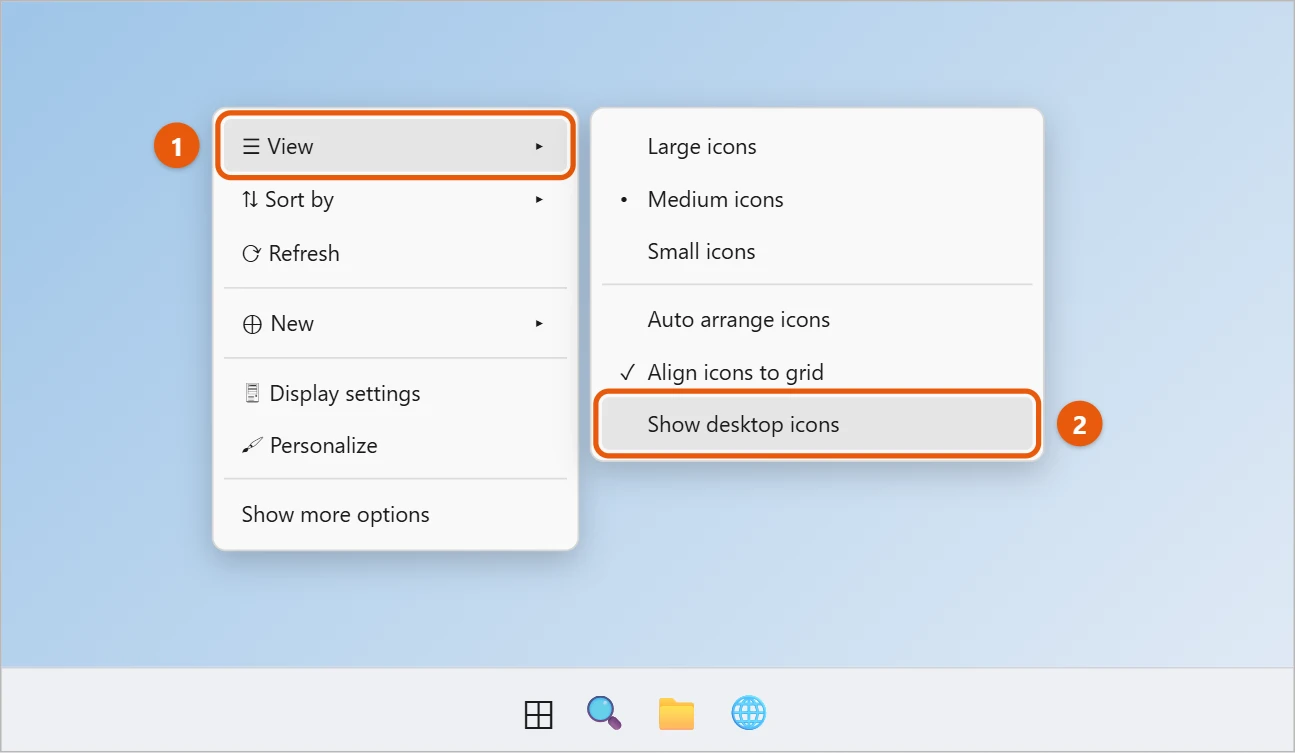
The icons should appear at once. If the check mark was already there, select it to clear it, then select it again; this does no harm and sometimes nudges a stuck desktop. If open windows are simply covering everything, press Windows key + D to minimize them all, and press it again to bring them back.
The same View menu has Large icons, Medium icons and Small icons. You can also hold Ctrl and turn the mouse wheel on the desktop. If the icons come back tiny or huge, change the desktop icon size in Windows 11 to a comfortable setting.
Bring back This PC, Recycle Bin and other system icons
Show desktop icons only reveals what was already on the desktop. System icons such as This PC and the Recycle Bin have their own switches, so they can be missing while your files show normally.
- Select Start > Settings > Personalization > Themes.
- Under Related settings, select Desktop icon settings.
- Check each icon you want. The list includes This PC (the box may be labeled Computer), User’s Files, Network and Recycle Bin, and on most PCs Control Panel.
- Select Apply, then OK.
The same window has an option that lets themes change desktop icons. If a new theme keeps swapping your icons, clear that box before you apply the theme again. Pictures of each screen are in showing This PC on the desktop in Windows 11, and while you’re in this window you can also put a Control Panel icon on the desktop.
Restart Windows Explorer
Windows Explorer is the process that draws the desktop, the taskbar and File Explorer windows. When it hangs, the desktop can stay blank even though every setting is right.
- Press Ctrl + Shift + Esc to open Task Manager.
- On the Processes page, select Windows Explorer. If you don’t see it near the top, scroll down; it can be listed under Apps or under Windows processes.
- Select Restart task at the top of the window.
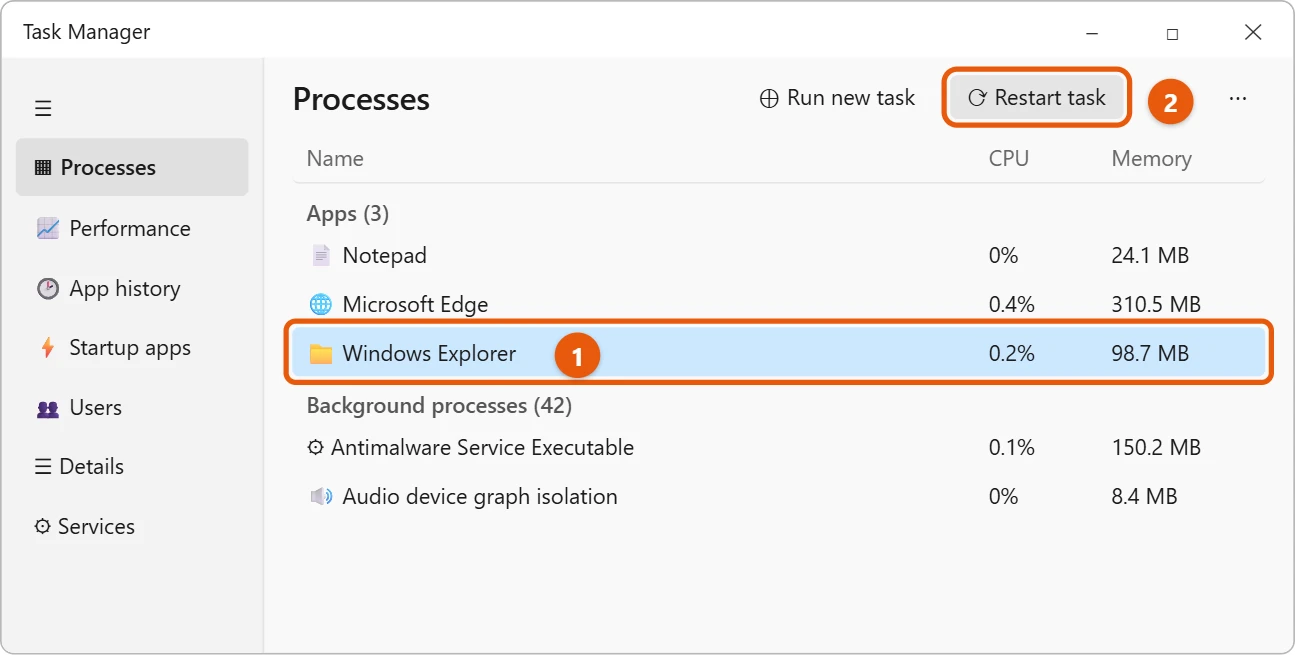
The taskbar and desktop vanish for a second or two and then return. Open File Explorer windows may close, but your other apps and documents stay open. If the keyboard shortcut doesn’t respond, there are other ways to open Task Manager in Windows 11. If the desktop is still empty after this, restart the whole PC before you try anything deeper.
If the Desktop folder moved to OneDrive
OneDrive can back up your Desktop, Documents and Pictures folders. When that backup is on, the Desktop you see is the one inside your OneDrive folder. If OneDrive signs out, the backup is switched off, or you sign in to a different PC, the desktop can look empty while your files sit in OneDrive.
To see where your Desktop points:
- Open File Explorer and select OneDrive in the left pane.
- Right-click the Desktop folder and select Properties.
- Open the Location tab. The path shows where Windows reads the desktop from, and Move lets you point it somewhere else.
If you’d rather keep the Desktop only on this PC, you can stop backing it up. Before you do, check for files marked as online only (a cloud icon in File Explorer). Right-click them and choose Always keep on this device so a copy is on your PC first.
- Select the OneDrive cloud icon in the taskbar, then Help & Settings > Settings.
- Select Sync and backup > Manage backup.
- Turn off Desktop.
- Choose Keep the files only on my PC or Keep the files only in OneDrive, depending on where you want them to live.
Microsoft explains these choices on its OneDrive folder backup page. If you can’t spot the OneDrive folder at all, see how to find the OneDrive folder in Windows 11.
If icons ended up on another screen or in odd places
Icons have fixed positions. After you unplug a second monitor, change the resolution or switch display modes, some of them can land somewhere you can’t see, usually at the far edge of the screen.
- Gather them up. Right-click the desktop, select View and turn on Auto arrange icons. Windows lines them up in columns from the top left. Turn it off again afterward if you like placing icons by hand.
- Snap them to rows. Align icons to grid in the same menu keeps them in neat rows and stops them from overlapping.
- Check the display mode. Press Windows key + P. If Second screen only is selected on a laptop with nothing attached, choose PC screen only.
If you use two screens regularly, it’s worth reviewing how to set up multiple monitors in Windows 11 so the main display is the one you expect.
Fix blank or wrong icon pictures
Sometimes the icons are present but show as white pages or the wrong picture. Windows keeps a cache of icon images, and it can fall out of date. Try these in order:
- Restart Windows Explorer as described above, or restart the PC.
- Open Command Prompt, type
ie4uinit.exe -showand press Enter. This is a widely shared refresh command rather than a step on a Microsoft Support page. - If one shortcut keeps its wrong picture, the file it points to may have moved. Right-click it, select Properties and check the target.
A deeper reset deletes the icon cache files while Explorer is stopped, and Windows rebuilds them. Only attempt it if you’re comfortable working with Task Manager and hidden system folders. To pick a new picture on purpose, see how to change desktop icons in Windows 11.
Other causes worth ruling out
- Hidden files. A file with the Hidden attribute won’t show on the desktop. In File Explorer, select View > Show > Hidden items, open Desktop and look for faded icons.
- A temporary profile. If Windows says you’re signed in with a temporary profile, your usual desktop isn’t loaded. Restart the PC. If the message keeps coming back, get help with the profile before deleting anything.
- A damaged account. To test, add a second local account under Settings > Accounts > Other users and sign in to it. If its desktop works, the problem is tied to your profile, not to Windows.
- A work or school PC. An administrator can set a policy that hides and disables everything on the desktop. If Show desktop icons makes no difference on a work PC, ask your IT team instead of editing settings yourself.
- Damaged system files. Open Terminal (Admin) and run
sfc /scannow. Let it finish, then restart. - A recent change. If icons vanished right after installing an app or driver, System Restore can roll Windows back to an earlier restore point without touching your documents.
Skip registry cleaners and “desktop fixer” apps. None of the fixes here need them.
Get back icons or files you deleted
If a shortcut or file really was deleted, check the Recycle Bin first. Right-click the item and select Restore, or follow the steps to restore items from the Windows 11 Recycle Bin. If you emptied it, a backup is the only route: OneDrive’s own recycle bin for files that were in OneDrive, or File History or another backup if you had one turned on.
App shortcuts are easy to recreate, since deleting a shortcut never removes the app:
- Open Start and select All (All apps on some builds) to see every app.
- Drag the app onto the desktop. Windows creates a new shortcut.
- For a file or folder, right-click the desktop and select New > Shortcut, then browse to it.
Questions people ask when icons vanish
Why did my icons disappear after a restart or update?
Usually it’s one of the causes above: Show desktop icons was cleared, Explorer didn’t load cleanly, or OneDrive backup changed where the Desktop lives. Work through the first three sections before suspecting the update itself.
Why are only This PC and the Recycle Bin missing?
Those are system icons, and they’re controlled in Desktop icon settings, not by Show desktop icons. Turn them back on there.
Why don’t new files I save to the desktop show up?
Press F5 on the desktop to refresh it. If they still don’t appear, the app may be saving to a different Desktop folder, such as the local one while your desktop now reads from OneDrive. Check the Location tab described above.
How do I hide desktop icons on purpose?
Clear Show desktop icons in the View menu. To hide only a few, hide specific desktop icons instead, or move clutter into folders using the ideas in removing things from the desktop without deleting them.
Do these steps work on Windows 10?
The View menu and Task Manager fixes are the same, but some screens differ. Use showing or restoring desktop icons in Windows 10, which also covers tablet mode. Windows 10 itself reached end of support on October 14, 2025.
Once your icons are back, Microsoft’s page on how to customize the desktop icons in Windows lists every remaining option.

Matt Jacobs writes and maintains the guides on Support Your Tech, which he started in 2017. He spent most of his career keeping small-business PCs running and still takes the occasional consulting job, so the steps here come from fixing the same problems on other people’s computers. Every guide is checked on his own Windows 11, Windows 10, Mac, iPhone and iPad before it goes up.