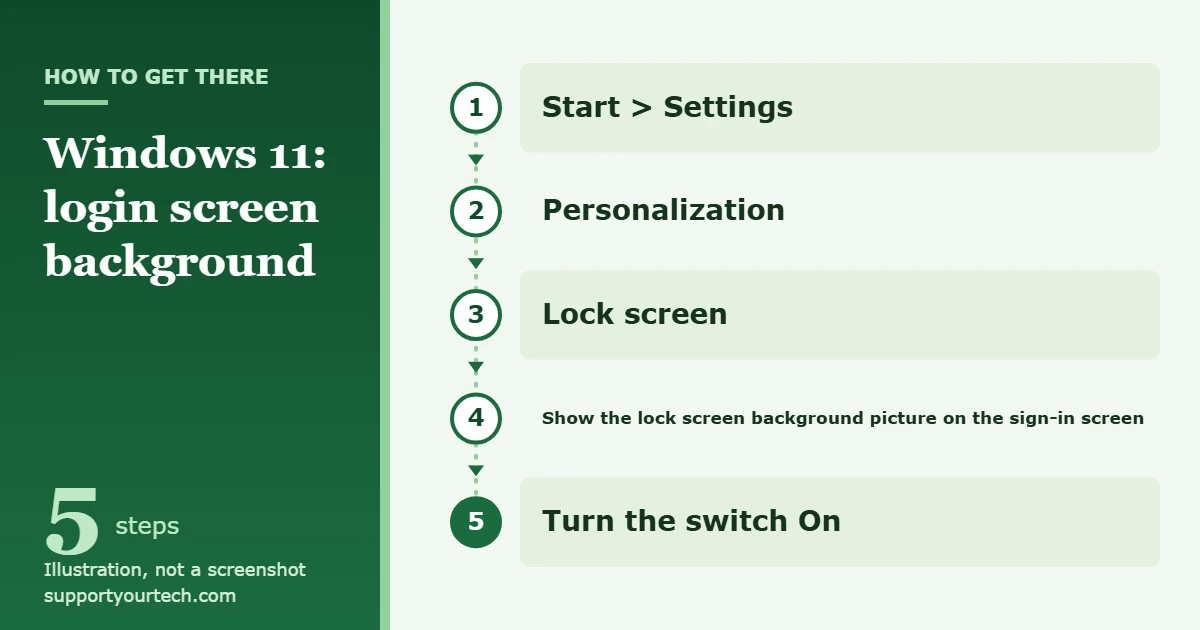
To change the login screen background in Windows 11, select Start > Settings > Personalization > Lock screen, choose a background, and turn on Show the lock screen background picture on the sign-in screen. The picture, name, and sign-in method shown on that screen are changed separately, under Settings > Accounts.
Applies to: Windows 11. Checked against Microsoft Support on October 7, 2026.
What you can change on the login screen
Windows calls the login screen the sign-in screen. It is the screen where you type a PIN or password, or use your face or fingerprint. It appears after the lock screen, which is the first screen you see when the PC starts or wakes up.
Windows 11 has no single “login screen” page in Settings. Each part of the screen is controlled from a different place:
| Part of the login screen | Where to change it |
|---|---|
| Background picture | Settings > Personalization > Lock screen |
| Account picture | Settings > Accounts > Your info |
| Account name | Your Microsoft account profile online, or the local account settings on the PC |
| PIN, fingerprint, or face sign-in | Settings > Accounts > Sign-in options |
The layout itself, meaning where the picture, name, and PIN box sit, is fixed. Microsoft does not document a setting for moving or restyling those parts, so this guide sticks to the changes Windows supports. The name text is one of them: it comes from your account, and you can change the name shown on the lock screen.
Change the login screen background
The login screen does not have its own wallpaper setting. It borrows the lock screen background when one switch is turned on.
- Select Start, then select Settings. The Settings window opens.
- Select Personalization, then select Lock screen. The lock screen options appear, starting with Personalize your lock screen.
- Open the menu next to Personalize your lock screen and pick a background. Picture uses a single image, Slideshow uses images from folders on your device, and Windows spotlight shows a rotating set of images from Microsoft.
- On the same page, find Show the lock screen background picture on the sign-in screen and turn the switch On. Windows now uses the same background image on both screens.
- Press the Windows logo key + L to lock the PC, then dismiss the lock screen. The sign-in screen should show your background behind the PIN or password box.
If you only need help picking the image, slideshow folders, or Windows spotlight, our guide on changing the lock screen wallpaper in Windows 11 covers those choices in detail. Microsoft lists every option on the page in Customize the Lock Screen in Windows.
Change the picture shown for your account
The round picture above your name on the login screen is your account picture. Changing it in Settings updates the login screen too.
- Open Settings and select Accounts > Your info. Your current picture and account details appear at the top.
- Under Adjust your photo, select Choose a file > Browse files to pick a photo that is already saved on the PC.
- If the device has a camera and you would rather take a new photo, select Open camera instead.
Windows remembers the last three pictures you have used, and you can switch between them on the Your info page. That makes it easy to go back if you do not like the new one. Microsoft’s steps are in Change Your Account Picture in Windows.
Remove an old account picture
To delete a picture so it no longer appears as one of the recent choices:
- Open File Explorer from the taskbar.
- Go to C:\Users\yourname\AppData\Roaming\Microsoft\Windows\AccountPictures, replacing yourname with your account name.
- If you cannot see the AppData folder, select View > Show > Hidden items.
- Delete the picture you no longer want.
Change the name shown on the login screen
How you change the name depends on the kind of account you sign in with.
- Microsoft account: the name comes from your Microsoft account profile, so it is changed online. Sign in to your Microsoft account, open the Edit name screen, type the new name, enter the Captcha characters, and select Save. Microsoft notes that name changes may take up to 24 hours to update everywhere, so the login screen may keep the old name for a while.
- Local account: the name is stored on the PC and is changed there. Our guide on changing your user name in Windows 11 walks through it.
- Work or school account: the name is managed by the organization, so ask your IT department.
Microsoft warns against using non-standard font characters, such as those from Wingdings, in a user name. They are not supported and may prevent sign-in. Microsoft’s instructions for each account type are in How to change your user account name.
Change how you sign in
If “changing the login screen” means swapping the password box for a PIN, a fingerprint, or face recognition, that is done under sign-in options.
- Open Settings and select Accounts > Sign-in options.
- Under Ways to sign in, select the method you want: Facial recognition (Windows Hello), Fingerprint recognition (Windows Hello), or PIN (Windows Hello).
- Select Set up and follow the instructions on the screen.
Face sign-in needs a Windows Hello compatible camera, and fingerprint sign-in needs a fingerprint reader. If the device does not have one built in, an external USB camera or reader can be used. For the fingerprint steps, see our guide on adding a fingerprint in Windows 11.
To change an existing PIN, go to Accounts > Sign-in options, select PIN (Windows Hello), and then select Change PIN. Enter your current PIN and follow the instructions to create a new one. Microsoft documents this in Change or reset your PIN in Windows.
Remove the password option from the login screen
With a Microsoft account, you can make the login screen offer Windows Hello only. On the Sign-in options page, under Additional settings, turn on For improved security, only allow Windows Hello sign-in for Microsoft accounts on this device. From the next sign-in, Windows accepts only face, fingerprint, or PIN, and the password entry is no longer offered. Make sure you know your PIN before turning this on.
Confirm the change, or undo it
Press the Windows logo key + L. That shortcut locks the PC, so you can dismiss the lock screen and look at the sign-in screen without restarting.
Every change in this guide can be reversed from the place where you made it:
- Background: return to Personalization > Lock screen and turn Show the lock screen background picture on the sign-in screen off, or pick a different background.
- Account picture: return to Accounts > Your info and select one of the earlier pictures that Windows remembers.
- Name: repeat the name change with the old name.
- Windows Hello only: turn the switch under Additional settings off again to bring back the password option.
Troubleshooting
The login screen does not show my picture
Check that Show the lock screen background picture on the sign-in screen is on. When it is off, the sign-in screen does not use your lock screen background. Then lock the PC again to recheck.
The background setting cannot be changed
On a work or school computer, this is usually deliberate. Microsoft documents two policies an administrator can apply: Prevent changing lock screen and logon image, which stops users from changing the image and shows the default one instead, and Force a specific default lock screen and logon image, which sets one image for both the lock screen and the logon screen. If either applies, only your IT department can change it. Do not try to work around a policy on a computer you do not own.
The old name still appears
For a Microsoft account, allow for the delay Microsoft describes, up to 24 hours for the name to update everywhere. Also confirm you changed the right kind of account: editing a Microsoft account profile does not rename a local account, and the reverse is also true.
Facial recognition or fingerprint will not set up
Those options need matching hardware: a Windows Hello compatible camera for face sign-in and a fingerprint reader for fingerprint sign-in. Without that hardware, use PIN (Windows Hello) instead.
I forgot my PIN at the login screen
Look for I forgot my PIN below the PIN box on the sign-in screen, select it, and follow the prompts. If that link is not available, select Sign-in options on the sign-in screen and sign in with your password instead.
Frequently asked questions
Are the lock screen and the login screen the same thing?
No. The lock screen appears first, when the PC starts or wakes up. The login screen, which Windows calls the sign-in screen, appears after you dismiss the lock screen and is where you enter your PIN or password. One switch on the Lock screen page lets both use the same background.
Can the login screen have a different picture from the lock screen?
Windows 11 does not offer a separate picture setting for the sign-in screen. The documented choice is whether it shows the lock screen background, which the switch on the Lock screen page turns on or off.
Does changing the login screen background change my desktop wallpaper?
No. The desktop wallpaper is a separate setting from the lock screen and sign-in screen background.
Why does my login screen show a picture I did not choose?
If the lock screen is set to Windows spotlight, Microsoft supplies a rotating set of images. Switch Personalize your lock screen to Picture to keep one image of your own. On a managed PC, the organization may have set the image.
Can I sign in with just a PIN instead of a password?
Yes. Set up PIN (Windows Hello) under Accounts > Sign-in options. With a Microsoft account, you can also turn on the Windows Hello only switch under Additional settings so the password is no longer offered at sign-in.
Do I need to restart to see the changes?
No. Press the Windows logo key + L to lock the PC and view the lock screen and sign-in screen right away.
Once the background, picture, and sign-in method look right, lock the PC one more time to check all three together. If you share the computer, our guide on signing in to a local account in Windows 11 explains how to pick another account from the same screen.

Matt Jacobs has been working as an IT consultant for small businesses since receiving his Master’s degree in 2003. While he still does some consulting work, his primary focus now is on creating technology support content for SupportYourTech.com.
His work can be found on many websites and focuses on topics such as Microsoft Office, Apple devices, Android devices, Photoshop, and more.