Last updated on November 17th, 2026 at 03:04 pm
An older program or game installer shows boxes, question marks or strings like éä where the text should be, yet the rest of Windows 11 looks fine. The fix is usually the system locale. Set it to the program’s language under Administrative language settings > Change system locale, then restart. This setting only affects non-Unicode programs; it doesn’t change the language of Windows menus or Settings.
This covers Windows 11 versions 25H2 and 26H2. You need an administrator account.
Is the system locale really your problem?
Windows has four language-related settings, and they’re easy to mix up. Each fixes a different symptom:
| Setting | What it controls | Change it when |
|---|---|---|
| System locale (language for non-Unicode programs) | The character set older programs use to show text | One older program shows boxes, ???? or random symbols |
| Windows display language | Menus, Settings and built-in apps | You want Windows itself in another language |
| Regional format | Dates, times, numbers and currency | Dates or decimals look wrong |
| Keyboard (input method) | The characters you type | Keys type the wrong letters |
Unicode is the modern standard that lets one program show text in almost any language. Most current apps use it, so they ignore the system locale. Older programs, many games from the 1990s and 2000s, and some installers instead expect a single “code page” that matches the language they were written for. If yours expects Japanese but Windows provides an English code page, Japanese text turns into nonsense.
If the problem is with Windows menus, see how to change the display language in Windows 11. If it’s dates or the clock, switching the time format is the setting you want. And if only a handful of characters show as empty boxes in a modern app, a missing font is more likely; installing a font on Windows 11 may fix it.
Check your current system locale
Before changing anything, note what you have now so you can switch back later. Two quick ways:
- Region dialog: press Windows + R, type intl.cpl, press Enter and open the Administrative tab. The current setting is listed under Language for non-Unicode programs.
- PowerShell: open Terminal and run
Get-WinSystemLocale. It returns the locale code (such as en-US) and its name.
Example: The Current System Locale
On a Windows 11 Home laptop (version 25H2), Control Panel > Clock and Region > Region > Administrative tab showed Language for non-Unicode programs with Current language for non-Unicode programs: English (United States).
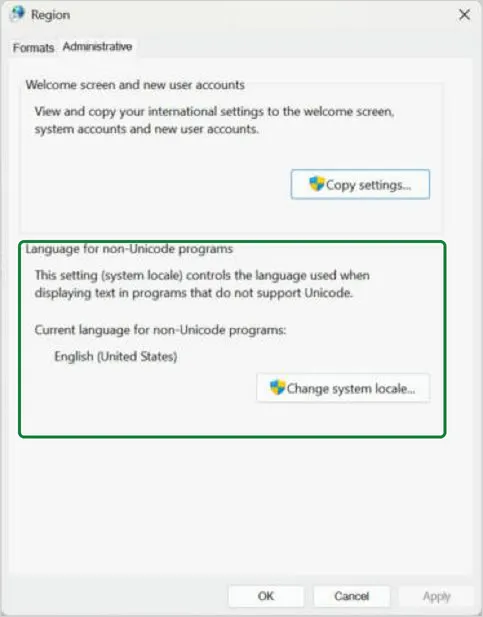
Change system locale is the button below it. Its shield icon means it needs administrator rights, and the change only applies after a restart. I closed the dialog with Cancel.
Change the system locale in Settings
- Save your work and close the program that shows garbled text, because you’ll need to restart.
- Open Settings (Windows + I) and go to Time & language > Language & region.
- Scroll down to Related settings and select Administrative language settings. The older Region dialog opens on its Administrative tab.
- Under Language for non-Unicode programs, select Change system locale. Approve the User Account Control prompt if it appears.
- Open the Current system locale list and choose the program’s language, for example Japanese (Japan).
- Leave Beta: Use Unicode UTF-8 for worldwide language support unticked for now (more on that below), then select OK.
- Select Restart now. The new locale doesn’t take effect until Windows restarts.
After the restart, open the program again. Text that was garbled should now read correctly. Changing the locale also installs the bitmap fonts older programs in that language rely on, so you don’t need to add them yourself.
Faster routes: Run box and PowerShell
Run box: press Windows + R, type intl.cpl and press Enter. Open the Administrative tab, select Change system locale, pick the language, select OK and restart. This is the same dialog the Settings route opens, just without the clicking through Settings. You can also reach it from Control Panel > Clock and Region > Region.
PowerShell: useful if you switch often or want to script it. Right-click Start, choose Terminal (Admin), and run the command below, replacing ko-KR with the code you need:
Set-WinSystemLocale -SystemLocale ko-KRThen restart, either from Start or by running:
Restart-ComputerMicrosoft’s Set-WinSystemLocale reference confirms the command needs administrator rights and takes effect only after a restart.
Pick the locale that matches the program
The locale has to match where the program was made, not the language you’d like to read. Common cases:
| Program made for | Choose in the list | PowerShell code |
|---|---|---|
| Japan | Japanese (Japan) | ja-JP |
| Korea | Korean (Korea) | ko-KR |
| Mainland China | Chinese (Simplified, China) | zh-CN |
| Taiwan | Chinese (Traditional, Taiwan) | zh-TW |
| Russia | Russian (Russia) | ru-RU |
| Back to US English | English (United States) | en-US |
Chinese is the usual trap. Alex installs a game bought in Taiwan, sets the locale to Chinese (Simplified), and still sees gibberish. Simplified and Traditional Chinese use different code pages, so the game needs Chinese (Traditional, Taiwan). If you’re not sure where a program came from, check its publisher or the original box or store page.
Microsoft highly recommends also setting the Windows display language to match the system locale. Many people skip that for a single program, but if it still misbehaves, matching the two is the next thing to try.
Should you turn on the UTF-8 beta option?
The Change system locale dialog has a box labeled Beta: Use Unicode UTF-8 for worldwide language support. It’s off by default. When ticked, Windows gives non-Unicode programs UTF-8 (a Unicode encoding) instead of a language-specific code page, so in theory one setting covers every language.
In practice it helps some developer tools and newer programs written with UTF-8 in mind, but older programs and games that assume a specific code page may show garbled text or misbehave with it on. Because it’s a system-wide beta setting, leave it off unless a program’s own instructions tell you to use it. Microsoft describes the option and its path in Use UTF-8 code pages in Windows apps.
If you try it, test the program you care about and one or two other older apps afterward. If anything breaks, reopen the dialog, untick the box and restart.
Apply it to the sign-in screen and new accounts
The system locale already applies to every user on the PC. The Copy settings button on the same Administrative tab does something related: it copies your current user’s display language, input language, regional format and location to the Welcome (sign-in) screen and system accounts, and to accounts created later. In PowerShell, Copy-UserInternationalSettingsToSystem -WelcomeScreen $True -NewUser $True does the same (Windows 11 only), as Microsoft’s Copy-UserInternationalSettingsToSystem reference explains.
- Open Administrative language settings and select Copy settings.
- Tick Welcome screen and system accounts, New user accounts, or both.
- Select OK and restart when prompted.
Most people fixing one program don’t need this. It’s useful when you’ve switched the whole PC to another language and want the sign-in screen to match.
Undo the change or fix what went wrong
- To switch back: repeat the steps, choose the locale you noted earlier (for example English (United States)), select OK and restart.
- Text is still garbled: confirm you restarted, then check the locale matches the program’s origin (see the table). Some games also need their own language files or a separate regional version.
- Change system locale asks for an administrator password or won’t apply: it’s a system setting that only an administrator can change (Microsoft’s Set-WinSystemLocale reference says so). Sign in with an administrator account, or ask whoever manages the PC. On a work or school device, your organization may control the setting.
- Other older programs now look wrong: the locale affects every non-Unicode program on the PC. Switch back when you’re done with the program that needed it, or keep the new one if it’s the program you use most.
- The program still crashes or looks odd: try running it in compatibility mode. Right-click its shortcut, select Properties, open the Compatibility tab, and tick Run this program in compatibility mode for.
Common questions about the system locale
Will I be able to type in the program’s language after changing it?
Not automatically. The system locale only controls how text is shown. To type Japanese, for example, you need to add a Japanese keyboard in Windows 11, then switch between keyboard layouts with Windows + Space as you type.
Can I use a different locale for just one program?
Windows doesn’t offer a per-program setting. The system locale applies to the whole PC and every user on it, so switch it when you need it and switch back when you’re finished.
Does the system locale change my time zone or currency?
No. Currency, number and date formats come from the regional format, and the clock follows your time zone setting. Changing the system locale leaves those alone. If the clock is the problem, see how to change the time zone in Windows 11.
Why does the dialog still show the old locale?
Usually because the change was made but Windows hasn’t restarted yet, or you chose Cancel at the restart prompt and then signed out instead of restarting. Signing out isn’t enough. Restart the PC, then check again with Get-WinSystemLocale or on the Administrative tab. If it still hasn’t changed, a work or school policy may be resetting it.
Is there any risk in changing it?
Little, as long as you remember what you had before. Your files and modern apps aren’t affected. The main side effect is that other older programs may show odd text until you switch back, and the UTF-8 beta box is the one part worth leaving alone unless you need it.

Matt Jacobs writes and maintains the guides on Support Your Tech, which he started in 2017. He spent most of his career keeping small-business PCs running and still takes the occasional consulting job, so the steps here come from fixing the same problems on other people’s computers. Each guide follows Microsoft, Apple and Google’s own documentation and is updated when the steps change. Screenshots marked “Recreated” are illustrations of the real screens.