Last updated on November 10th, 2026 at 10:12 am
Windows Setup refuses USB-connected disks, so to put Windows 10 version 22H2 on an external drive you write it straight from an ISO. In Rufus, select the drive and the ISO, set Image option to Windows To Go and click START; the built-in DISM and bcdboot commands do the same job. Because Windows 10 has reached end of support, the copy only gets security updates if you’re enrolled in Windows 10 Extended Security Updates.
What a “portable” Windows drive is (and isn’t)
Microsoft used to offer this as a feature called Windows To Go, which let Windows 10 Enterprise and Education users create a workspace that booted from a certified USB drive. Microsoft removed Windows To Go in Windows 10 version 2004, partly because it didn’t support feature updates and needed special USB drives that few manufacturers still made.
What’s left is an unofficial route: tools such as Rufus, or the DISM commands, copy a full Windows installation onto the external drive. Keep these limits in mind before you invest time in it:
- It isn’t a supported Microsoft configuration. Most things work, but if something breaks there’s no official fix.
- Speed depends almost entirely on the drive. Windows does lots of small reads and writes. An external SSD on a USB 3.x or USB-C port feels close to normal; a spinning hard drive or a cheap flash drive feels sluggish.
- Activation can be awkward. Windows activation is tied to hardware, so moving the drive between different PCs may leave it unactivated on some of them.
- Don’t unplug it while Windows is running. Pulling the cable mid-session is like pulling the power on a normal PC, and you can lose work or corrupt the installation.
If you just want a drive that installs Windows onto a computer’s internal disk, you want an installer drive, not a portable one. That’s a different job, covered in creating a bootable Windows 10 USB drive.
Can I use a USB flash drive instead of an external hard drive?
Technically yes, but most flash drives have poor random write speed, which makes Windows painfully slow and wears the drive out sooner. A USB flash drive that’s built on SSD hardware, or a small external SSD, is a far better buy.
Can I use Windows To Go in Windows 10 or 11 today?
No. The Windows To Go creator was only ever in Enterprise and Education editions and was removed starting with Windows 10 version 2004. Windows 11 never included it. The “Windows To Go” option in Rufus is Rufus’s own implementation that borrows the name.
Do I need a separate license for the portable copy?
Plan on it. The copy on the drive is a separate installation, and it activates like any other. A digital license linked to one PC may not activate the drive on a different PC.
Drive, port and the ISO
- An external drive of 64 GB or more. Microsoft’s partitioning guidance calls for at least 20 GB for a 64-bit Windows partition, but updates and apps fill that quickly. An external SSD is the best choice.
- A USB 3.0 or faster port on both the PC you build on and the PC you boot.
- The Windows 10 ISO file (step 1 below).
- A Windows 10 product key or digital license for the copy on the drive.
- A Windows PC with an administrator account to build the drive.
Warning: Every method below erases the whole external drive, not just one folder. Copy anything you want to keep onto another disk first.
Step 1: Download the Windows 10 ISO
- Open Microsoft’s Download Windows 10 page and, under Create Windows 10 installation media, select Download Now to get the Media Creation Tool.
- Run the tool and accept the license terms.
- Choose Create installation media (USB flash drive, DVD, or ISO file) for another PC, then select Next.
- Pick your language, edition and the 64-bit (x64) architecture.
- Choose ISO file, then pick a folder such as Downloads. The download is several gigabytes.
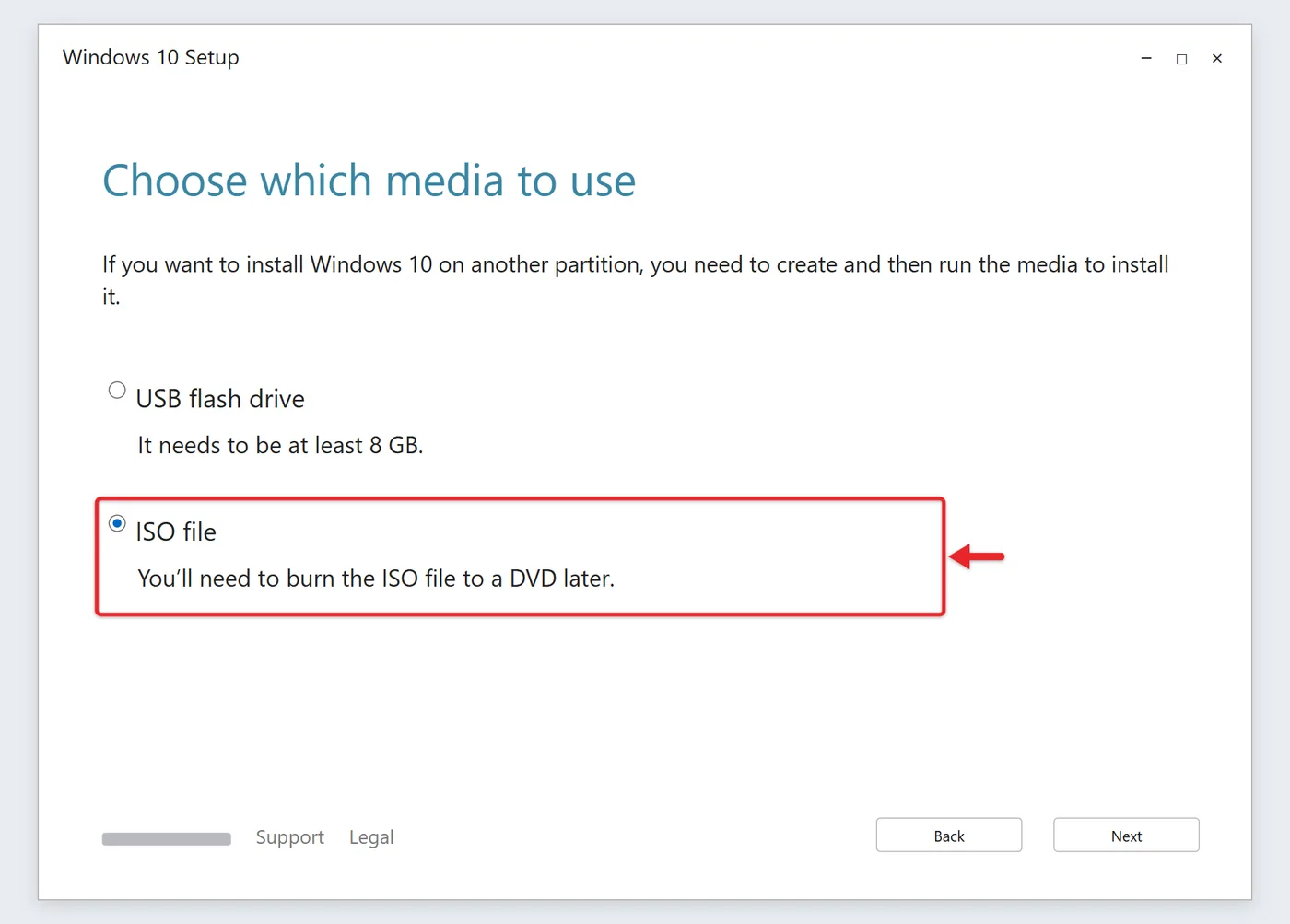
Don’t choose the USB flash drive option here, even though it looks tempting. It builds an installer, not a drive that runs Windows. For more detail on this step, see downloading the Windows 10 ISO file.
Step 2: Choose a method
- Rufus (Method A) is the easiest for most people. It’s free, open source and takes only a few clicks.
- DISM and bcdboot (Method B) uses only tools built into Windows. Pick it if you can’t install software on the PC, or you want full control over the partitions. It’s also the easiest way to wipe the wrong disk by mistake, so go slowly.
- Other portable-Windows tools exist, including paid utilities that clone your current Windows onto a USB drive. They work in a similar way, but check what the free edition supports before you start.
Method A: Create the drive with Rufus
Rufus runs on Windows 8 or later. Download it from the official Rufus website; the portable version doesn’t need installing.
- Plug in the external drive and open Rufus. Approve the administrator prompt.
- Open the Device list and select your external drive. If it isn’t listed, select Show advanced drive properties and tick List USB Hard Drives. Because a USB hard drive often holds files you care about, check its size and name carefully before you go on.
- Next to Boot selection, click SELECT and open the Windows 10 ISO.
- Under Image option, change Standard Windows installation to Windows To Go.
- Set Partition scheme to GPT for PCs from roughly the last ten years (UEFI firmware). Choose MBR only if the drive must start older PCs that use legacy BIOS mode.
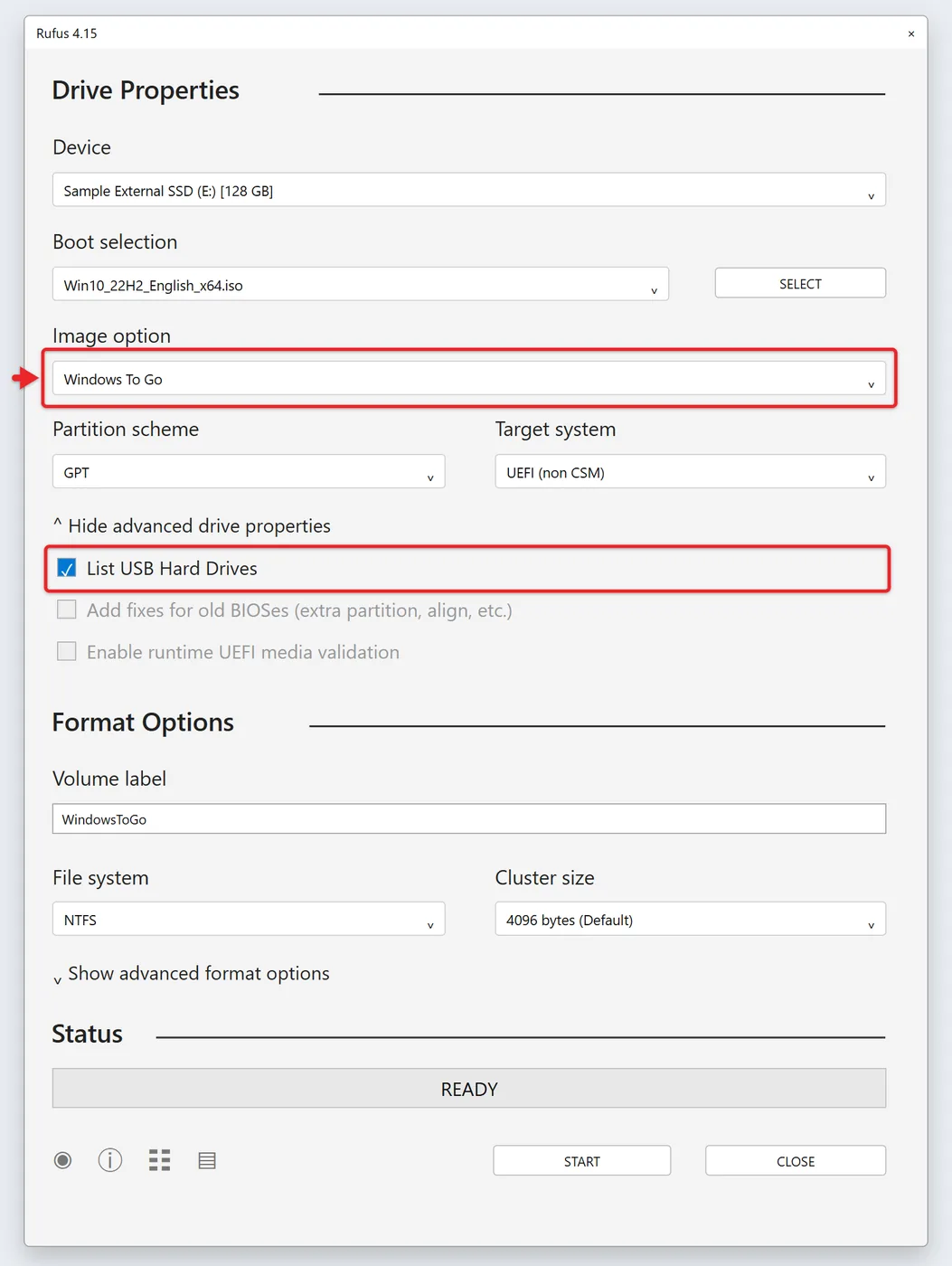
- Click START. If your ISO contains several editions, choose the one you have a license for (for example, Windows 10 Pro).
- Confirm the warning that all data on the drive will be destroyed, then wait. The status bar shows progress, and the drive is ready when it says READY.
How long it takes is a good test of the drive. The Rufus FAQ notes that if creating a Windows To Go drive takes more than about 20 minutes, the drive is poorly suited to running Windows, because it’s too slow at small random writes. An SSD-based drive is the fix.
Will the same drive work on any computer?
Often, but not always. The PC must be able to boot from USB, use the matching firmware mode (UEFI for GPT, legacy BIOS for MBR), and allow it to start (some business PCs restrict USB booting). Windows may also need to download drivers for each new machine, and activation may not carry over.
Can I run it on a Mac?
Apple’s Boot Camp only supports installing Windows 10 on Intel-based Macs, and Apple’s instructions cover an internal Boot Camp partition, not an external drive. Some Intel Macs may start a portable Windows drive from the startup disk menu, but Apple doesn’t document it. Boot Camp isn’t available on Apple silicon Macs.
Method B: Create the drive with DISM and bcdboot
This builds a drive that starts on UEFI PCs, using the commands Microsoft documents for applying a Windows image and copying boot files with BCDboot.
Warning: The clean command in step 4 wipes whichever disk is selected, with no undo. If you select your internal disk by mistake, you’ll erase your PC. Unplug other external drives first so there’s only one to choose from.
- In File Explorer, right-click the ISO and choose Mount. Note the new drive letter. This guide uses E:.
- Look inside E:\sources. ISOs made with the Media Creation Tool usually contain install.esd; others contain install.wim. Use whichever file you have in the commands below.
- Right-click Start, choose Terminal (Admin) on Windows 11 or Windows PowerShell (Admin) on Windows 10, and type
diskpart. - Type
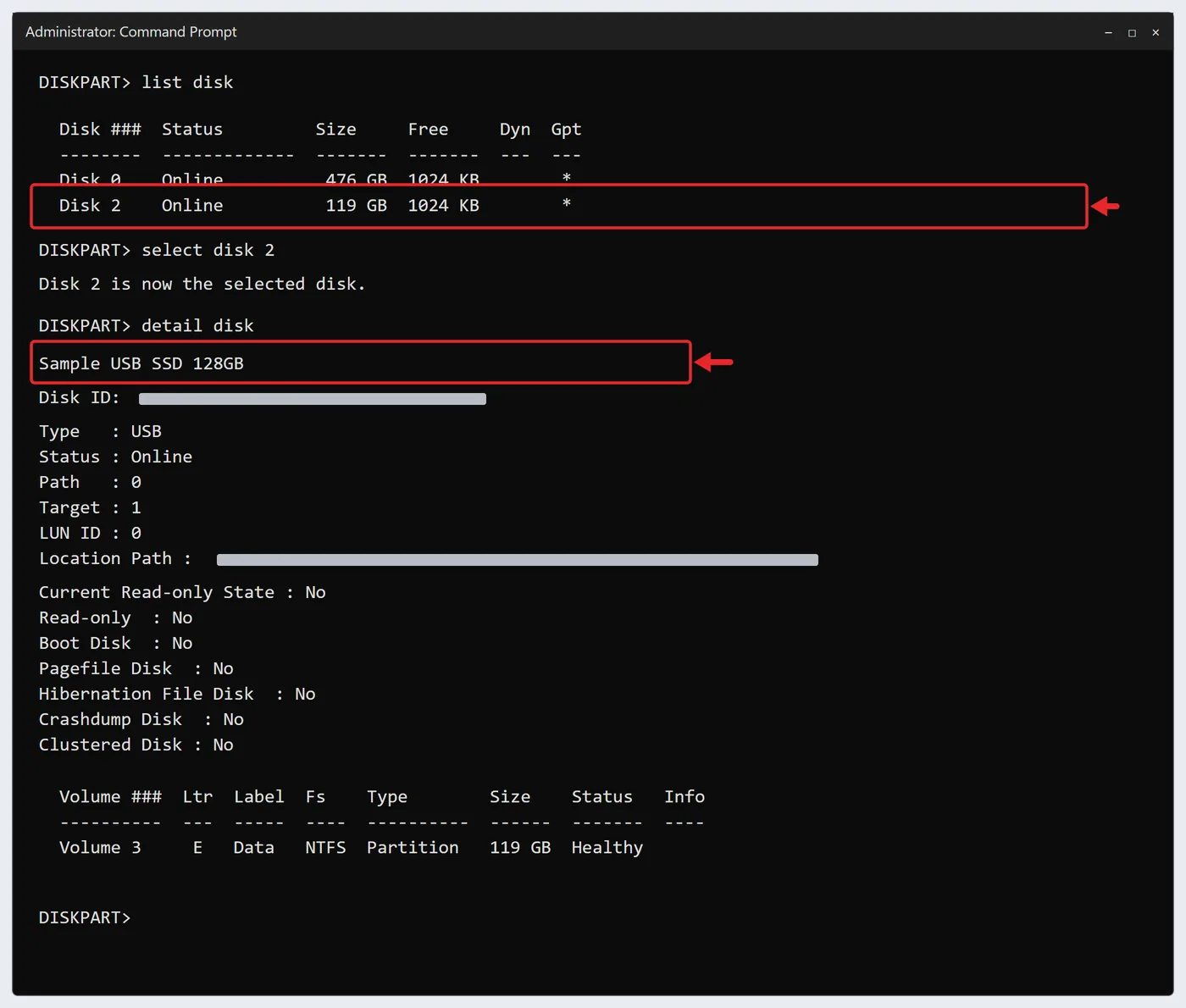
list diskand identify the external drive by its size. Then typeselect disk 2, replacing 2 with your drive’s number. Typedetail diskand check the name matches your external drive before going on.
- Enter these commands one at a time. They create a FAT32 EFI system partition (S:) and an NTFS Windows partition (W:):
cleanconvert gptcreate partition efi size=300format quick fs=fat32 label=Systemassign letter=Screate partition msr size=16create partition primaryformat quick fs=ntfs label=Windowsassign letter=Wexit - List the editions in the image with
dism /Get-WimInfo /WimFile:E:\sources\install.esdand note the Index number of your edition. - Copy Windows to the drive with
dism /Apply-Image /ImageFile:E:\sources\install.esd /Index:6 /ApplyDir:W:\, replacing 6 with your index. This takes a while; wait for “The operation completed successfully.” - Make the drive bootable with
bcdboot W:\Windows /s S: /f ALL. The/soption tells BCDboot the drive will be started on another computer, so it doesn’t add an entry to this PC’s boot menu.
When you’re done, right-click the mounted ISO in File Explorer and choose Eject, then safely remove the external drive.
Step 3: Start a PC from the external drive
- Shut down the computer you want to use, plug the drive into a USB port on the computer itself (not a hub), and switch it on.
- Press the one-time boot menu key straight away. Common keys are F12, F11, F8, F9 or Esc, depending on the manufacturer; the startup screen often shows it.
- Choose the external drive. On UEFI PCs it’s usually listed with a “UEFI:” prefix and the drive’s brand name.
- The first start can take several minutes while Windows detects hardware and restarts once or twice. Then you’ll see the normal Windows 10 setup screens, where you pick a region, keyboard and account.
If the drive isn’t in the list, or you want to change the boot order permanently, booting from USB in Windows 10 explains boot menus and firmware settings in more detail.
How to check it worked
- You reach the Windows 10 desktop with the computer’s internal disk untouched.
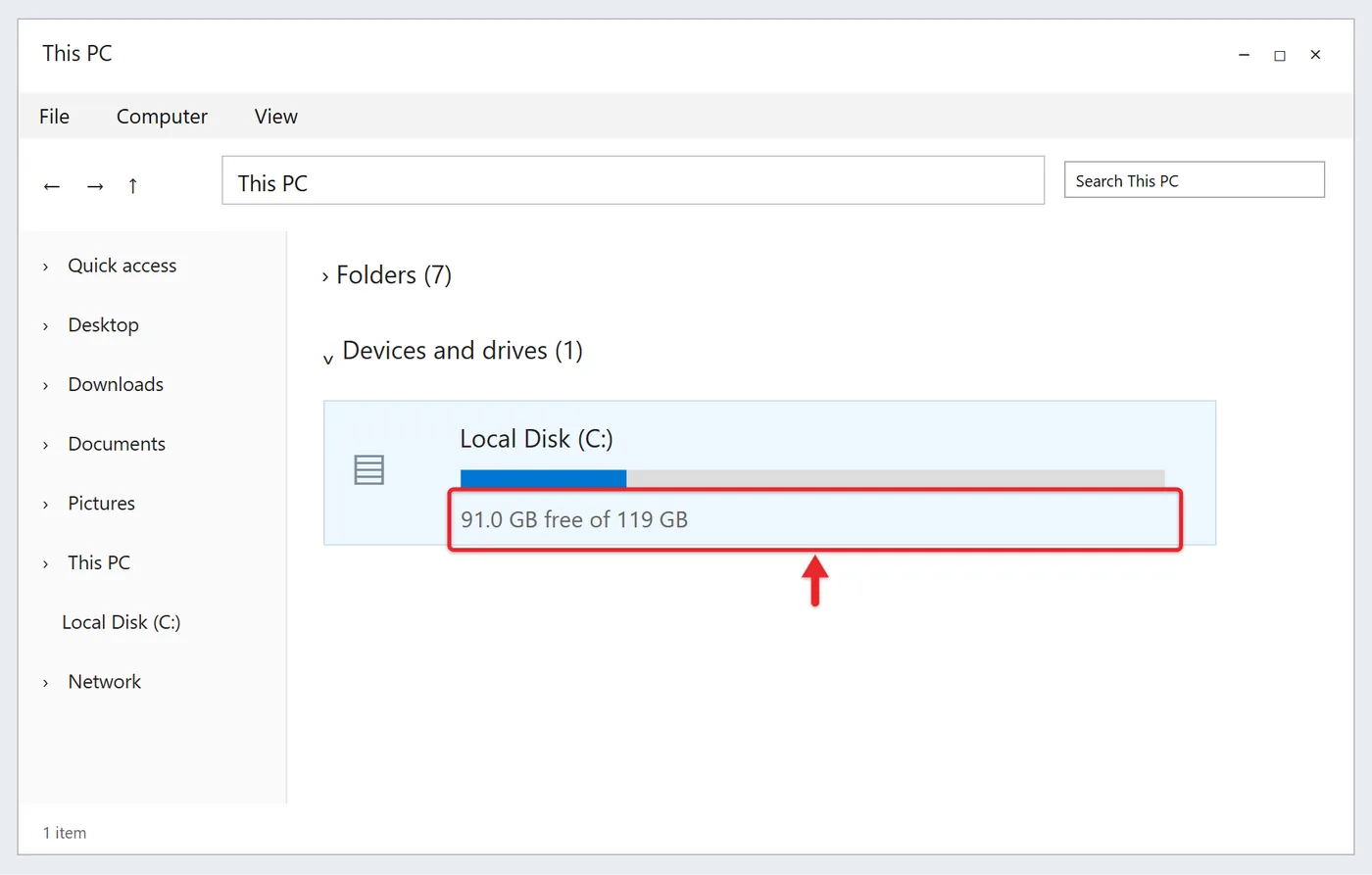
- Open File Explorer > This PC. The C: drive should be the size of your external drive, not your internal one.
- Press Windows key + R, type
winverand press Enter to confirm the version. - Go to Settings > Update & Security > Activation to check activation, and Windows Update to install any available updates.
To go back to the computer’s own Windows, shut down, unplug the drive and switch on as normal. To reuse the external drive for files later, delete its partitions in Disk Management (or run clean in diskpart on that disk) and create a new NTFS or exFAT volume.
Drives that Windows won’t install to or boot from
“Windows cannot be installed to this disk”
You’ll see this if you boot an ordinary installer and try to pick the external drive as the destination. Setup doesn’t accept USB disks, so use Method A or Method B instead.
The drive doesn’t appear in the boot menu
Try a different USB port on the computer itself. A GPT drive only starts in UEFI mode, so on an older PC set to legacy BIOS (or CSM) you’ll need an MBR drive made with Rufus. Some PCs also need USB boot enabled in the firmware settings first.
It starts, then shows a blue screen or restarts in a loop
This is more likely when you move the drive to very different hardware, or on drives that are too slow. Try it on the PC you built it on first. If it only fails elsewhere, rebuild the drive on a faster SSD.
Windows is very slow
The drive or port is almost always the bottleneck. Use an external SSD in a USB 3.1, USB 3.2 or USB-C port, and avoid USB 2.0 ports (often black rather than blue).
The internal disk doesn’t show up in File Explorer
Portable Windows installations may keep the host computer’s internal disks offline to protect them. You can bring one online in Disk Management if you need files from it, but be careful not to change or format it.
When another approach fits better
- You only need a second Windows on one computer. A virtual machine is simpler and safer; see setting up a virtual machine on Windows 10.
- You’re replacing your internal drive. Moving Windows 10 to an SSD keeps your apps and files without reinstalling.
- You want a Windows 11 drive. Rufus can write a Windows 11 ISO in the same way, and making a bootable USB for Windows 11 covers getting that ISO and building an installer drive.
Once the drive starts, run Windows Update, set a password or PIN, and turn on BitLocker for the drive if your edition supports it, since a portable drive is easy to lose. Keep personal files backed up somewhere else too, because a single external drive is a single point of failure.

Matt Jacobs writes and maintains the guides on Support Your Tech, which he started in 2017. He spent most of his career keeping small-business PCs running and still takes the occasional consulting job, so the steps here come from fixing the same problems on other people’s computers. Every guide is checked on his own Windows 11, Windows 10, Mac, iPhone and iPad before it goes up.