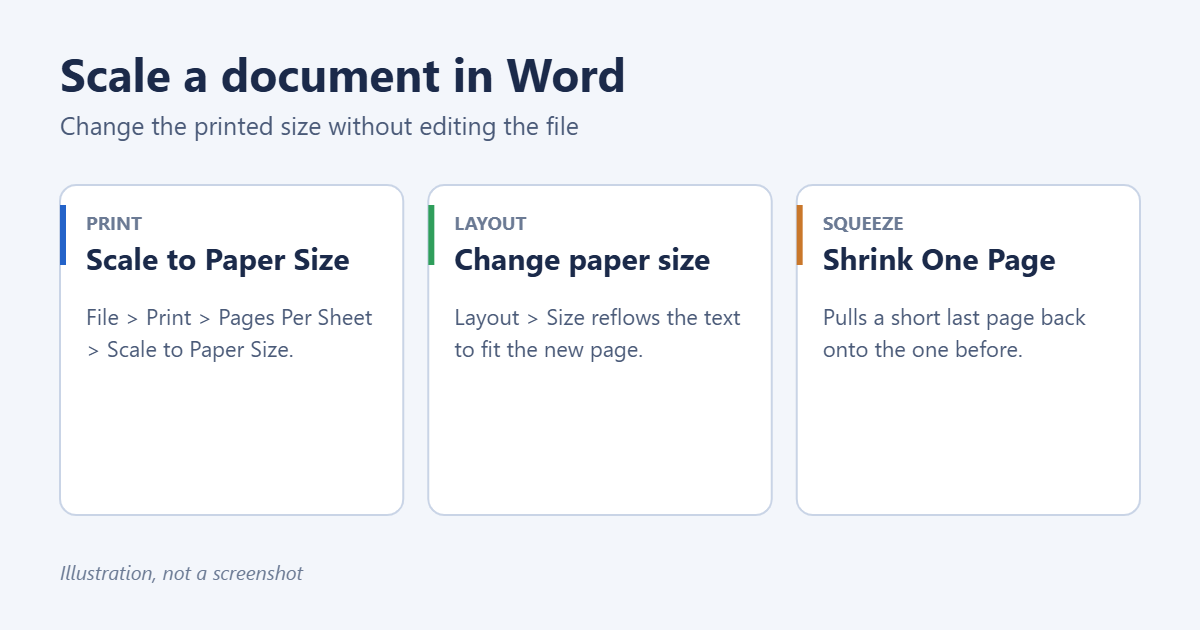
To scale a document in Word when printing, go to File > Print, select the 1 Page Per Sheet setting at the bottom, point to Scale to Paper Size and choose the paper you’re printing on, such as Letter or A4. Word shrinks or enlarges each page to fit. This only affects the printout. To change the document itself, change the paper size in Layout > Size or adjust margins and font size.
Applies to: Word for Microsoft 365, Word 2024, 2021, 2019 and 2016 on Windows and Mac. Last reviewed October 8, 2026.
Method 1: Scale the printout to a different paper size (Windows)
- Go to File > Print, or press Ctrl+P.
- Under Settings, select the last box, which says 1 Page Per Sheet.
- Point to Scale to Paper Size and choose the paper in your printer.
- Check the preview on the right and select Print.
This is the fix when a document set up for A4 prints cut off on Letter paper, or the other way round. Word for Windows doesn’t have a percentage scale setting. If you need, say, 90%, look in Printer Properties, where many printer drivers offer one.
Method 2: Scale the printout on a Mac
- Go to File > Print, or press Command+P.
- Select Show Details if you see it.
- Type a percentage in the Scale box, or open the Paper Handling section and tick Scale to fit paper size.
- Select Print.
Method 3: Print several pages on one sheet
In the same 1 Page Per Sheet menu, choose 2, 4, 6, 8 or 16 Pages Per Sheet. Word shrinks the pages to fit. Two per sheet is still readable; four or more is best for proofreading the layout.
Method 4: Change the document’s paper size
To change the file rather than just the printout, go to Layout > Size and pick a size, or select More Paper Sizes for a custom one. Word reflows the text onto the new page size, so the number of pages may change. Check tables and pictures afterwards, as they may need resizing.
Method 5: Shrink the document to fit fewer pages
If a few lines spill onto an extra page, use Shrink One Page. Word doesn’t show it on the ribbon, so add it on Windows: right-click the Quick Access Toolbar, select Customize Quick Access Toolbar, set Choose commands from to All Commands, add Shrink One Page and select OK. Word reduces the font size slightly until the last page disappears. For more ways, see how to fit a Word document on one page.
You can also do it by hand:
- Reduce margins in Layout > Margins > Narrow.
- Lower the font size: press Ctrl+A, then Ctrl+[ to shrink everything by one point at a time.
- Reduce the spacing between lines.
Scale a single picture or table
To scale an object rather than the whole document, select it, then go to Picture Format > Size launcher (the small arrow) and set Scale height and width as a percentage. For tables, select the table and use Table Layout > AutoFit > AutoFit Window.
Troubleshooting
Scale to Paper Size makes no difference
The document’s page size already matches the paper you picked. Change it only when the two differ.
The printout is still cut off
Your margins are smaller than the printer can handle. Increase them to at least 0.25 inches in Layout > Margins.
The layout changed after changing paper size
That’s expected with Method 4. Press Ctrl+Z to go back and use Method 1 instead, which leaves the file unchanged.
Frequently asked questions
Does zooming in Word change the printed size?
No. The Zoom slider on the status bar only changes how big the document looks on your screen.
Can I scale just one page?
Not in the print settings. Put the page in its own section and change its size or orientation, as in how to make only one page landscape in Word.
Will scaling affect comments in the printout?
Comments in the margin shrink the page further. Turn them off first; see how to print a Word document without comments.
Related: how to get Word to show one page at a time.
Related: how to remove margins in Word.
Related: how to view multiple pages in Word.

Matt Jacobs has been working as an IT consultant for small businesses since receiving his Master’s degree in 2003. While he still does some consulting work, his primary focus now is on creating technology support content for SupportYourTech.com.
His work can be found on many websites and focuses on topics such as Microsoft Office, Apple devices, Android devices, Photoshop, and more.