To send an email from a Windows 10 computer, open a web browser, sign in to your email account, select New message (Outlook.com) or Compose (Gmail), fill in the To line, a subject and your message, and then select Send. If you would rather use an app, the free new Outlook for Windows does the same job with New > Mail.
Applies to: Windows 10 with Outlook.com, Gmail, new Outlook for Windows, or classic Outlook (Microsoft 365, 2024, 2021, 2019, 2016). Checked against Microsoft Support and Google Help on October 7, 2026.
What you need before you start
- An email account. Any account works: Outlook.com, Hotmail, Gmail, Yahoo, iCloud, or one from your employer, school or internet provider. You need its address and password.
- The recipient’s email address. It must be typed exactly; a single wrong letter means the message goes nowhere or to the wrong person.
- An internet connection and either a web browser or an email app.
Do not plan on the Mail app that came with Windows 10. Microsoft ended support for Windows Mail, Calendar and People on December 31, 2024, and those apps can no longer send or receive email. Microsoft’s replacement is the new Outlook for Windows, which is covered below.
Which method should you use?
| Method | Best for | Setup needed |
|---|---|---|
| Email website in a browser | Sending a message right now, or using a shared computer | None; just sign in |
| New Outlook for Windows | Keeping several email accounts in one free app | Install the app and add your account once |
| Classic Outlook | PCs that already have Microsoft 365 or Office installed | Add your account once |
Send an email from a web browser (Outlook.com)
This is the shortest route because nothing has to be installed. These steps are for a Microsoft email account such as an Outlook.com or Hotmail address. Gmail has its own section next.
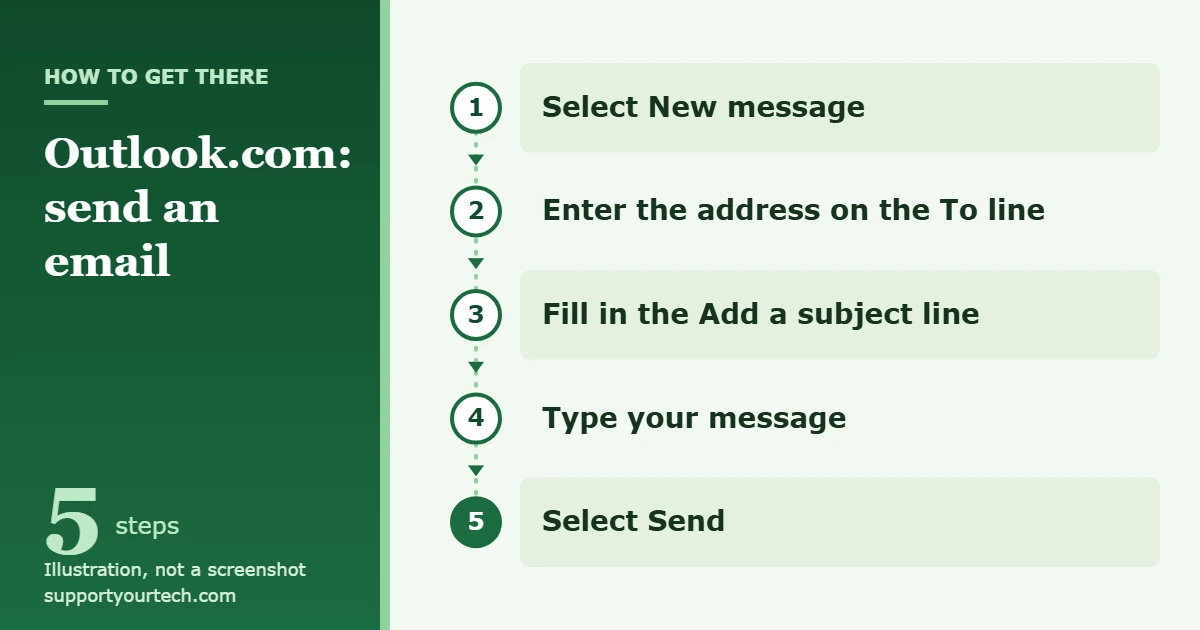
- Open your web browser, go to Outlook.com, and sign in with your Microsoft account. Your inbox opens.
- At the top of the page, select New message. A blank message opens.
- On the To line, type the recipient’s name or email address. Suggested contacts appear as you type, and you can pick one from the list.
- To copy someone else in, select Cc or Bcc on the right side of the To line and enter their address.
- On the Add a subject line, type a short description of what the message is about.
- Click in the large area below the subject and type your message.
- To include a file, select Attach, then Browse this computer, choose the file, and select Open.
- Select Send. The message window closes and the email is on its way.
If you stop partway through, Outlook.com saves the unfinished message as a draft automatically, so you can come back to it. To throw the draft away instead, select Discard at the bottom of the message pane.
Send an email from Gmail in a browser
- Open your web browser, go to Gmail, and sign in with your Google account.
- Click Compose. A new message window opens.
- In the To field, add the recipient’s address. You can also add people in the Cc and Bcc fields.
- Add a subject.
- Write your message.
- To include a file, click the Attach icon at the bottom of the message, select the file, and click Open.
- At the bottom of the message, click Send. A “Message sent” notice appears with Undo and View message options.
Google’s own instructions are on its Send or unsend Gmail messages help page. Other providers, such as Yahoo Mail, follow the same pattern in a browser: sign in, start a new message, fill in the recipient, subject and body, and send. The button names differ slightly from one provider to the next.
Send an email with the new Outlook for Windows
New Outlook is Microsoft’s free replacement for the Windows 10 Mail app. Microsoft says it needs no subscription, and it works with Outlook.com and Hotmail accounts, work or school accounts, Gmail, Yahoo, iCloud, and other accounts that connect through IMAP. You can get it from the Microsoft Store; our guide on how to install Outlook on Windows 10 walks through that.
Add your email account (first time only)
- Open new Outlook. On the View tab, select View settings.
- Select Accounts > Your accounts.
- Under Email accounts, select Add Account.
- Pick a suggested account or type your email address, then select Continue.
- Enter your password if you are asked for it, then select Done. Your mailbox appears in Outlook.
Microsoft notes that some non-Microsoft providers, including Gmail, Yahoo and iCloud, require you to change settings on their own websites before the account can be added. If Outlook asks for an app password, that is a separate, randomly generated password you create on your email provider’s website and paste into Outlook in place of your normal one. For AOL addresses, see how to add AOL Mail to Outlook with an app password.
Write and send the message
- On the ribbon, select New > Mail, or press Ctrl + N. A blank message opens.
- If you have more than one account in Outlook, check the From line at the top of the message. Select its dropdown to send from a different account.
- In the To, Cc or Bcc boxes, enter the recipients’ names or email addresses. Outlook suggests people you have emailed before.
- In the Add a subject field, type the subject.
- Type your message in the body.
- To include a file, select Insert > Attach file and choose the file.
- Select Send.
Microsoft documents these steps in Create an email message in Outlook. If you want your name and contact details added to every message automatically, see how to add a signature in Outlook on Windows 10.
Send an email with classic Outlook
Classic Outlook is the version that comes with Microsoft 365 and with Office 2024, 2021, 2019 and 2016. If your account is not in it yet, select File > Add Account, enter your email address, select Connect, enter your password if prompted, and then select OK > Finish.
- Select Home > New Email. A new message window opens.
- Enter a name or email address in the To, Cc or Bcc field.
- In Subject, type the subject of the message.
- Place the cursor in the body of the message and type.
- Select Send.
To, Cc and Bcc: who sees what
- To is for the people the message is written for.
- Cc (carbon copy) is for people who should see the message but are not expected to act on it. Everyone can see who was copied.
- Bcc (blind carbon copy) hides those recipients from everyone else. People in Bcc can see the To and Cc recipients, but nobody can see them, and they cannot see each other. Use it when you email a group of people who do not know each other, so their addresses stay private.
Reply to or forward an email
To answer a message you received in Outlook, select the email, select Reply, type your message, and select Send. To pass a message on to someone else, select Forward, add the person you are forwarding to, add a note if you like, and select Send.
One difference catches people out: in Outlook, an attachment you received is not added to a reply automatically, but it is included when you forward the message. If the person you are replying to needs the file back, forward the message or attach the file again.
How to confirm the email was sent, and how to undo it
- Gmail: the “Message sent” notice confirms it. Select Undo in that notice to pull the message back before the cancellation period runs out.
- To get more time to undo in Gmail: open Settings at the top right, select See all settings, find Undo Send, choose a cancellation period of 5, 10, 20 or 30 seconds, and select Save changes at the bottom.
- Any provider: look in your sent mail folder. A message listed there has left your mailbox. A message still sitting in your drafts has not been sent.
After the undo period, a sent email cannot be taken back, so check the recipient addresses and attachments before you select Send.
Troubleshooting: the email will not send
The attachment is too large
Outlook.com cannot send a message with an attachment larger than 25 MB. Personal Gmail accounts have the same 25 MB limit; when you go over it, Gmail removes the attachment and adds it to the message as a Google Drive link instead. In Outlook, you can share a large file as a OneDrive link rather than a regular attachment.
The file type is blocked
Gmail does not let you attach executable files, such as files ending in .exe, to prevent viruses. Outlook also blocks some file types from being sent or received.
The message comes back as undeliverable
Microsoft lists the usual causes of a non-delivery message: the recipient’s address is wrong or does not exist, the recipient’s mailbox is full, the recipient’s mail server is down, or a spam filter blocked the message. Check the address for typos first, then try again later or contact the person another way.
Your own mailbox is full or the account is blocked
When the storage for an Outlook.com account is full, you cannot send email. Free up space and try again. Microsoft may also block an account temporarily after unusual sign-in activity, and brand-new Outlook.com accounts start with a low sending limit that is raised once the account establishes credibility.
Outlook keeps asking for a password or will not add the account
If you changed your email password recently, update it in Outlook. For Gmail, Yahoo and iCloud accounts, check the provider’s website for settings that must be changed before Outlook can connect, and use an app password if Outlook asks for one.
Work or school accounts
An email account from an employer or school is managed by that organization. If it will not sign in or send from a home PC, the organization’s IT help desk has to resolve it.
The Windows 10 Mail app opens but does nothing
That is expected. The app is no longer supported and cannot send or receive mail. Use your provider’s website or new Outlook instead.
Frequently asked questions
Can I still send email from Windows 10 now that support has ended?
Yes. Windows 10 reached end of support on October 14, 2025, and Microsoft says a Windows 10 PC keeps working but no longer receives security updates unless it is enrolled in the Extended Security Updates program. Email websites and Outlook still work. If your PC is eligible, Microsoft’s recommended route is the free upgrade to Windows 11.
Do I have to pay for Outlook to send email?
No. Microsoft states that the new Outlook for Windows is for everyone and needs no subscription. Classic Outlook is the version that comes with Microsoft 365 or a purchased copy of Office. Sending from Outlook.com or Gmail in a browser is also free.
What happened to the Mail app in Windows 10?
Microsoft ended support for Windows Mail, Calendar and People on December 31, 2024. Those apps can no longer send or receive email, and Microsoft directs users to the new Outlook for Windows.
Can I send email from a Gmail or Yahoo address in Outlook?
Yes. New Outlook supports Gmail, Yahoo, iCloud and other accounts that connect through IMAP, alongside Microsoft accounts. Add the account under Accounts > Your accounts in Outlook’s settings.
How big a file can I email?
Up to 25 MB of attachments per message in Outlook.com and in personal Gmail accounts. For anything larger, share the file as a OneDrive or Google Drive link.
Can I unsend an email?
In Gmail, only for a few seconds: select Undo in the “Message sent” notice. You can set that period to as long as 30 seconds in Gmail’s settings. Once it has passed, the message cannot be recalled from Gmail.
Next, send a short test message to your own address. If it shows up in your inbox, everything is working and you are ready to email anyone.
Related: how to set an out of office reply in Gmail.
Related: how to remove your signature in Gmail.

Matt Jacobs has been working as an IT consultant for small businesses since receiving his Master’s degree in 2003. While he still does some consulting work, his primary focus now is on creating technology support content for SupportYourTech.com.
His work can be found on many websites and focuses on topics such as Microsoft Office, Apple devices, Android devices, Photoshop, and more.