To delete a folder in Outlook, right-click it in the folder pane, choose Delete Folder (or Delete in new Outlook and on the web), and confirm. The folder, its subfolders and every message inside move to Deleted Items, so you can drag it back if you change your mind. The folder is only gone for good once you delete it from Deleted Items or empty that folder, and after that you can recover the messages for a limited time, but not the folder itself.
Applies to: classic Outlook for Windows (Microsoft 365, 2024, 2021, 2019, 2016), the new Outlook for Windows, Outlook on the web and Outlook.com, and Outlook for Mac (Microsoft 365, 2024, 2021). You can only delete folders you or an app created. Built-in folders such as Inbox, Drafts, Sent Items, Deleted Items, Junk Email, Outbox and Archive can’t be removed.
Before you delete a folder
A deleted folder takes everything inside it along for the ride, so spend a minute on these checks first:
- Save the messages you want. Drag them into another folder, or select them and use Move on the Home tab. Subfolders count too: a Clients folder with an Alex subfolder and a Jordan subfolder disappears as one unit.
- Back up anything you might need later. Microsoft recommends exporting the folder to an Outlook data file (.pst) first. In classic Outlook that’s File > Open & Export > Import/Export > Export to a file > Outlook Data File (.pst), then pick the folder.
- Check your rules. A rule that files mail into the folder stops working once the folder is gone. Open your rules and point them somewhere else or delete them. Our guide to creating and editing rules in Outlook shows where they live in each version.
- Find the folder pane. Every method below starts from the list of folders on the left. If you can’t see it, bring back the Outlook folder list first.
Not sure which Outlook you have? Classic Outlook has a File tab at the far left of the ribbon. New Outlook for Windows has no File tab and looks almost exactly like Outlook on the web, which runs in your browser at outlook.com or outlook.office.com.
Delete a folder in classic Outlook for Windows
- In the folder pane, right-click the folder you want to remove. Expand your account (the arrow next to your email address) if the folder is nested out of sight.
- Choose Delete Folder. You can also select the folder and choose Delete Folder on the Folder tab.
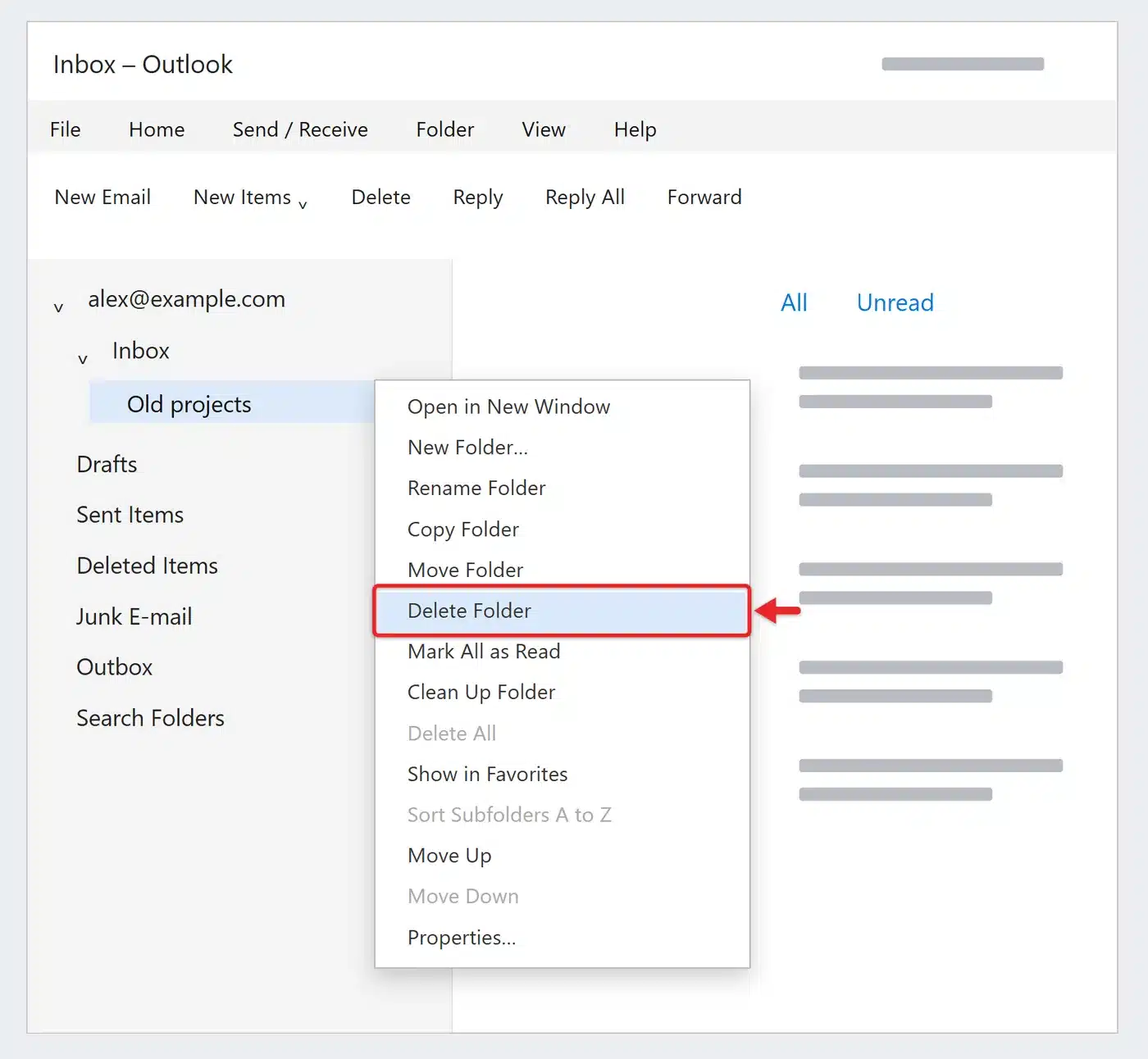
- Outlook asks whether you want to delete the folder and move its contents to Deleted Items. Select Yes.
The folder vanishes from its old spot and shows up as a subfolder of Deleted Items, with an arrow you can use to expand it. If the warning says the folder will be permanently deleted instead, stop and read it: that happens when the folder is already inside Deleted Items, and with some IMAP or POP accounts. Select No if you aren’t ready to lose it.
Delete a folder in new Outlook, Outlook on the web and Outlook.com
New Outlook for Windows and Outlook on the web share the same design, so the steps are identical.
- In the folder list on the left, right-click the folder. If the list is collapsed, select the menu icon (three lines) at the top to show it.
- Choose Delete (some accounts show Delete folder).
- Select OK in the confirmation box.
The folder and its contents move to Deleted Items. With Outlook.com accounts, keep in mind that email left in Deleted Items is deleted automatically after 30 days, and the account can be set to empty Deleted Items every time you sign out (Settings > Mail > Message handling). Restore anything you want sooner rather than later.
Delete a folder in Outlook for Mac
- In the sidebar, select the folder you want to remove.
- Select Delete on the ribbon, or Control-click (right-click) the folder and choose Delete Folder.
- Confirm if Outlook asks.
For Microsoft 365, Exchange and Outlook.com accounts the folder normally lands in Deleted Items, the same as on Windows. Microsoft’s Mac help page doesn’t spell out where the contents go for every account type, so check Deleted Items before you empty anything.
Get a deleted folder back from Deleted Items
As long as the folder is still sitting in Deleted Items, restoring it is a drag and drop, and it comes back with all its messages and subfolders intact.
- Select the arrow next to Deleted Items to expand it. Your folder appears underneath.
- Drag the folder onto the account name (to put it back at the top level) or onto another folder (to make it a subfolder).
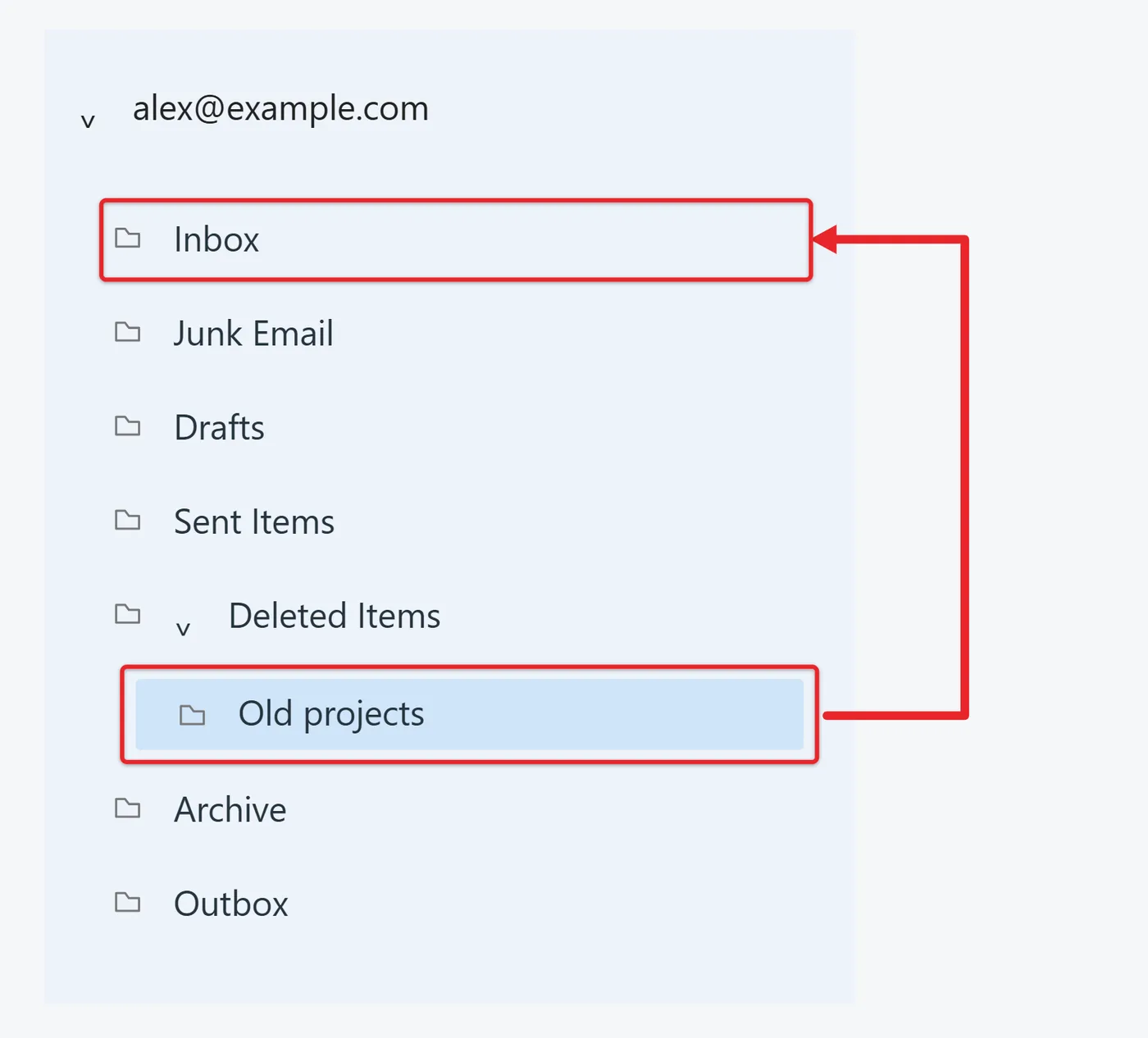
- Or right-click the folder and choose Move Folder in classic Outlook, or Move in new Outlook, on the web and on Mac, then pick the destination.
You’ll know it worked when the folder shows up in its old place in the folder list and is no longer listed under Deleted Items. Open it and check that the messages are there. If a rule used to file mail into it, check that the rule still points to the right folder.
Recover the emails after Deleted Items was emptied
This is where most people get caught out. When you empty Deleted Items, delete the folder from inside Deleted Items, or press Shift + Delete on it, the folder itself is gone. Microsoft’s Exchange documentation on the Recoverable Items folder explains that a user-created folder deleted this way can’t be recovered, but its messages move to a hidden Recoverable Items folder where you can still restore them for a while. You’ll get the emails back loose, not neatly sorted in their old folder, so plan to recreate the folder and move them into it.
How long you have
| Account type | How long emptied items stay recoverable |
|---|---|
| Work or school (Microsoft 365, Exchange Online) | 14 days by default. Your administrator can raise this to a maximum of 30 days, and retention policies or holds may keep items longer. |
| Outlook.com, Hotmail, Live (personal) | 30 days after items are removed from Deleted Items |
| On-premises Exchange | Set by your organization’s administrator |
| Gmail, Yahoo and other IMAP or POP accounts | No Outlook recovery; check your email provider’s own trash or your backups |
The work and school figures come from the Exchange Online defaults; the Outlook.com figure comes from Microsoft’s Outlook.com help. Microsoft’s guide to recovering deleted items in Outlook notes that your administrator sets the actual limits, so treat these as the usual windows rather than a promise.
Classic Outlook
- Make sure Outlook is online and connected to the mail server (no “Working Offline” or “Disconnected” in the status bar).
- Select Deleted Items in the folder pane.
- On the Home tab, select Recover Deleted Items From Server. You may also see a link at the top of the message list that says Recover items recently removed from this folder.
- In the window that opens, sort by the Deleted On column to find the messages you lost. Hold Ctrl to select several, or Ctrl + A for all.
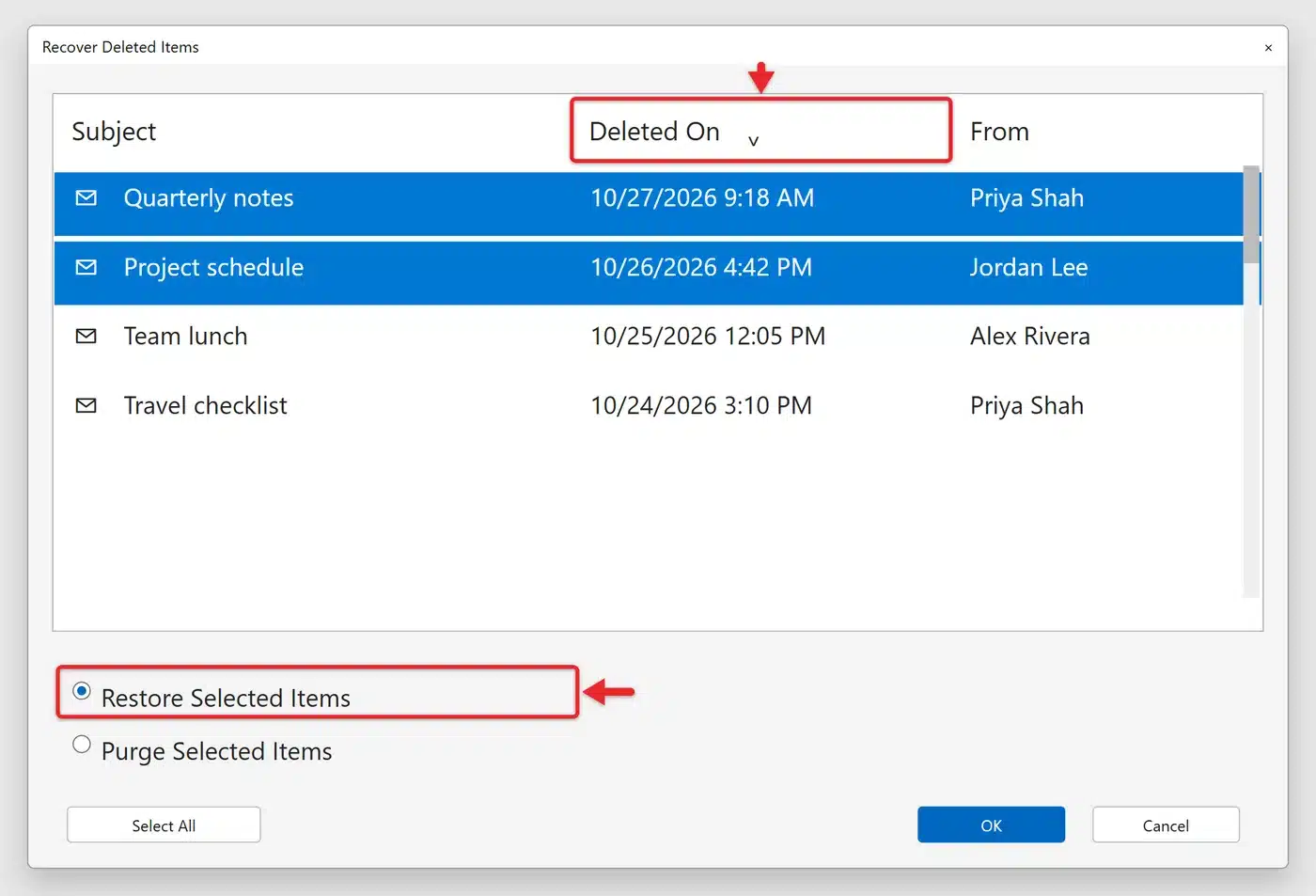
- Choose Restore Selected Items, then select OK.
The messages return to Deleted Items. Create a new folder with the old name (right-click your account or Inbox and choose New Folder), then move them into it.
If your account shows Trash instead of Deleted Items, or the Recover Deleted Items command is missing, the account doesn’t support this kind of recovery. That’s common with IMAP and POP accounts.
New Outlook, Outlook on the web and Outlook.com
- Select Deleted Items in the folder list.
- At the top of the message list, find Recover items deleted from this folder and select Recover (on the web it may be a single link).
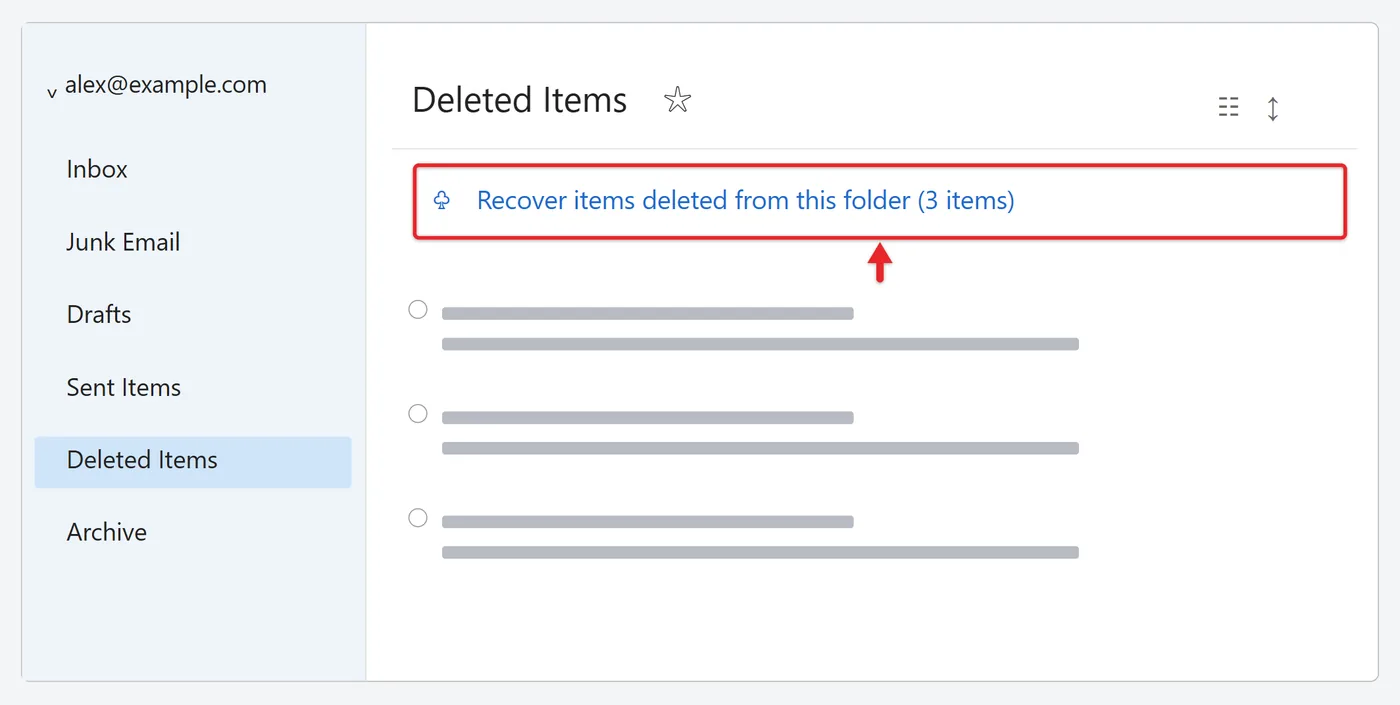
- Check the boxes next to the messages you want back.
- Select Restore. In new Outlook, choose Go back to deleted items to return to the folder.
The restored messages appear in Deleted Items, ready to move into a fresh folder.
Outlook for Mac
The quickest route on a Mac is to sign in to Outlook on the web in Safari or another browser and use the steps above. Because the messages are restored on the server, they show up in Outlook for Mac after it syncs.
If the messages aren’t there
- Work or school account: contact your IT administrator quickly. Admins can search the mailbox’s Recoverable Items on the server and may be able to restore items you can’t see. Tell them the mailbox address, the folder name and roughly when you deleted it.
- You have a backup: in classic Outlook, select File > Open & Export > Open Outlook Data File, open the .pst file, and drag the folder from it back into your mailbox. Older classic Outlook setups that used AutoArchive may have a file named archive.pst in Documents\Outlook Files.
- Otherwise: if neither you nor your administrator can find the items, they’ve most likely been permanently deleted.
Delete a folder permanently
Only do this when you’re sure. As covered above, a folder removed from Deleted Items can’t come back as a folder.
- Just that folder: expand Deleted Items, right-click the folder and choose Delete Folder (classic Outlook, Mac) or Delete (new Outlook, web). Outlook warns that it will be permanently deleted.
- Everything in Deleted Items: right-click Deleted Items and choose Empty Folder (classic Outlook, Mac) or Empty folder (new Outlook, web), then confirm.
- Skip Deleted Items entirely: in classic Outlook, select the folder and press Shift + Delete. This has the same result as deleting it from Deleted Items.
Rename, move or tidy up instead
If the folder is just in the way, one of these may suit you better than deleting it:
- Rename: right-click the folder and choose Rename Folder (classic Outlook, Mac) or Rename (new Outlook, web).
- Nest it: drag the folder onto another one, such as a parent folder named Old projects, so it stops cluttering the top level.
- Archive the messages: select messages and choose Archive to move them to the built-in Archive folder without deleting anything.
- Clean Up Folder: in classic Outlook, select Home > Clean Up > Clean Up Folder to remove redundant copies of messages in conversations while keeping the folder.
Troubleshooting
Delete Folder is greyed out or missing
- It’s a built-in folder. Inbox, Drafts, Sent Items, Deleted Items, Junk Email, Outbox and Archive are required by the mailbox and can’t be deleted.
- It’s in a shared mailbox. You need full permission on that mailbox. Ask its owner or your administrator.
- Your organization protects it. Retention policies or labels set by your administrator can block deletion of some folders or their contents.
- Classic Outlook is offline. Exchange and Microsoft 365 folder changes need a connection. Check the status bar and turn off Work Offline on the Send / Receive tab.
Classic Outlook throws an error when you delete
An add-in can get in the way. Close Outlook, press Windows + R, type outlook.exe /safe and press Enter. Safe mode starts Outlook without add-ins; try deleting the folder there, then restart Outlook normally.
The folder comes back after you delete it
- IMAP accounts (Gmail, Yahoo, iCloud and others): the folder lives on your provider’s server. Delete it, or the matching Gmail label, through the provider’s website, then let Outlook sync. In classic Outlook you can also right-click the account, choose IMAP Folders, select Query, pick the folder and choose Unsubscribe so Outlook stops showing it.
- A rule or app recreates it: rules, phones, and connected apps that file mail into a named folder may create it again. Remove or change them.
- Another device hasn’t synced yet: give it a few minutes, or select Send / Receive > Update Folder in classic Outlook.
Outlook looks different after you deleted folders
If the folder pane or message list changed layout, change the Outlook view back to normal. For a deeper reset of views and panes in classic Outlook, see resetting Outlook to its default settings.
Frequently asked questions
Can I delete several folders at once?
No. Outlook only lets you select one folder at a time in the folder pane. The workaround is to create a temporary folder, drag the folders you want gone into it, and then delete the temporary folder in one go.
Does deleting a folder in the desktop app delete it everywhere?
For Microsoft 365, Exchange, Outlook.com and IMAP accounts, yes. The folder lives on the mail server, so the change syncs to Outlook on your phone, the web and other computers. Folders inside a local .pst file, such as an archive or a POP account, only exist on that computer.
Can I delete a folder from the Outlook phone app?
The option isn’t available in every version of the iPhone and Android app. If you don’t see a delete or edit option for folders, open Outlook on the web in your phone’s browser, or wait until you’re at a computer. The folder disappears from the app after it syncs.
Why did my folder disappear when I didn’t delete it?
It was probably dragged into another folder by accident. Search for a message you know was in it, open the message, and check which folder it’s in. If the folder truly went to Deleted Items, use the restore steps above.
Next step
Once your folder list is lean, set up rules so new mail lands in the folders you kept, and take a quick look inside Deleted Items before you empty it. That one glance is the difference between a quick drag back and rebuilding a folder from loose messages.

Matt Jacobs writes and maintains the guides on Support Your Tech, which he started in 2017. He spent most of his career keeping small-business PCs running and still takes the occasional consulting job, so the steps here come from fixing the same problems on other people’s computers. Every guide is checked on his own Windows 11, Windows 10, Mac, iPhone and iPad before it goes up.