Last updated on November 17th, 2026 at 03:08 pm
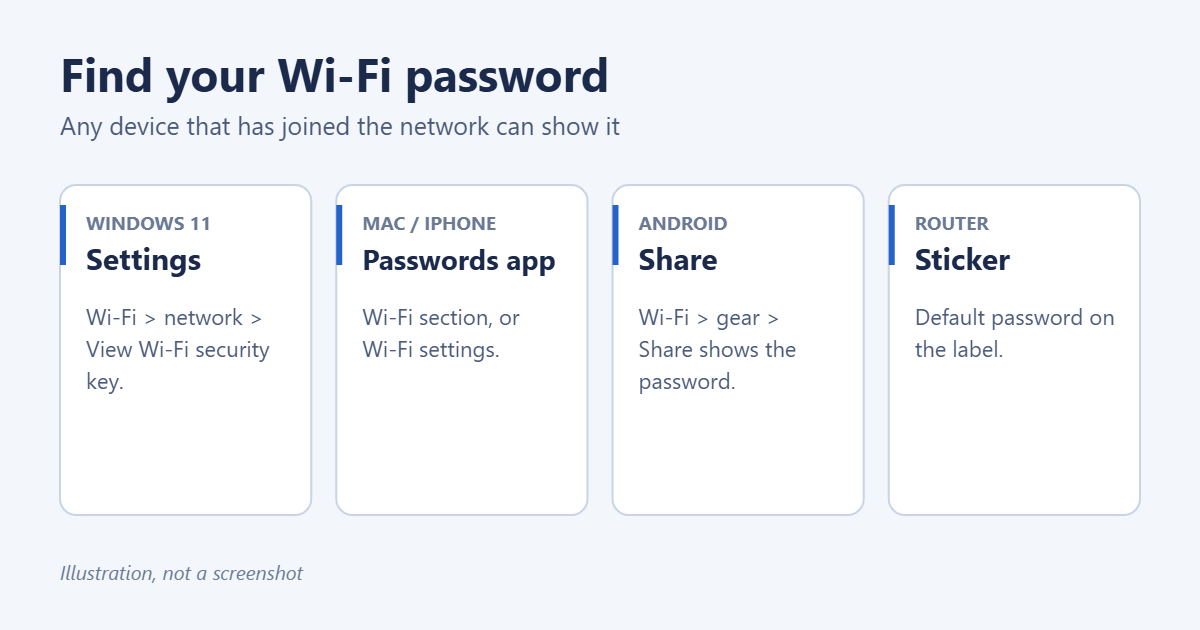
A device that’s already connected is the quickest place to find your Wi-Fi password. On Windows 11, go to Settings > Network & internet > Wi-Fi, select your network and choose View Wi-Fi security key. On an iPhone, open Settings > Wi-Fi, tap the info button next to the network and tap Password. If nothing is connected, check the default password on your router’s sticker. Windows 10, Mac, iPad and Android get their own sections.
Windows 11
- Open Settings > Network & internet > Wi-Fi.
- Select Manage known networks and choose your network. If you’re connected to it, you can select [Network name] properties at the top instead.
- Next to View Wi-Fi security key, select View. The password appears in a pop-up.
If that option isn’t there, use the Control Panel method for Windows 10 below. It works on Windows 11 too. Your PC keeps other passwords as well; here’s how to find stored passwords on Windows 11.
Is it safe to share my Wi-Fi password?
With people you trust, yes. For visitors, a guest network, which most routers offer, keeps them away from your own devices.
Related: how to find the Wi-Fi password on Windows 11 and how to find saved passwords on Windows 10.
Windows 10
- Right-click Start, select Run, type
ncpa.cpland press Enter. - Double-click your Wi-Fi adapter and select Wireless Properties.
- Open the Security tab and tick Show characters. The password appears in Network security key.
You need to be connected to the network and signed in as an administrator. There’s more detail on viewing your Wi-Fi password on Windows 10. On a Windows 10 computer specifically, the steps to find your network password on Windows 10 also cover router passwords and the “Enter network credentials” prompt.
Any network you’ve used before (Windows 10 and 11)
- Right-click Start and select Terminal or Command Prompt.
- Run
netsh wlan show profilesto list the networks your PC remembers. - Run
netsh wlan show profile name="Your Network" key=clear, using the exact network name. - Look for Key Content under Security settings. That’s the password.
Mac
- Open the Passwords app (macOS Sequoia and later) and select Wi-Fi in the sidebar.
- Select your network and hover over or click the hidden password to reveal it.
On older versions, open System Settings > Wi-Fi, select Advanced (or scroll to Known Networks), click the three dots next to the network and choose Copy Password. You’ll be asked for your Mac password.
iPhone and iPad
- Open Settings > Wi-Fi.
- Tap the info button (i) next to your network. For a network you’re not connected to, tap Edit first to see known networks.
- Tap Password and confirm with Face ID, Touch ID or your passcode.
On iOS 18 and later, you can also open the Passwords app and tap Wi-Fi to see every network you’ve joined.
Android
- Open Settings > Network & internet > Internet (or Wi-Fi).
- Tap the gear next to your network.
- Tap Share and confirm it’s you. A QR code appears, with the password written underneath on most phones.
On Samsung Galaxy phones, go to Settings > Connections > Wi-Fi, tap the gear next to the network, and tap the eye icon next to Password or tap QR code.
From your router
Check the sticker
Most routers have a label on the bottom or back with the network name (SSID) and the default password, sometimes called the Wi-Fi key, WPA key or Network key. This only works if nobody has changed the password.
Log in to the router
If the password was changed and no device knows it, sign in to the router’s settings. The address and admin login are usually on the same sticker. Many internet providers also show and let you change the Wi-Fi password in their app. Look under Wireless or Wi-Fi settings for the password, or set a new one; every device will then need to reconnect.
If you can’t log in, pressing the router’s reset button for about 10 seconds restores the sticker password, but it also erases your settings. Check your provider’s instructions first.
Security key options missing or a password that doesn’t work
“View Wi-Fi security key” or “Show characters” is missing or greyed out
Sign in with an administrator account. On a work PC, your organization may hide it.
The password shown doesn’t work on another device
Passwords are case-sensitive, and characters like 0 and O or l and I are easy to confuse. Use the QR code from Android or share from an iPhone (hold your iPhone near the other Apple device while it’s on the password screen) to avoid typing it.

Matt Jacobs writes and maintains the guides on Support Your Tech, which he started in 2017. He spent most of his career keeping small-business PCs running and still takes the occasional consulting job, so the steps here come from fixing the same problems on other people’s computers. Each guide follows Microsoft, Apple and Google’s own documentation and is updated when the steps change. Screenshots marked “Recreated” are illustrations of the real screens.