Last updated on November 10th, 2026 at 10:33 am
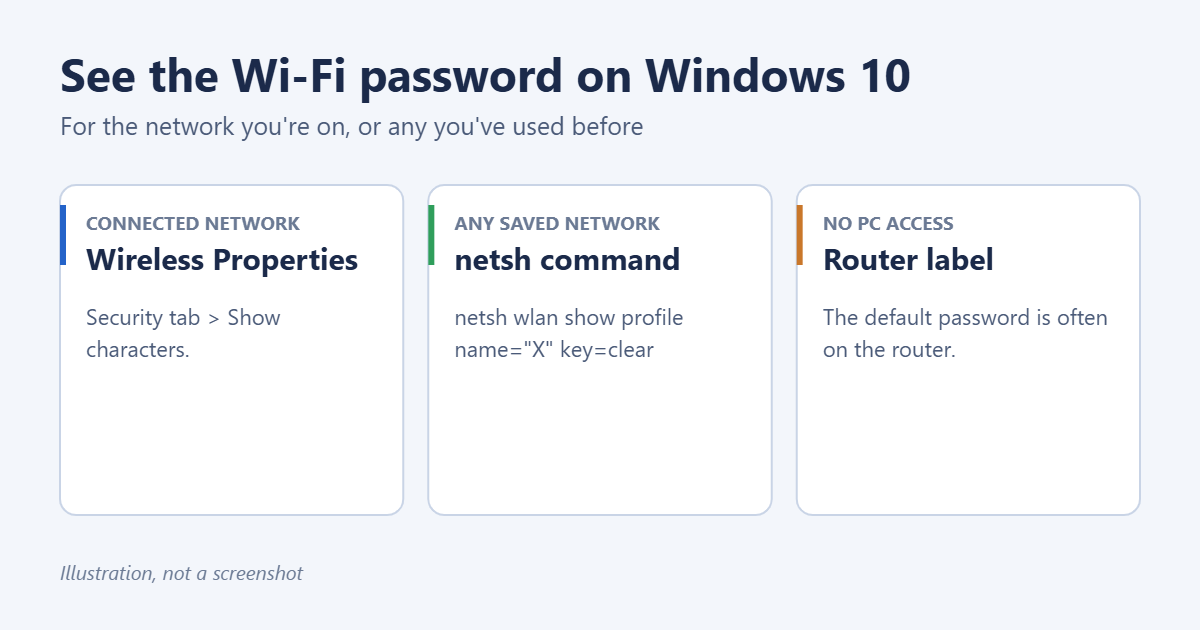
Windows 10 shows the password of the Wi-Fi network you are on in Control Panel > Network and Sharing Center: select the network name next to Connections, then Wireless Properties, open the Security tab and tick Show characters. For a saved network you aren’t connected to now, use the netsh command in Command Prompt. Either way, you need an administrator account. Windows 11 menus differ, so follow the Windows 11 Wi-Fi password steps there.
Method 1: The network you’re connected to
- Press Windows + R, type ncpa.cpl and press Enter. (Or go to Settings > Network & Internet > Status > Network and Sharing Center.)
- Double-click your Wi-Fi adapter, or select the network name next to Connections in Network and Sharing Center.
- Select Wireless Properties.
- Open the Security tab and tick Show characters.
The Network security key box shows the password. Untick Show characters when you’re done.
Method 2: Any network you’ve connected to before
- Select Start, type cmd, right-click Command Prompt and choose Run as administrator.
- List saved networks:
netsh wlan show profiles - Show the password for one of them, replacing the name:
netsh wlan show profile name="Home WiFi" key=clear - Look under Security settings for Key Content. That’s the password.
Keep the quotation marks around names with spaces. If Key Content doesn’t appear, the command wasn’t run as administrator, or the network uses a work login rather than a shared password.
Method 3: Check the router or another device
- Many routers have the default Wi-Fi name and password printed on a label underneath.
- On an Android phone connected to the network, open its Wi-Fi settings, tap the network and Share to see a QR code and often the password.
- On an iPhone with iOS 16 or later, go to Settings > Wi-Fi, tap the info button next to the network and tap Password.
A few more places to look are listed in how do I find my Wi-Fi password?
See all saved Wi-Fi passwords at once
To list every saved network with its password, open Windows PowerShell (Admin) and paste this single command:
(netsh wlan show profiles) | Select-String ": (.+)$" | %{$n=$_.Matches.Groups[1].Value.Trim(); $k=(netsh wlan show profile name="$n" key=clear) | Select-String "Key Content\W+:(.+)$"; [pscustomobject]@{Network=$n; Password=if($k){$k.Matches.Groups[1].Value.Trim()}else{""}}} | Format-Table -AutoSizeIt shows a two-column table of network names and passwords. Networks with a blank password are open networks or use a work sign-in. Close the window afterwards, especially on a shared PC.
Where does Windows store other passwords?
Sign-ins for shares and apps are in Credential Manager, where you can find saved passwords or clear cached credentials.
For a shared folder or network PC that asks for a login, look up your network credentials in Windows 10, or find stored passwords with CMD.
Export Wi-Fi profiles to move them to another PC
In an admin Command Prompt, run netsh wlan export profile key=clear folder=C:\WiFi (create the folder first). Each network is saved as an XML file containing its password. On the new PC, run netsh wlan add profile filename=”C:\WiFi\Wi-Fi-Home WiFi.xml” for each file. Delete the folder when you’re done, because the files contain passwords in plain text.
Change the Wi-Fi password
Windows can only show the password, not change it. To change it, sign in to your router’s admin page (the address and login are usually on the router label), find the wireless or Wi-Fi security settings, and set a new password. Then reconnect each device with the new password.
Greyed-out Show characters or no profile
Show characters is greyed out
You’re signed in as a standard user. Sign in with an administrator account, or ask the PC’s owner.
“There is no profile assigned to the specified interface”
The name is wrong. Copy it exactly from netsh wlan show profiles.
The password works on the PC but not on a new device
The router password may have changed and Windows reconnects with a cached key. Forgetting the Wi-Fi network and reconnecting with the new password clears it.

Matt Jacobs writes and maintains the guides on Support Your Tech, which he started in 2017. He spent most of his career keeping small-business PCs running and still takes the occasional consulting job, so the steps here come from fixing the same problems on other people’s computers. Every guide is checked on his own Windows 11, Windows 10, Mac, iPhone and iPad before it goes up.