To check COM ports in Windows 10, right-click Start, select Device Manager, and expand Ports (COM & LPT). Each serial device is listed with its port number in brackets, such as (COM3).
Applies to: Windows 10. Checked against Microsoft Learn on September 27, 2026.
Check COM ports in Device Manager
- Right-click Start and select Device Manager. See how to open Device Manager in Windows 10.
- Select the arrow next to Ports (COM & LPT).
- The COM number is at the end of each device’s name.
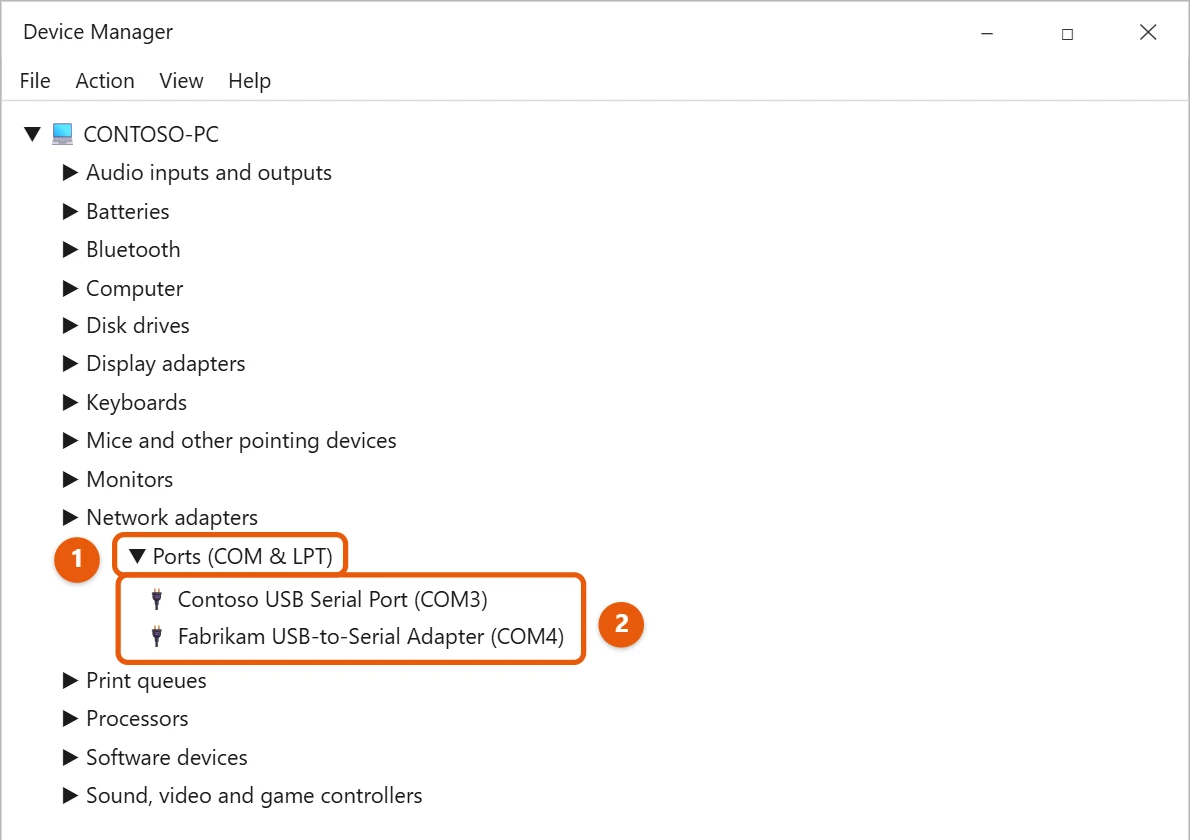
Don’t see Ports (COM & LPT)? Plug the device in, then select Action > Scan for hardware changes. If it’s still missing, the device may need a driver from its maker. To see ports for devices that aren’t plugged in, select View > Show hidden devices.
Check with a command
In Command Prompt, run mode. It lists each COM port and its settings.
In PowerShell, run:
[System.IO.Ports.SerialPort]::GetPortNames()
It lists the COM port names, such as COM3 and COM4.
Change a COM port number
Some older apps only work with low numbers, like COM1 to COM4.
- In Device Manager, right-click the device under Ports (COM & LPT) and select Properties.
- Select the Port Settings tab, then Advanced.
- Choose a new number in COM Port Number and select OK.
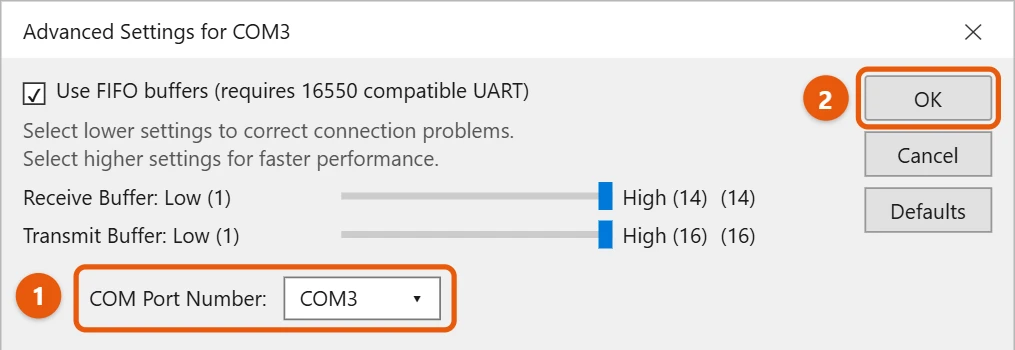
If Windows says the number is in use, it may belong to a device that isn’t plugged in. Pick a different number unless you’re sure that device is gone.
Work out which port belongs to your device
If several COM ports are listed, keep Device Manager open on Ports (COM & LPT), unplug your device, and watch which entry disappears. Plug it back in and the same port returns. You can also double-click a port, open the Details tab, and choose Bus reported device description to see the name the device reports, such as the name of an Arduino board or a USB-to-serial adapter.
If the COM port is missing or won’t open
- The device shows under Other devices with a warning. Windows has no driver for its USB-to-serial chip. Common chips are FTDI, CH340, Silicon Labs CP210x, and Prolific. Download the driver from the chip maker or the device maker.
- A Prolific adapter shows “PL2303HXA PHASED OUT” or Code 10. Newer Prolific drivers don’t support older or counterfeit chips. Use an adapter with a supported chip instead.
- Your app says “Access denied” or “port in use.” Only one app can use a COM port at a time. Close other serial programs, such as a terminal app or the Arduino IDE’s Serial Monitor.
- The port number keeps changing. Windows assigns a new number when you use a different USB port. Plug the device into the same USB port each time, or set a fixed number as shown above.
- Many old numbers say “(in use).” Those are reserved for devices you’ve connected before. Turn on View > Show hidden devices and uninstall faded ports you no longer need.
Frequently asked questions
Is a COM port the same as a USB port?
No. A USB-to-serial adapter or device shows up as a COM port, but the USB port itself doesn’t. To see what’s plugged into USB, see how to see connected USB devices in Windows 10.
Is a COM port the same as a network port?
No. Network ports are numbers apps use to talk over a network. See how to find port numbers in Windows 10.
How do I do this in Windows 11?
See how to check COM ports in Windows 11.
What baud rate should I use?
Use whatever the device’s manual says, often 9600 or 115200. The speed in Device Manager’s Port Settings is only a default. Most programs set their own speed when they open the port, and both ends must match or you’ll see garbled text.
My PC has no serial port. What do I need?
A USB-to-serial adapter. Once its driver is installed, it shows up as a COM port in Device Manager like a built-in one.
Microsoft’s reference is mode. More help is on our Windows Help & Guides page.

Matt Jacobs has been working as an IT consultant for small businesses since receiving his Master’s degree in 2003. While he still does some consulting work, his primary focus now is on creating technology support content for SupportYourTech.com.
His work can be found on many websites and focuses on topics such as Microsoft Office, Apple devices, Android devices, Photoshop, and more.