The quickest way to clear memory (RAM) on Windows 11 is to restart your PC: select Start > Power > Restart. Without restarting, open Task Manager (Ctrl + Shift + Esc), sort Processes by Memory, and close the apps you don’t need with End task. To keep memory free, turn off apps that start with Windows in Settings > Apps > Startup.
Applies to: Windows 11. No downloads or administrator rights needed. Checked against Microsoft Support on September 29, 2026.
RAM or storage: which “memory” do you mean?
People use “memory” for two different things:
- RAM is the short-term memory Windows and your open apps use while they run. When it’s full, your PC slows down or you see a “low on memory” warning. Everything in RAM is cleared when you restart. This guide is about RAM.
- Storage is your drive (C:), where files and apps are saved. If you see “low disk space” or your drive is full, you need to free up storage instead. Jump to the “If you meant storage space” section near the end.
Step 1: Check how much memory is in use
Before you close anything, see whether memory is actually the problem.
- Press Ctrl + Shift + Esc to open Task Manager.
- Select Performance, then Memory.
- Look at In use and Available. The number at the top right is how much RAM your PC has.
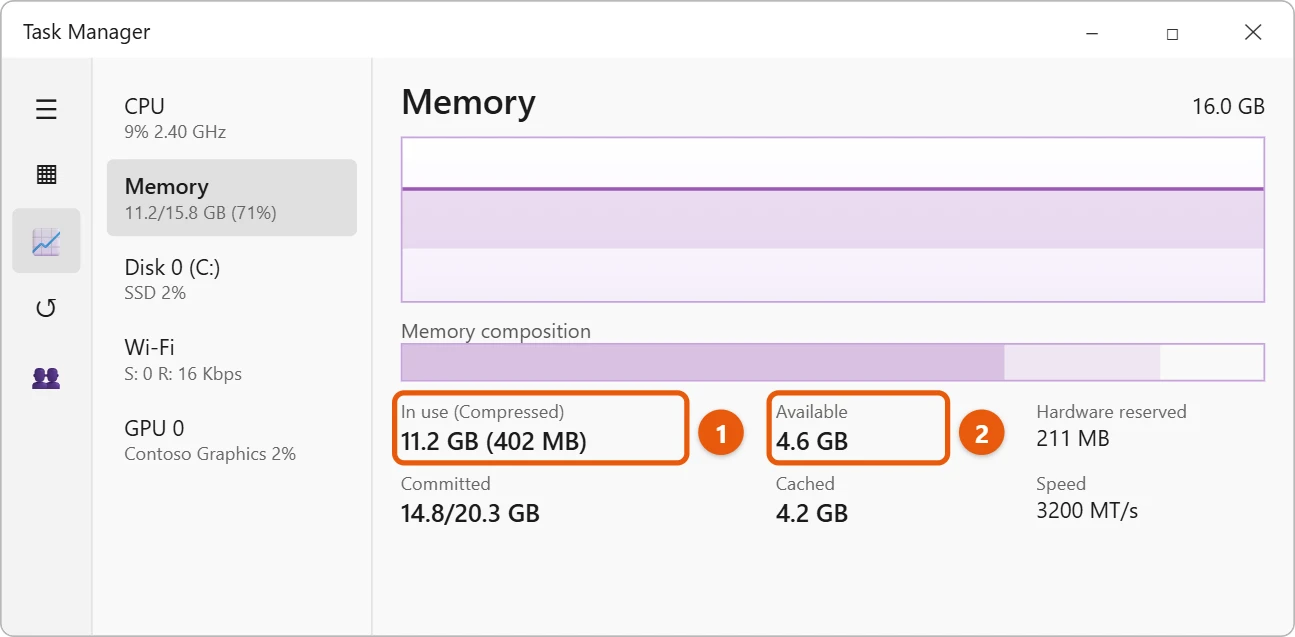
What the numbers mean:
- In use is memory taken by Windows and open apps. Compressed in brackets is memory Windows squeezed to fit more in.
- Available is memory ready for new apps. If this stays above about a quarter of your total, you probably don’t need to clear anything.
- Cached is memory holding recently used files so they open faster. It isn’t wasted. Windows hands it back the moment an app needs it.
- Committed shows memory apps have asked for, out of RAM plus the page file on your drive. If the first number gets close to the second, you may see a low-memory warning.
Method 1: Restart your PC
Restarting closes every app and clears RAM completely. Microsoft lists it as one of the first things to try when a PC is slow.
- Save your work.
- Select Start > Power > Restart.
- After Windows starts, open only the apps you need.
Choose Restart, not Shut down. With Fast startup on, shutting down saves part of Windows to the drive and loads it again next time, so a restart gives a cleaner start.
Method 2: Close the apps using the most memory
- Open Task Manager (Ctrl + Shift + Esc) and select Processes.
- Select the Memory column heading to sort apps from most to least memory.
- Select an app you don’t need right now.
- Select End task at the top.
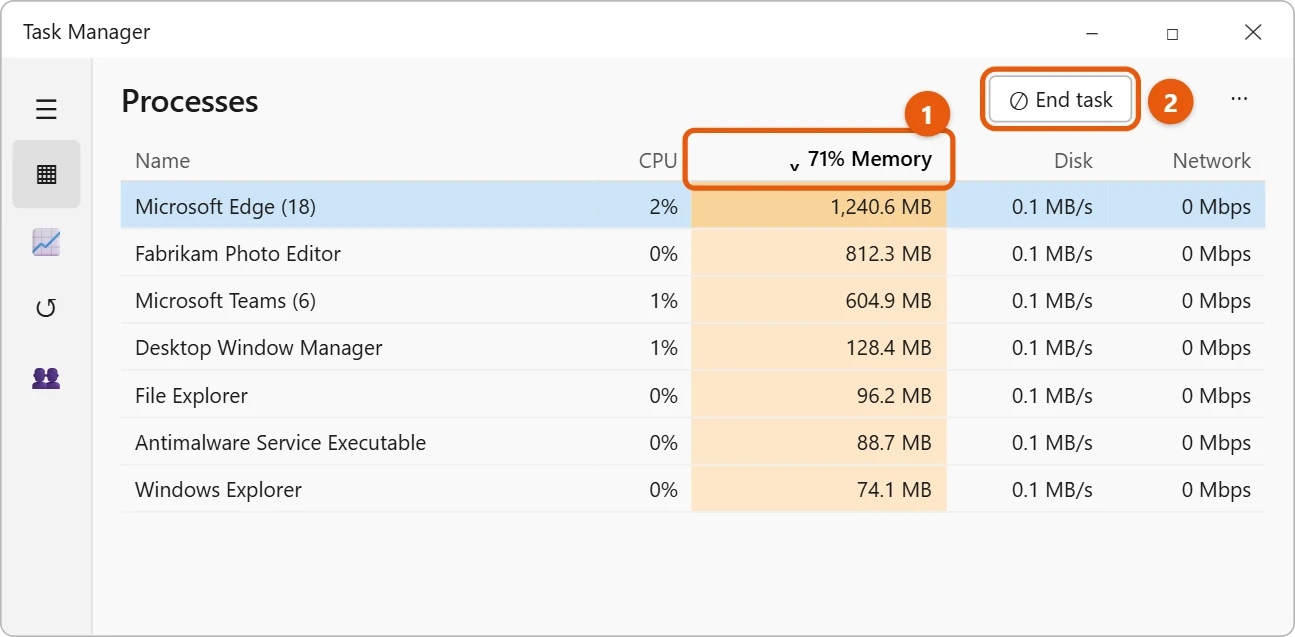
Before you end a task: save your work in that app. End task closes it right away, and unsaved changes are lost. Only end apps you recognize. Leave anything under Windows processes, or that you don’t know, alone.
You’ll see Available go up in the Performance view. Closing the app normally, with its own X button, frees the same memory and is safer if it’s still working.
Method 3: Close browser tabs you don’t need
Web browsers are often the biggest memory users, because every open tab uses some RAM. Close tabs you’re done with, or save them as favorites.
In Microsoft Edge, sleeping tabs free memory from tabs you haven’t looked at for a while:
- In Edge, select Settings and more (…) > Settings.
- Select System and performance.
- Make sure Save resources with sleeping tabs is on. You can also pick how soon inactive tabs go to sleep.
Method 4: Stop apps from starting with Windows
Apps that start when you sign in use memory all day, even if you never open them.
- Select Start > Settings > Apps > Startup.
- Look at the impact under each app. High impact apps use the most resources at startup.
- Turn off the switch for apps you don’t need right away. You can still open them from the Start menu when you want them.
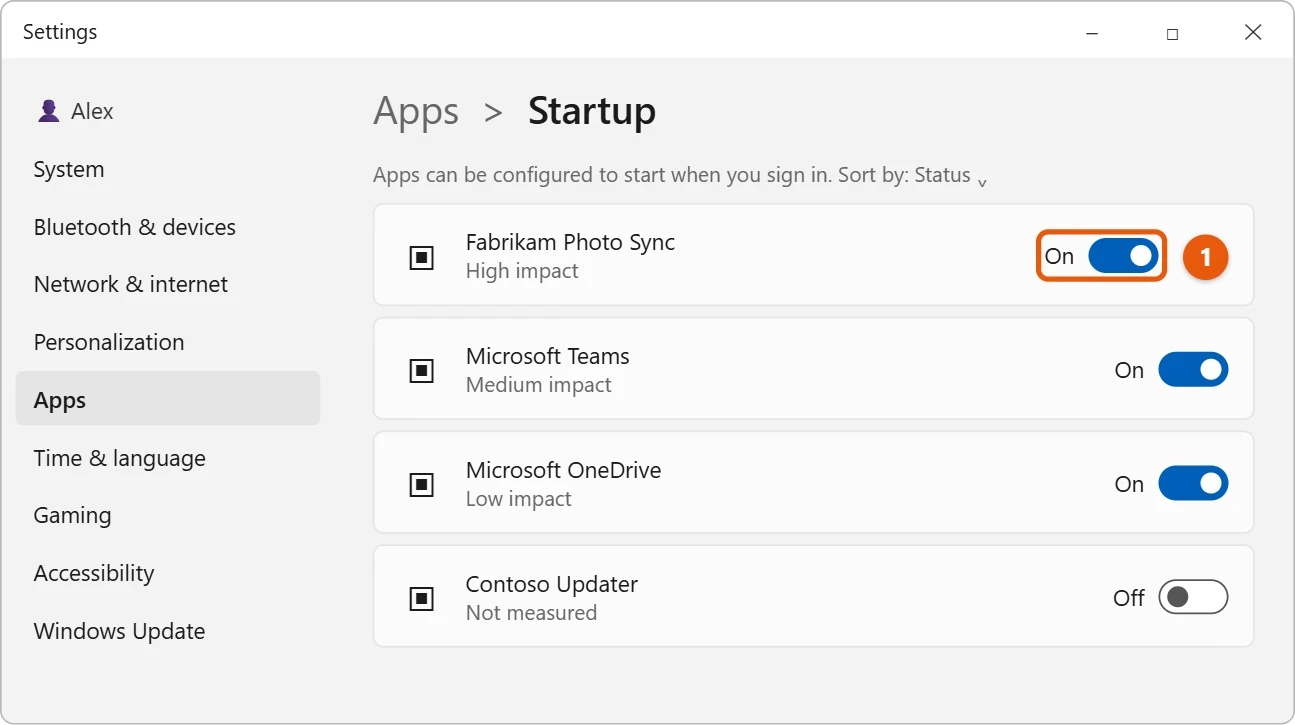
The change takes effect the next time you restart. To undo it, turn the switch back on.
Method 5: Limit apps that run in the background
Some apps keep running in the background after you close their window. For apps from the Microsoft Store, you can stop that:
- Select Start > Settings > Apps > Installed apps.
- Select More options (…) next to the app, then Advanced options. (If you don’t see Advanced options, the app doesn’t have this setting.)
- Under Background apps permissions, choose Never.
Many desktop apps also add an icon near the clock. Right-click the icon and choose Quit or Exit to close them fully. For more, see how to turn off background apps in Windows 11.
Method 6: Update Windows and your apps
Updates often fix apps that use more and more memory over time, called a memory leak.
- Select Start > Settings > Windows Update > Check for updates, and install what’s offered.
- Open Microsoft Store, select Downloads (or Library), and select Get updates.
- For other apps, use their built-in update option, usually in Help or Settings.
Method 7: Leave virtual memory on automatic
Windows uses a page file on your drive as extra memory when RAM runs low. Microsoft recommends letting Windows manage its size automatically, and that’s the default. There’s nothing to clear. If someone changed it in the past, it’s worth asking whoever set up your PC to set it back to automatic.
What not to do
- Skip “RAM cleaner” and “memory booster” apps. Windows already manages memory. These tools mostly push data out of the cache, so apps open more slowly afterward.
- Skip scripts that claim to free memory. Tricks like small script files that grab and release memory don’t make your PC faster and can make apps unstable.
- Don’t end Windows processes you don’t recognize. Ending the wrong one can freeze or restart your PC.
When you need more RAM
Clearing memory helps for a while, but if your PC is always short, it may simply need more. Signs:
- Available stays very low even after a restart with only a few apps open.
- In use sits near your total RAM most of the day.
- You often see “Your computer is low on memory.”
To see how much RAM you have, select Start > Settings > System > About and look at Installed RAM. Many laptops can’t be upgraded, so check your PC maker’s support site before you buy anything.
If you meant storage space
If your drive is full, clear files instead of RAM:
- Select Start > Settings > System > Storage.
- Select Cleanup recommendations and review Temporary files, Large or unused files, Files synced to the cloud, and Unused apps.
- Select what to remove, then Clean up.
- To do this automatically, turn on Storage Sense on the same page.
Microsoft’s full guide is Free up drive space in Windows.
If memory stays high
- Memory is high right after startup. Check Settings > Apps > Startup again, and restart after turning apps off.
- One app keeps using more and more. Close and reopen it. If it keeps happening, update the app, or uninstall and reinstall it.
- The browser uses a lot of memory. Close tabs, turn on sleeping tabs, and turn off browser extensions you don’t use.
- You see “Your computer is low on memory.” Save your work, close the largest apps in Task Manager, and restart. If it keeps coming back, you likely need more RAM.
Frequently asked questions
Does closing an app free its memory?
Yes, usually right away. If an app keeps running near the clock after you close it, quit it from that icon too.
Is high memory use bad?
Not always. Windows uses spare memory to cache files so they open faster. It’s only a problem when Available is low and your PC feels slow.
Will clearing RAM delete my files?
No. RAM only holds what’s running. Your files are saved on your drive. Just save open work before you restart or end a task.
How often should I restart?
Restarting once every few days, or whenever your PC feels slow, keeps memory fresh. Installing Windows updates also restarts it for you.
Does Windows 11 need a lot of RAM?
Windows 11 needs at least 4 GB. For everyday use with a web browser and office apps, 8 GB or more works much better.
Next steps
For more ways to speed things up, see how to make your PC faster in Windows 11. To check the size, speed and type of your RAM, see how to check RAM in Windows 10, which works the same way in Windows 11. Microsoft’s own list is in Tips to improve PC performance in Windows.
Related: How to turn off Efficiency mode in Windows 11.

Matt Jacobs has been working as an IT consultant for small businesses since receiving his Master’s degree in 2003. While he still does some consulting work, his primary focus now is on creating technology support content for SupportYourTech.com.
His work can be found on many websites and focuses on topics such as Microsoft Office, Apple devices, Android devices, Photoshop, and more.