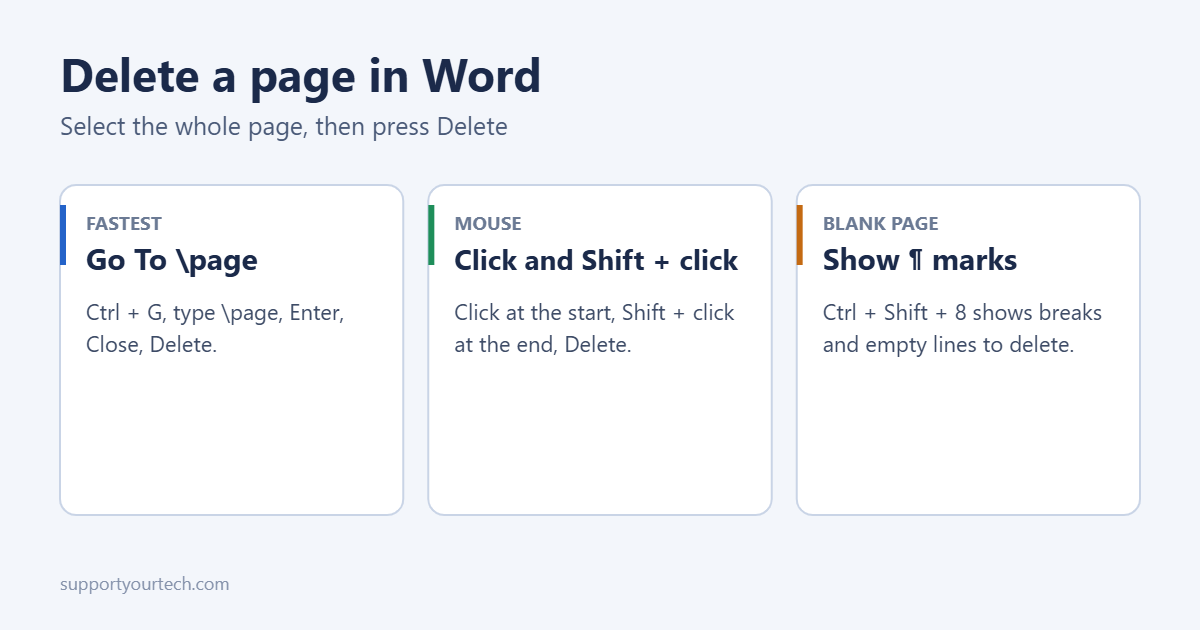
To delete a page in Word, click anywhere on that page, press Ctrl + G, type \page in the Enter page number box, press Enter, then click Close and press Delete. Word selects everything on the page in one go. Word has no “delete page” button because pages are just where text flows, so deleting a page means deleting its content. For a blank page that won’t go away, the fix is to remove hidden breaks or empty paragraphs, covered below.
Method 1: Select the page with Go To
- Click anywhere on the page you want to delete.
- Press Ctrl + G (or go to Home > Find > Go To).
- In Enter page number, type
\pageand press Enter. Word highlights all the content on that page. - Click Close.
- Press Delete or Backspace.
The \page bookmark is built into Word and always means “the current page”. Check the selection before deleting, especially if a table or picture continues from the previous page.
Method 2: Select with the mouse
- Click just before the first word on the page.
- Scroll to the end of the page.
- Hold Shift and click just after the last word.
- Press Delete.
To delete several pages in a row, click at the start of the first one and Shift + click at the end of the last one.
In a long document, go to View > Navigation Pane and click Pages to see thumbnails. Click a thumbnail to jump to that page, then use Method 1 to select and delete it. If you use headings, the Headings tab lets you right-click a heading and choose Delete to remove that whole section, which is often what you want.
Delete a blank page
An empty page is caused by something you can’t see. Press Ctrl + Shift + 8 (or click the ¶ button on the Home tab) to show formatting marks, then look at the blank page:
| What you see | What to do |
|---|---|
| Several ¶ marks | Select them and press Delete |
| “Page Break” | Click just before it and press Delete |
| “Section Break (Next Page)” | Click before it and press Delete. Check the formatting of the next section afterwards |
| One ¶ after a table at the end | Select it and set the font size to 1, or set its paragraph spacing to 0 |
| “Page break before” formatting | Right-click the paragraph, Paragraph > Line and Page Breaks, untick Page break before |
The last paragraph after a table can’t be deleted, which is why a final blank page often appears after a full-page table. Shrinking that paragraph pulls it back onto the previous page. For stubborn cases, see how to delete a blank page in Word that won’t go away and how to get rid of a page break in Word.
On a Mac
Click on the page, then go to Edit > Find > Go To (or press Option + Command + G), type \page, press Return, close the box and press Delete. Show formatting marks with Command + 8.
In Word for the web
Go To isn’t available. Select the page’s content with click and Shift + click, then press Delete. To see breaks, turn on Home > Show/Hide ¶.
Troubleshooting
Deleting the page messed up the next page’s layout
You deleted a section break, and the following text took on the previous section’s formatting, such as orientation or margins. Press Ctrl + Z to undo, then delete only the content above the break. If you mix portrait and landscape pages, see how to make only one page landscape in Word.
Text from the next page moved up
That’s expected. Word reflows text when content is removed. Add a page break with Ctrl + Enter where the next section should start. See how to insert a page break in Word.
I deleted the wrong page
Press Ctrl + Z right away. If you’ve already saved and closed the file, check File > Info > Version History for files stored in OneDrive or SharePoint.
Frequently asked questions
Can I delete a page from a PDF in Word?
Word converts a PDF into an editable document when you open it, so you can delete pages as above and save it again as PDF. Complex layouts may not convert perfectly.
How do I delete a page with a header or footer only?
Headers and footers repeat on every page in a section, so they don’t create pages by themselves. If a page only shows a header, it has an empty paragraph or break in the body. Show ¶ marks to find it.
Summary
- Click on the page, press Ctrl + G, type
\page, Enter, Close, Delete. - Or click and Shift + click to select, then Delete.
- For blank pages, show ¶ marks and delete breaks or empty paragraphs.
- Shrink the last paragraph after a table to remove the final blank page.
Related: convert a PDF to Word on a Mac.

Matt Jacobs has been working as an IT consultant for small businesses since receiving his Master’s degree in 2003. While he still does some consulting work, his primary focus now is on creating technology support content for SupportYourTech.com.
His work can be found on many websites and focuses on topics such as Microsoft Office, Apple devices, Android devices, Photoshop, and more.