Last updated on November 17th, 2026 at 03:02 pm
Just downloaded something and can’t see where it went? Press Ctrl + J in Edge, Chrome or Firefox on Windows 11. That opens the browser’s own download list, which records where each file was saved, and the folder icon or Show in folder takes you straight to it. Older files usually sit in the Downloads folder in File Explorer, at C:\Users\<your user name>\Downloads.
Pick the route that fits what happened
The quickest way to a lost file depends on what you remember about it. Start with the row that matches your situation, and move down the article only if that route comes up empty.
| What happened | Start here | Why it works |
|---|---|---|
| You downloaded it a minute ago | The browser’s download list (Ctrl + J) | The list shows the exact folder, even if it isn’t Downloads |
| You downloaded it days or weeks ago | The Downloads folder, sorted by Date modified | Browsers clear or trim their lists, but the file stays on disk |
| You remember only part of the name | File Explorer search, starting in Downloads | Search matches partial names and file types |
| It came from email, a chat app or your phone | That app’s own save setting | These apps don’t always use the browser’s folder |
| The folder looks empty or is missing | The checks under “When the folder or the file seems to be gone” | The folder may have moved, or the file may have been cleaned up or quarantined |
Ask the browser where the file went
Every major browser keeps a record of recent downloads with a link to the file’s location. This is the most reliable first step, because it reports where the file really landed instead of where you assume it went. Microsoft, Google and Mozilla all list Ctrl + J as the shortcut for this list on Windows.
- Switch to the browser you used for the download.
- Press Ctrl + J. Edge shows a small Downloads panel, Chrome opens a Downloads page in a new tab, and Firefox opens its Library window with Downloads selected.
- Find the file. Chrome and Edge have a search box at the top of the list if it’s long.
- Select the folder icon, or Show in folder. File Explorer opens with the file already highlighted.
If you’d rather click than type, Edge has Settings and more (…) > Downloads, Chrome has More (⋮) > Downloads, and Firefox has a Downloads arrow button on its toolbar.
A few things the list can tell you that the folder can’t:
- “Deleted” or “File moved or missing”: the browser saved it, but the file has since been moved, renamed or removed. Skip ahead to search, or check the Recycle Bin.
- A warning such as “dangerous” or “blocked”: the browser stopped the file. Chrome and Edge let you keep some flagged files from the download warning, but only do that for a file you were expecting from a site you trust.
- “Failed” or a paused bar: the download never finished, so there is no usable file to find. Retry it from the list.
Worked example: Priya downloads a bank statement in Chrome, but it’s not in Downloads. Ctrl + J shows it under today’s date, and Show in folder opens Documents\Statements, because she picked that folder the last time Chrome asked where to save. Nothing was lost; the browser simply remembered her last choice.
Open the Downloads folder yourself
If the browser list has been cleared, or you used a different app, go to the folder directly.
- Open File Explorer from the folder icon on the taskbar, or press Windows + E.
- Select Downloads in the navigation pane on the left. Since Windows 11 version 22H2, Downloads is pinned to Quick access by default, so it appears near the top of the pane and under Quick access on the Home page.
- Select Sort on the toolbar, then Date modified, and make sure Descending is selected so the newest file sits at the top.
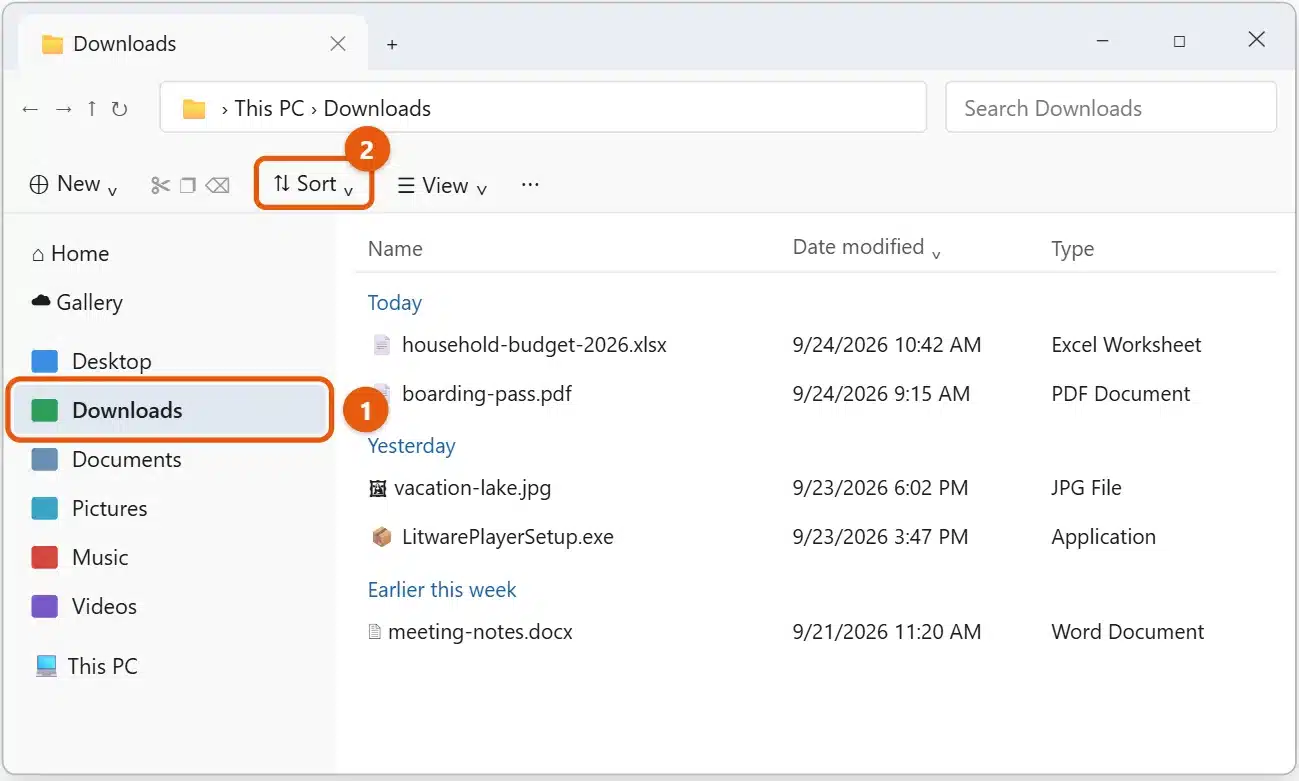
If Downloads has vanished from the left pane, someone (or an app) unpinned it. Microsoft’s fix is to open File Explorer, select Home, select the up arrow beside the address bar, then right-click Downloads and choose Pin to Quick access.
Two keyboard routes skip the clicking. Press Windows + R, type shell:downloads and press Enter, or click the File Explorer address bar, type the same text and press Enter. Both open the folder wherever it currently lives, which helps if it was moved to another drive.
Seeing headings such as Today, Earlier this week and Last month? That’s File Explorer grouping files by date. It’s harmless, but it can push a new file into a collapsed group. Select Sort > Group by > (None) for one flat list, and switch the view to Details (View > Details) to see the date, type and size columns side by side.
Search when you only remember part of the name
Search is the right tool when a file isn’t near the top of Downloads or you’ve already tidied it into another folder. Also check Recent on the File Explorer Home page, and the Desktop and Documents folders, which are common places for a save dialog to drop a file.
- Open Downloads in File Explorer first. Searching one folder is much faster than searching the whole PC.
- Click the search box at the top right and type any part of the name, such as
invoiceor.pdf. - If nothing turns up, select This PC in the left pane and run the same search. Give it a minute on a large drive.
- When the file appears, right-click it and choose Open file location to see the folder it lives in.
To narrow a long list, add a filter after you search. The search options let you limit results by date modified, file kind or size, so limiting results to documents modified this week cuts hundreds of hits down to a handful.
Where Edge, Chrome and Firefox save new files
If new downloads keep turning up somewhere other than Downloads, the browser’s setting is the reason. Each browser shows its current folder in its settings.
| Browser | Where to look | What to change |
|---|---|---|
| Microsoft Edge | Settings and more (…) > Settings > Downloads; the folder is under Location | Select Change to pick a different folder |
| Google Chrome | More (⋮) > Settings > Downloads; the folder is under Location | Select Change, or turn on Ask where to save each file before downloading |
| Mozilla Firefox | Menu (three lines) > Settings > Downloads (older versions: Files and Applications under General) | Select Browse next to Save files to |
Turning on an “ask every time” option is handy if you file things as you go, but it’s also the most common reason a file ends up in an odd place: the save dialog opens in whatever folder you used last. Edge has a similar ask-first switch on the same Downloads page.
On a work or school PC, your organization can set the download folder through browser policy. If the setting is grayed out or shows a “managed by your organization” note, you can’t change it yourself; ask your IT team where downloads are routed. To move the folder on your own PC, see how to change the download location in Windows 11.
Downloads that never went through a browser
Plenty of files arrive on a Windows 11 PC without a browser involved, and each app decides where they go.
- Email attachments. Opening an attachment straight from a mail app usually gives you a temporary copy. To keep it, use the app’s Save as or Download option, which normally offers Downloads first.
- Teams and other chat apps. Files you download from a chat normally go to Downloads, but these apps have their own download setting that can point elsewhere.
- Files from your phone. Files you share to the PC with Phone Link or Nearby sharing generally land in Downloads by default. Nearby sharing has its own save location setting in Settings > System > Nearby sharing.
- Microsoft Store apps. These install themselves and show up in the Start menu’s app list, not as files in Downloads.
- Game launchers. Steam and similar launchers keep game data in their own library folders, which you’ll find in the launcher’s settings.
If something seems to be downloading but never appears anywhere, it may still be running. You can check what’s downloading in the background on Windows 11 before you go hunting.
When the folder or the file seems to be gone
Work through these checks in order. Each one rules out a different cause.
1. The Downloads folder was moved. Right-click Downloads in File Explorer, select Properties, and open the Location tab. The box shows where the folder really is. If it points to a second drive or a USB stick, that drive has to be connected for the folder to show its files. Restore Default moves it back to your user folder, but warning: let the move finish before you unplug anything, and don’t point it at the root of a drive.
2. The file is in OneDrive. If OneDrive backs up your Desktop and Documents, a file you saved to Desktop actually lives inside the OneDrive folder. Start by finding the OneDrive folder in Windows 11 and search there.
3. Storage Sense cleaned it up. Storage Sense can delete files in Downloads that haven’t been opened for a set time, but only if someone turned that option on. Microsoft notes it’s off by default and, with default settings, doesn’t touch Downloads. Check Settings > System > Storage > Storage Sense and look at the setting labeled Delete files in my Downloads folder if they haven’t been opened for more than. Set it to Never if you want Downloads left alone.
4. It went to the Recycle Bin. Open the Recycle Bin from the desktop, sort by Date Deleted, right-click the file and choose Restore. A file deleted with Shift + Delete skips the bin, so it won’t be there.
5. Windows Security quarantined it. Open Windows Security and select Protection history. If the file is listed, Microsoft Defender flagged it. Only choose Restore if you’re sure the file is safe, since Defender will flag it again if it really is a threat. Reviewing threat details needs an administrator account.
6. It never finished. A file ending in .crdownload (Chrome and Edge) or .part (Firefox) is an incomplete download. It won’t open; delete it and download the file again.
7. It’s there but won’t open. Files from the internet carry a “came from another computer” mark. If Windows or Office blocks a file you trust, right-click it, choose Properties, and select the Unblock checkbox on the General tab. Warning: only do this for files from a source you know, because the mark is there to slow down malware.
Example: Jordan’s Downloads folder opens empty on Monday. The Location tab shows E:\Downloads, and E: is the external drive he unplugged on Friday. Plugging it back in brings every file back.
Make Downloads quicker to reach next time
A couple of small changes save you this search in the future.
- Put Downloads on Start. Go to Settings > Personalization > Start > Folders and turn on Downloads. A folder icon appears beside the power button on the Start menu.
- Keep it pinned. If Downloads ever drops off the left pane, pin it again with the Home method above.
- Clean up now and then. A tidy folder makes the newest file obvious. When you’re ready, delete old downloads on Windows 11 after moving anything you want to keep.
Many downloads arrive as compressed folders. If yours is a .zip, zipping and unzipping files in Windows 11 covers extracting it. Still on an older PC? The steps for finding downloads on Windows 10 differ slightly.
Downloads questions people ask
Does removing a file from the browser’s download list delete it?
No. Clearing an entry or the whole list in Edge, Chrome or Firefox only removes the record. The file stays on disk. Some browser versions also put an option on an individual entry that deletes the file itself, so read the menu item before you click.
What are .crdownload and .part files?
They’re placeholders a browser writes while a download is in progress. If one is left behind after the download stopped, the file is incomplete. Delete it and start the download again rather than renaming it.
Why does my download sometimes end in (1) or (2)?
Browsers don’t overwrite a file that already has the same name, so they add a number. If you downloaded setup.exe twice, the newest is probably setup (1).exe, which is a good reason to sort by date rather than by name.
Is changing the storage drive in Settings the same as moving Downloads?
No. Settings > System > Storage > Advanced storage settings controls where new content such as apps is saved. Your browser and the Downloads folder’s Location tab decide where downloaded files go.
For Microsoft’s own wording on browser download folders, see Find where your browser is saving downloads, and for the pinning steps, File Explorer in Windows; Microsoft’s page on managing drive space with Storage Sense explains exactly when it deletes files from Downloads.

Matt Jacobs writes and maintains the guides on Support Your Tech, which he started in 2017. He spent most of his career keeping small-business PCs running and still takes the occasional consulting job, so the steps here come from fixing the same problems on other people’s computers. Every guide is checked on his own Windows 11, Windows 10, Mac, iPhone and iPad before it goes up.