Last updated on November 18th, 2026 at 12:27 pm
In Word, double-click the header, select Home > Show/Hide (¶) and delete any empty lines below the header text. Then, on the Header & Footer tab, lower Header from Top, for example to 0.3 inch, and reduce the top margin in Layout > Margins > Custom Margins. A large logo, big font or extra spacing also makes the header taller. This works in Word for Microsoft 365 and Word 2016 through 2024, on Windows or Mac.
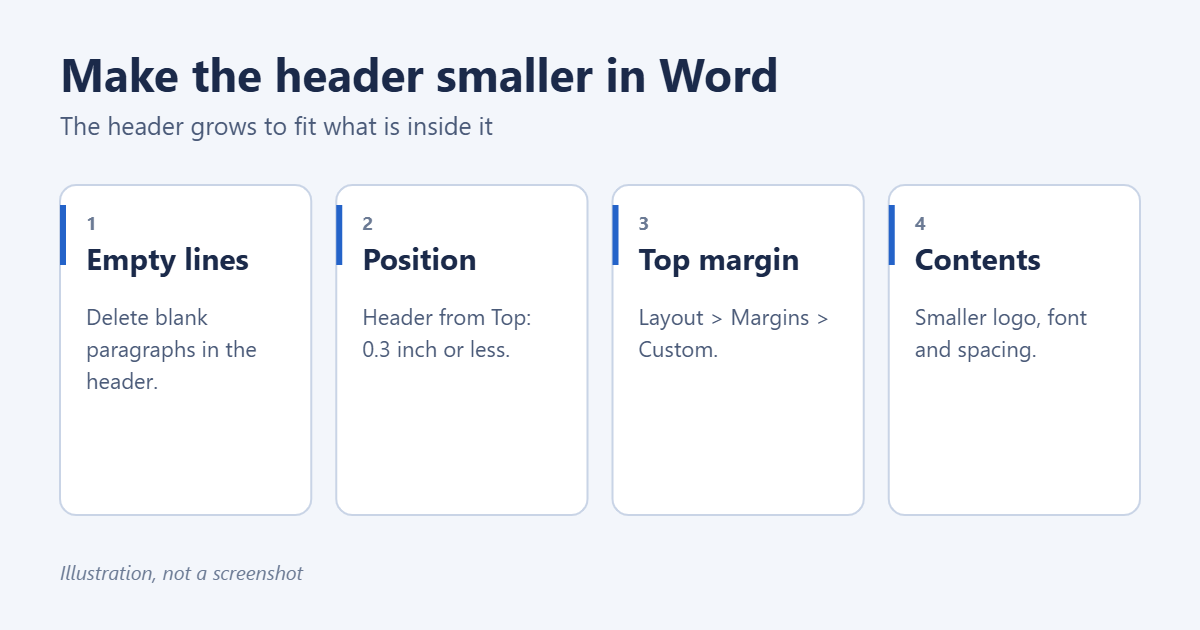
How header space works
Two settings decide where the body text starts:
- Header from Top: how far the header sits from the top edge of the page. The default is 0.5 inch.
- Top margin: where the body text starts. The default is 1 inch.
If the header’s contents reach past the top margin, Word pushes the body text down to make room. So a header can take up more space than the margins suggest, and shrinking its contents is often the real fix. This is also why a page set to Narrow margins in Word can still show a deep top margin when the header is large.
Remove empty lines
- Double-click the header to open it.
- Select Home > Show/Hide (¶) to see paragraph marks.
- Delete any extra ¶ marks below the header text. Word always keeps one, which can’t be removed.
- If that last paragraph mark adds space, select it and set its font size to 1.
Move the header closer to the edge
- With the header open, select the Header & Footer tab.
- In the Position group, lower Header from Top, for example to 0.3″.
- Do the same for Footer from Bottom if the footer is too big too.
Many printers can’t print within about 0.25 inch of the edge, so don’t go much lower if you’ll print the document.
Reduce the top margin
- Select Layout > Margins > Custom Margins.
- Lower Top, for example from 1″ to 0.75″.
- On the Layout tab of the same dialog, you can also set the header and footer distances under From edge.
- Select OK.
If the top margin is smaller than the header’s contents, the body text still starts below the header, so also remove empty lines and shrink what’s in the header.
Shrink what’s in the header
- Logo: click it and drag a corner handle inward, or set an exact height on the Picture Format tab. Set its Wrap Text to In Front of Text so it doesn’t push the header text down.
- Text: select the header text and choose a smaller font size on the Home tab.
- Spacing: open the Paragraph dialog and set Before and After to 0 pt and Line spacing to Single.
- Tables: if the header uses a table for layout, reduce its row height and cell margins in Table Properties.
To make these changes the default for this document, right-click the Header style in the Styles pane and select Modify.
Smaller header on the first page only
Double-click the first page’s header, tick Different First Page on the Header & Footer tab, and make that header as small or as large as you like. Other pages keep their own header. Making different headers in Word covers other ways to vary them.
Hide header space on screen only
To see more text while you type, double-click the gap between two pages. Word hides the white space, including headers and footers, on screen. Double-click the line between pages to show it again. This doesn’t affect printing. To see where the top margin ends and the body text begins, turn on crop marks or the ruler to show margins in Word.
Headers that stay tall or look faded
The header is still tall after deleting everything
Check the header style’s spacing in the Paragraph dialog, and look for a hidden table or text box with Home > Select > Selection Pane.
The header looks faded
That’s only on screen. The fix is in making the header not faded in Word.
I need more room on the page overall
Fitting everything on one page in Word covers other ways to save space.
Related: deleting a header in Word and removing a border line in Word.

Matt Jacobs writes and maintains the guides on Support Your Tech, which he started in 2017. He spent most of his career keeping small-business PCs running and still takes the occasional consulting job, so the steps here come from fixing the same problems on other people’s computers. Each guide follows Microsoft, Apple and Google’s own documentation and is updated when the steps change. Screenshots marked “Recreated” are illustrations of the real screens.