Last updated on November 17th, 2026 at 03:02 pm
Double-click a PDF and it lands in Edge again; open a vacation photo and the wrong viewer pops up. The fix lives in Settings > Apps > Default apps in Windows 11, and there are four routes to it: change one file type, change everything one app handles, change it from a single file in File Explorer, or switch your browser. Pick the one that matches your problem below and you’ll be done in under a minute.
Pick the quickest route
Windows 11 assigns defaults one file type (like .pdf) or one link type (like HTTPS) at a time, rather than one big “photo viewer” or “music player” slot. That’s more precise, but it means you should start from whatever is actually bothering you.
| What’s bothering you | Fastest route | Where |
|---|---|---|
| One kind of file opens in the wrong app (PDFs, .mp4 videos) | Change one file type | Settings > Apps > Default apps, search box |
| You just installed an app and want it to take over everything it can open | Change defaults by app | Settings > Apps > Default apps, app list |
| You’re looking at the file right now in File Explorer | Open with > Always | Right-click the file |
| Web links open in the wrong browser | Set the browser as default | The browser’s page in Default apps |
The steps below apply to Windows 11 Home and Pro on current versions. The layout of the Default apps page has stayed much the same across recent updates, so if a label looks slightly different on your PC, look for the closest match.
Change the default for one file type or link type
This is the route most people need. It fixes one annoyance without touching anything else.
- Press Windows + I to open Settings, then select Apps > Default apps. (You can also press Windows + R, type
ms-settings:defaultappsand press Enter.) - In the box under Set a default for a file type or link type, type the extension with its dot, such as .pdf, .jpg or .mp4. For a link type, type its name, such as HTTPS or MAILTO.
- Select the matching result. Windows shows the app that currently opens that type.
- Select that app (or the plus sign if nothing is set), choose the app you want from the list, and confirm with Set default if Windows asks.
A worked example: Priya’s PDFs open in Edge, but she reads them in Adobe Acrobat Reader. She searches .pdf, selects Microsoft Edge under it, picks Acrobat Reader and confirms. Every PDF from then on opens in Acrobat, and Edge still works normally for web pages. If you’re still deciding which reader to use, compare the options in changing the default PDF viewer in Windows 11.
One catch: similar extensions are separate entries. Setting .jpg does not change .jpeg, .png or .heic, and .mp4 does not change .mkv. If one photo opens in your new viewer and the next doesn’t, check its extension and repeat the steps for that type. iPhone photos in .heic format need extra Microsoft Store extensions before Photos can show them, so follow the steps to open HEIC files in Windows 11 before choosing a default for that type.
Example: Looking Up One File Type
On a Windows 11 Home laptop (version 25H2), Settings > Apps > Default apps has a Set a default for a file type or link type box at the top. Typing .pdf offered .pdf and .pdfxml.
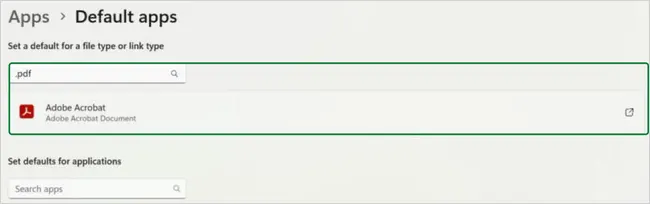
Choosing .pdf showed Adobe Acrobat (Adobe Acrobat Document) as the current default. Selecting that row opens the list of apps you can switch to.
Change everything one app can open
Use this after installing an app you want to use for many types at once, such as VLC for video and music or a new photo viewer.
- Open Settings > Apps > Default apps.
- Under Set defaults for applications, search for the app or scroll to it, and select it.
- Windows lists every file type and link type the app has registered, each with the app that opens it now.
- Select a type that shows a different app, choose your app and confirm. Repeat for each type you want to move.
There’s no single “use this app for everything” switch for most apps, so Jordan, who wants VLC to play his whole music and video collection, would work down the list: .mp3, .m4a, .mp4, .mkv, .avi and so on. It takes a couple of minutes, but it’s a one-time job. The same page is a quick way to audit an app: if a type you expected isn’t listed, the app never registered it, and you’ll need the File Explorer route below. Media players get their own walkthrough in changing the default media player in Windows 11.
Browsers are the exception
Browsers usually get a one-click button. Microsoft documents it for Edge: select Microsoft Edge under Set defaults for applications, then select Set default next to Make Microsoft Edge your default browser. Many other browsers show a similar Set default button on their own page. That button normally moves the main web types together, such as .htm, .html, HTTP and HTTPS, but check those four on the browser’s page afterward, and set any that didn’t change by hand.
Each browser’s screens are shown in changing the default browser in Windows 11. Chrome can also ask to become the default from its own settings, and that route is covered in setting Chrome as the default browser.
Change it from a file in File Explorer
When the file is already in front of you, this is quicker than opening Settings, and it works for odd extensions that don’t appear in the app lists.
- Right-click the file and select Open with > Choose another app.
- Select the app you want. If it isn’t shown, look for a link to choose an app on your PC or more apps, then browse to the program’s .exe file (usually in C:\Program Files).
- Select Always to make it the default for that file type, or Just once to open this file without changing anything. (Those are the buttons on current versions; if you see an ‘Always use this app’ check box instead, check it to make the change permanent.)
“Just once” is handy for testing: open the file in the new app first, and only switch the default if you like the result. If you picked Always by mistake, there’s nothing to undo as such; just repeat the steps with the app you want, or change the type in Settings.
For most file types there’s also a route through Properties: right-click the file, select Properties, and on the General tab select Change next to Opens with. It leads to the same app picker.
Unusual types often need a specific program installed first. A .jnlp file, for example, is a Java Web Start launcher, and the usual app for it is OpenWebStart; the setup is walked through in opening a JNLP file in Windows 11.
Set email and other link types
Links behave like file types. When you click an email address on a web page, Windows looks up the MAILTO link type to decide which app opens. Search MAILTO in the Default apps search box and pick your email app, such as Outlook or Thunderbird. Webmail users have a different setup, explained in setting Gmail as the default email in Windows 11.
Other link types work the same way: search the name, select it, pick the app. If you don’t know a link type’s name, open the app’s page under Set defaults for applications and read the entries in capitals there; those are its link types.
Defaults worth setting on a new PC
A fresh Windows 11 PC opens most things in Microsoft apps. Setting these once saves a lot of right-clicking later:
- Browser: .htm, .html, HTTP and HTTPS (or the browser’s Set default button).
- PDF: .pdf, if you prefer a dedicated reader to Edge.
- Photos: .jpg, .jpeg, .png and .heic.
- Video and music: .mp4, .mkv, .mp3 and .m4a.
- Email: MAILTO.
- Documents: .docx, .xlsx and .txt, if you use something other than Microsoft Office and Notepad.
Install the apps first. An app has to be on the PC and register its file types before Windows will offer it, so new programs belong on the PC before this step (see installing programs on Windows 11).
Reset defaults to Microsoft’s choices
If you’ve changed so many types that things are a mess, Windows 11 has a reset option at the bottom of the Default apps page, shown on current versions as Reset all default apps with a Reset button. Before you use it, know what it does:
- Every file and link type goes back to Microsoft’s choice, so PDFs and web links return to Edge and photos to Photos.
- Your own choices are not saved anywhere, so you can’t undo a reset; you’d set each type again.
- No apps are uninstalled. Acrobat, VLC or Chrome stay on the PC; they just stop being the default.
To fix only one type, skip the reset and change that one type with the search box instead.
Why a default changes back
You set a default, and a week later the old app is back. The usual causes:
- An app asks to be the default. Browsers, PDF readers and media players often show a prompt after an update. Accepting it, even by accident, takes over the types again. Decline the prompt or turn off the “check if default” option in that app’s settings.
- An app reinstall or major update can re-register its file types. Check the type in Settings after big updates.
- A work or school PC. IT can push a default associations file through Group Policy (Set a default associations configuration file, under Computer Configuration > Administrative Templates > Windows Components > File Explorer). It’s applied each time you sign in, so your changes are replaced. Ask IT rather than fighting it.
For admins setting up several PCs, Microsoft’s route is to configure one PC, export its associations with Dism /Online /Export-DefaultAppAssociations:C:\appassoc.xml from an elevated prompt, and point that policy at the file. The policy is available on Pro, Enterprise and Education, as described in Microsoft’s ApplicationDefaults policy reference.
When the app you want isn’t offered
- It isn’t installed, or it’s a portable app that never registered. Install it properly, then try again, or use Open with > Choose another app and browse to its .exe file.
- The type isn’t something it opens. Windows only lists apps that registered that type. Check the app’s own settings for a file association option.
- It’s a search problem, not a browser problem. Changing your default browser doesn’t change which search engine that browser uses. That’s a setting inside the browser; for example, you can make Google the default search engine separately.
Which default-app questions do people ask next?
Why didn’t setting my default browser change how PDFs open?
The browser’s Set default button normally moves web types (.htm, .html, HTTP, HTTPS), not .pdf. If you want PDFs in Chrome or another browser, search .pdf and pick it there.
Does changing a default uninstall the old app?
No. Both apps stay installed and keep working. Only the app that opens that type on a double-click changes, and you can still use Open with to pick the other one at any time.
Do I need to change .jpg and .jpeg separately?
Yes. They’re the same image format, but Windows treats each extension as its own entry. The same goes for .htm and .html, and .tif and .tiff.
Is this the same on Windows 10?
The idea is the same, but Windows 10’s Default apps page is laid out differently, with category slots for things like the web browser and photo viewer. The Windows 10 version is covered in setting default apps in Windows 10.
Start with whichever single file type annoys you most, set it from the search box, and add the rest from the new-PC list as they come up.

Matt Jacobs writes and maintains the guides on Support Your Tech, which he started in 2017. He spent most of his career keeping small-business PCs running and still takes the occasional consulting job, so the steps here come from fixing the same problems on other people’s computers. Each guide follows Microsoft, Apple and Google’s own documentation and is updated when the steps change. Screenshots marked “Recreated” are illustrations of the real screens.