To turn on OneDrive in Windows 11, open Start, type OneDrive, open the app, enter your Microsoft account, and select Sign in. OneDrive is already installed on Windows 11, so in most cases there is nothing to download. Once setup finishes, a cloud icon appears on the taskbar and a OneDrive folder appears in File Explorer.
Applies to: Windows 11 with the OneDrive sync app, using a personal Microsoft account or a work or school account. Checked against Microsoft Support on October 7, 2026.
What you need before you start
- An account. OneDrive only syncs while you are signed in. You can use a personal Microsoft account (for example an outlook.com or live.com address) or a work or school account. Microsoft’s Windows backup documentation says a free Microsoft account comes with 5 GB of OneDrive storage, with more available to buy.
- An internet connection. Sign-in and the first sync both need one.
- A decision about the folder location. Setup offers a default location for your OneDrive folder. Microsoft notes that the setup screen is the best time to change it, so decide beforehand if you want the folder on a different drive.
It also helps to know what “turning on” means here. Signing in connects the OneDrive folder on your PC to your cloud storage, and anything inside that folder syncs. Backing up your Desktop, Documents, and Pictures folders is a separate, optional setting that is covered further down.
- Select Start on the taskbar and type OneDrive. The OneDrive app appears in the search results.
- Open OneDrive. If nobody has signed in on this PC yet, the OneDrive setup window opens and asks for an email address.
- Enter your Microsoft personal account or your work or school account, then select Sign in. Enter your password and complete any verification prompt your account uses.
- On the This is your OneDrive folder screen, select Next to accept the default folder location. To put the folder somewhere else, select Change location first and pick the folder you want.
- On the All your files, ready and on-demand screen, read how files are marked as online-only, locally available, or always available, then select Next.
- Work through any remaining setup screens. They can vary with the app version and account type, and may include an offer to back up your folders, which you can accept or skip.
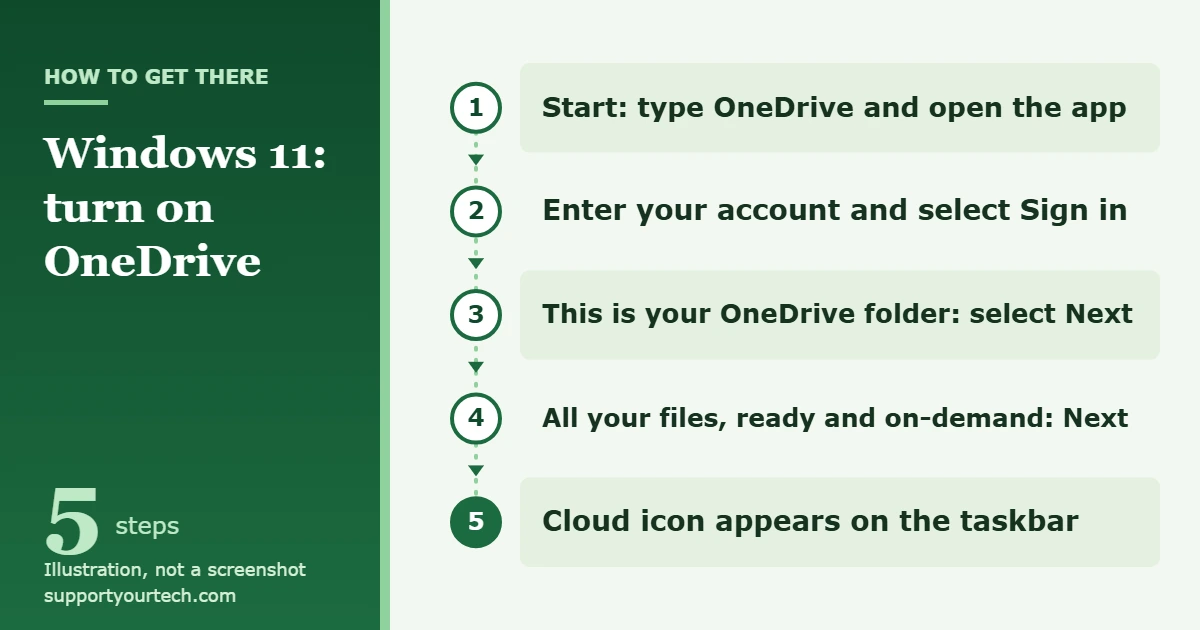
When setup is complete, your OneDrive files appear in File Explorer in the OneDrive folder, and the OneDrive cloud icon sits in the notification area at the right end of the taskbar. Microsoft’s full walkthrough is in Sync your computer’s files and folders with OneDrive.
Confirm that OneDrive is on and syncing
Look at the cloud icon in the notification area. If you do not see it, select the small arrow next to the notification area to show the icons that Windows has tucked away. Microsoft’s icon reference explains what each state means:
| What you see | What it means |
|---|---|
| Circular arrows on the cloud | Sync is in progress. Files are uploading or downloading. |
| Gray cloud with a line through it | You are not signed in, or OneDrive setup has not been completed. |
| Paused symbol on the cloud | Your files are not currently syncing. Select the icon and resume syncing. |
| Red circle with a white cross | A file or folder cannot be synced. Select the icon to read about the problem. |
| Yellow warning triangle | Your account needs attention. Select the icon to see the warning. |
Inside the OneDrive folder in File Explorer, each file also carries a status icon. A blue cloud means the file is online-only and takes up no space on the PC. A green check mark means the file has been downloaded and is available without an internet connection. A solid green circle with a white check mark means you chose to always keep that file on this device.
A simple test is to copy a small file into the OneDrive folder, wait for its status icon to settle, and then sign in at onedrive.com to check that the file is there.
Make OneDrive start every time you sign in to Windows
If OneDrive works after you open it but is not running after a restart, check the Windows startup list.
- Select Start > Settings > Apps > Startup.
- Find the OneDrive entry in the list of apps.
- Set its toggle to On so the app starts automatically when you sign in.
You can make the same change in Task Manager: right-click Start, select Task Manager, open the Startup apps tab, select the OneDrive entry, and select Enable.
Turn on folder backup for Desktop, Documents, and Pictures
Folder backup moves the contents of your standard Windows folders into OneDrive so they are protected and available on your other devices. It is optional. Because these folders are often large, check how much storage your account has before turning it on.
- Select the OneDrive cloud icon in the notification area.
- Select the OneDrive Help and Settings icon, then select Settings.
- Go to the Sync and backup tab and select Manage backup.
- Turn on the toggle for each folder that shows as not backed up, then select Save changes.
With a personal Microsoft account you can reach the same choices from Windows itself. Open Settings > Accounts > Windows backup, or select Start, type backup, and open the Windows Backup app, then expand Folders and choose from Desktop, Documents, Pictures, Videos, and Music. Microsoft states that work or school accounts do not work with the Windows Backup app. Our guide on how to back up files in Windows 11 walks through that app in more detail.
Microsoft lists several reasons a folder may refuse to back up, including a file path longer than 260 characters, a file larger than 250 GB, and file names that contain characters such as \ : / * ? < > ” or |. The details are in Back up your folders with OneDrive.
Choose what stays on your PC
Two settings control how much disk space OneDrive uses once it is on.
Files On-Demand shows every file in your OneDrive in File Explorer without downloading all of them. To check it, open OneDrive Settings, go to the Sync and backup tab, expand Advanced settings, and look at the Files On-Demand option. To keep a particular file or folder available offline, right-click it and select Always keep on this device. To hand the space back, right-click it and select Free up space.
Choose folders hides whole OneDrive folders from this PC. Open OneDrive Settings, go to the Account tab, and select Choose folders. In the Choose Folders dialog box, uncheck the folders you do not want on this computer and select OK. An unchecked folder is removed from the PC but stays available online. Microsoft notes that you cannot uncheck certain folders that are important to the PC, including Documents, Desktop, and Pictures, and that these choices apply only to that computer and account.
Add a second account
You can sync a personal account and a work or school account side by side. Open OneDrive Settings, go to the Account tab, and select Add an account. Microsoft allows several work or school accounts but only one personal account per PC. In File Explorer, personal files appear under OneDrive – Personal and work or school files under a OneDrive folder labeled with the organization’s name.
Troubleshooting when OneDrive will not turn on
Searching Start finds nothing
The sync app has probably been uninstalled. Download it from Microsoft’s OneDrive download page, open the downloaded file, and follow the prompts to sign in. In the Windows list of installed apps, Microsoft OneDrive is the backup and sync app; an entry for OneDrive by Microsoft Corporation is a separate Microsoft Store app. If the app is present but damaged, see how to reinstall OneDrive on Windows 11.
OneDrive opens, but no sign-in window appears
Check the notification area first, including the hidden icons, because OneDrive may already be running. A gray cloud with a line through it means setup was never finished: select the icon and sign in. If the app was closed with Quit OneDrive, opening it again from Start brings it back.
Nothing happens on a work or school PC
Microsoft documents that an organization can use a Group Policy setting to stop the OneDrive sync app from starting. The symptoms are no sign-in prompt, no syncing, and no error message. On an affected computer the value DisableFileSyncNGSC is set to 1 under HKEY_LOCAL_MACHINE\Software\Policies\Microsoft\Windows\OneDrive. A separate policy can block personal Microsoft accounts from syncing on managed PCs. In either case, ask your IT administrator rather than changing the registry yourself; Microsoft warns that serious problems can occur if the registry is edited incorrectly.
OneDrive is signed in but stuck or not syncing
Microsoft’s reset procedure rebuilds the sync connections without deleting your files.
- Press the Windows key and R to open the Run dialog box.
- Paste %localappdata%\Microsoft\OneDrive\onedrive.exe /reset and select OK.
- If you see a “Windows cannot find” message, Microsoft lists alternative paths for the command in Reset OneDrive.
- Restart OneDrive manually: select Start, type OneDrive, and open the desktop app.
After a reset, if you had chosen to sync only some folders, you need to make that selection again.
A red or yellow icon appears after setup
Select the cloud icon and read the message. A red circle with a white cross points to a specific file or folder that cannot sync. Microsoft lists invalid characters in the name, an overlong path, and an oversized file among the causes. A yellow warning triangle means the account itself needs attention.
How to turn OneDrive off again
To stop syncing on this PC without uninstalling anything, open OneDrive Settings, go to the Account tab, select Unlink this PC, and confirm with Unlink account. Microsoft states that you will not lose files or data by unlinking, and your files remain available at OneDrive.com. To close the app for the current session only, select the OneDrive Help and Settings icon and choose Quit OneDrive. To stop backing up a folder, return to Manage backup and turn that folder’s toggle off; OneDrive then asks whether to keep the files only in OneDrive or on your computer as well. Microsoft covers every option, including uninstalling, in Turn off, disable, or uninstall OneDrive.
Frequently asked questions
Is OneDrive already installed on Windows 11?
Yes. Microsoft’s setup instructions state that OneDrive is already installed on a Windows 11 PC. You only need to download it if someone has uninstalled it.
Do I need a Microsoft account to use OneDrive?
You need to sign in with either a personal Microsoft account or a work or school account. OneDrive does not sync while you are signed out.
Does turning on OneDrive upload everything on my PC?
No. Signing in syncs the contents of the OneDrive folder. Your Desktop, Documents, Pictures, and other standard folders are included only if you turn on folder backup, and you can change that at any time under Manage backup.
How much free storage does OneDrive include?
Microsoft’s Windows backup documentation says a free Microsoft account comes with 5 GB of OneDrive cloud storage, and that more can be purchased.
When should I choose the OneDrive folder location?
During setup. Microsoft describes the This is your OneDrive folder screen as the best time to make that change, using Change location before you select Next.
Will my files be deleted if I unlink or reset OneDrive?
Microsoft says unlinking does not cause you to lose files or data, and that resetting the sync app causes no data loss. Files stored in your OneDrive stay available on the web throughout.
Can I use a personal and a work account at the same time?
Yes. Add the second account from the Account tab in OneDrive settings. You are limited to one personal account, but you can add more than one work or school account.
Once the cloud icon shows that syncing is finished, decide whether you want folder backup on, and open one synced file at onedrive.com to confirm that your files are reaching the cloud.

Matt Jacobs has been working as an IT consultant for small businesses since receiving his Master’s degree in 2003. While he still does some consulting work, his primary focus now is on creating technology support content for SupportYourTech.com.
His work can be found on many websites and focuses on topics such as Microsoft Office, Apple devices, Android devices, Photoshop, and more.