To have Word read your document to you, click where you want reading to begin, then select Review > Read Aloud. Word starts speaking from the cursor and highlights each word as it goes. On Windows you can also press Ctrl + Alt + Space. Select X on the small control bar when you’re done.
Applies to: Word for Microsoft 365 on Windows and Mac, Word 2021 and Word 2019, which are the versions Microsoft’s Read Aloud page lists. Word for the web reads documents through Immersive Reader, and the Word mobile apps have their own Read Aloud command. Word 2016 and earlier don’t have Read Aloud, but they do have the simpler Speak command covered below.
Before you start
- Sound output. Read Aloud plays through your default speakers or headphones. If nothing else on the computer makes sound, fix that first.
- Internet and sign-in for the better voices. The natural-sounding (neural) voices come from a Microsoft online service, so they need a working connection and Word signed in with your Microsoft 365 account. Without them, Word falls back to the voices installed on your device.
- Proofing language. Read Aloud speaks in the document’s proofing language. Text marked as English (United Kingdom) gets a British voice, and a paragraph marked as Spanish is read with a Spanish voice.
- Privacy. Microsoft says Read Aloud doesn’t store your document content or the audio it produces.
Use Read Aloud in Word on Windows or Mac
- Open the document. Click at the point where reading should start. To hear the whole document, click before the first word (press Ctrl + Home on Windows or Command + Fn + Left Arrow on a Mac keyboard to jump there).
- To hear only one passage, select it instead. Word reads the selection and stops at the end of it.
- Select the Review tab on the ribbon. Read Aloud sits near the left end, in the Speech group, just after the Proofing group that holds Spelling & Grammar.
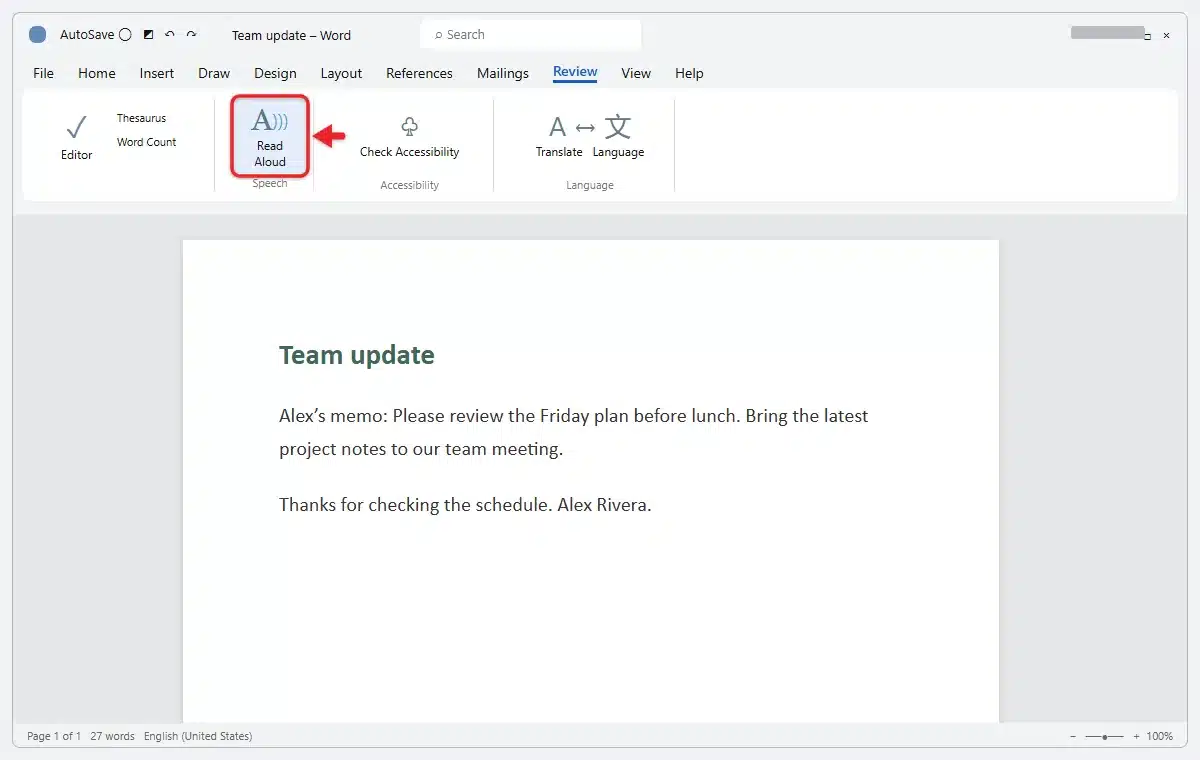
- Select Read Aloud. A small control bar appears near the top right of the document, and Word begins reading. Each word is highlighted as it’s spoken, and the page scrolls along with the voice.
- Use the control bar while it reads:
- Play/Pause stops and resumes at the same word.
- Previous and Next jump back or forward one paragraph.
- Settings (a gear, or More (…) in newer builds) opens the reading speed slider and Voice Selection.
- X stops reading and closes the bar.
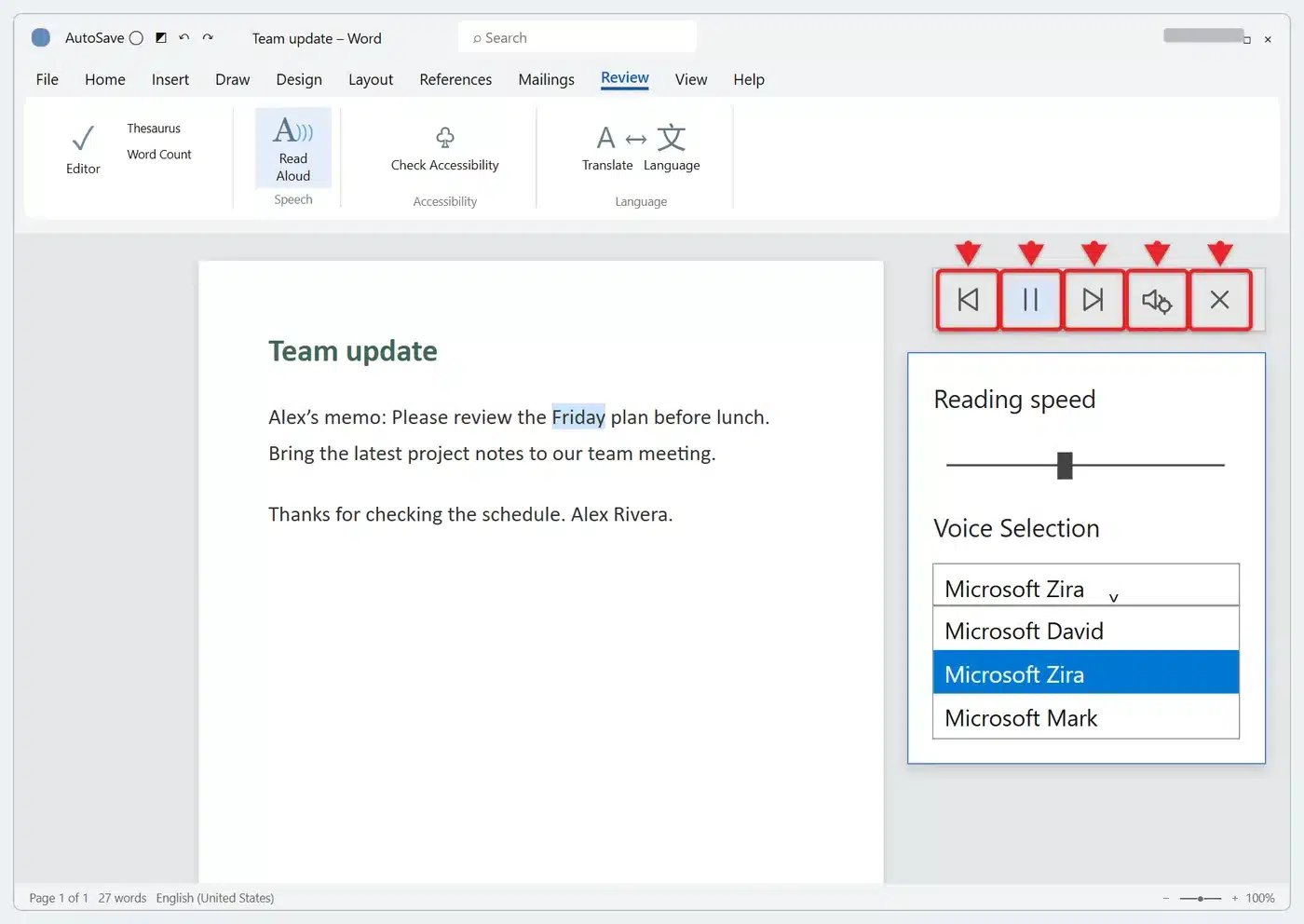
You’ll know it’s working when the highlight moves through the text in step with the voice. If the highlight moves but you hear nothing, jump to troubleshooting.
Tip for proofreading: follow the highlight with your eyes while you listen. Missing words, doubled words (“the the”) and clumsy sentences are much easier to hear than to see. Drop the speed a notch for dense material, and pause as soon as something sounds wrong so you can fix it on the spot.
Keyboard shortcuts (Word for Windows)
| Action | Shortcut |
|---|---|
| Start Read Aloud | Ctrl + Alt + Space |
| Play or pause | Ctrl + Space |
| Go to the start of the current paragraph | Ctrl + Left Arrow |
| Go to the start of the previous paragraph | Ctrl + Left Arrow twice |
| Skip to the next paragraph | Ctrl + Right Arrow |
| Slow down | Alt + Left Arrow |
| Speed up | Alt + Right Arrow |
These shortcuts work for Read Aloud out of the box; you don’t need to add anything to the toolbar first. Microsoft doesn’t publish an equivalent list for Word for Mac, so on a Mac use the Review tab button.
Use Immersive Reader for a distraction-free view
Immersive Reader opens the document full screen with reading aids, and it has Read Aloud built in. It’s the main way to have a document read in Word for the web.
- Select View > Immersive Reader.
- In the desktop app, adjust Column Width, Page Color, Line Focus, Text Spacing or Syllables if they help, then select Read Aloud.
- In Word for the web, select the Play button at the bottom of the screen, or select a word to start reading from there. The gear icon (Voice settings) changes the speed and voice.
- To leave, select Close Immersive Reader on the desktop app, or the back arrow (or Esc) in Word for the web.
Microsoft’s Immersive Reader guide lists every option. One limit worth knowing: Immersive Reader isn’t available for protected documents in Word for the web.
Read Aloud on iPhone, iPad and Android
The Word mobile apps can read documents too, and they need an internet connection to do it. Open the document in the Word app, then:
- Android tablet: tap the Review tab, then Read Aloud.
- iPad: tap the Read Aloud icon.
- Phone: the command is tucked into the app’s menus, and its position has moved between app versions. Look on the Review tab or in the More (three dots) menu.
The on-screen controls let you pause, change the speed and switch voices. If reading stops when the screen turns off, set a longer auto-lock time on the phone and start Read Aloud again.
Use Speak to hear just the selected text (Windows)
Speak is an older, simpler command that reads only what you’ve selected, then stops. It has no control bar or voice choice, but it’s the option to use in Word 2016 and earlier, and it also works in Outlook, PowerPoint and OneNote. Add it once to the Quick Access Toolbar:
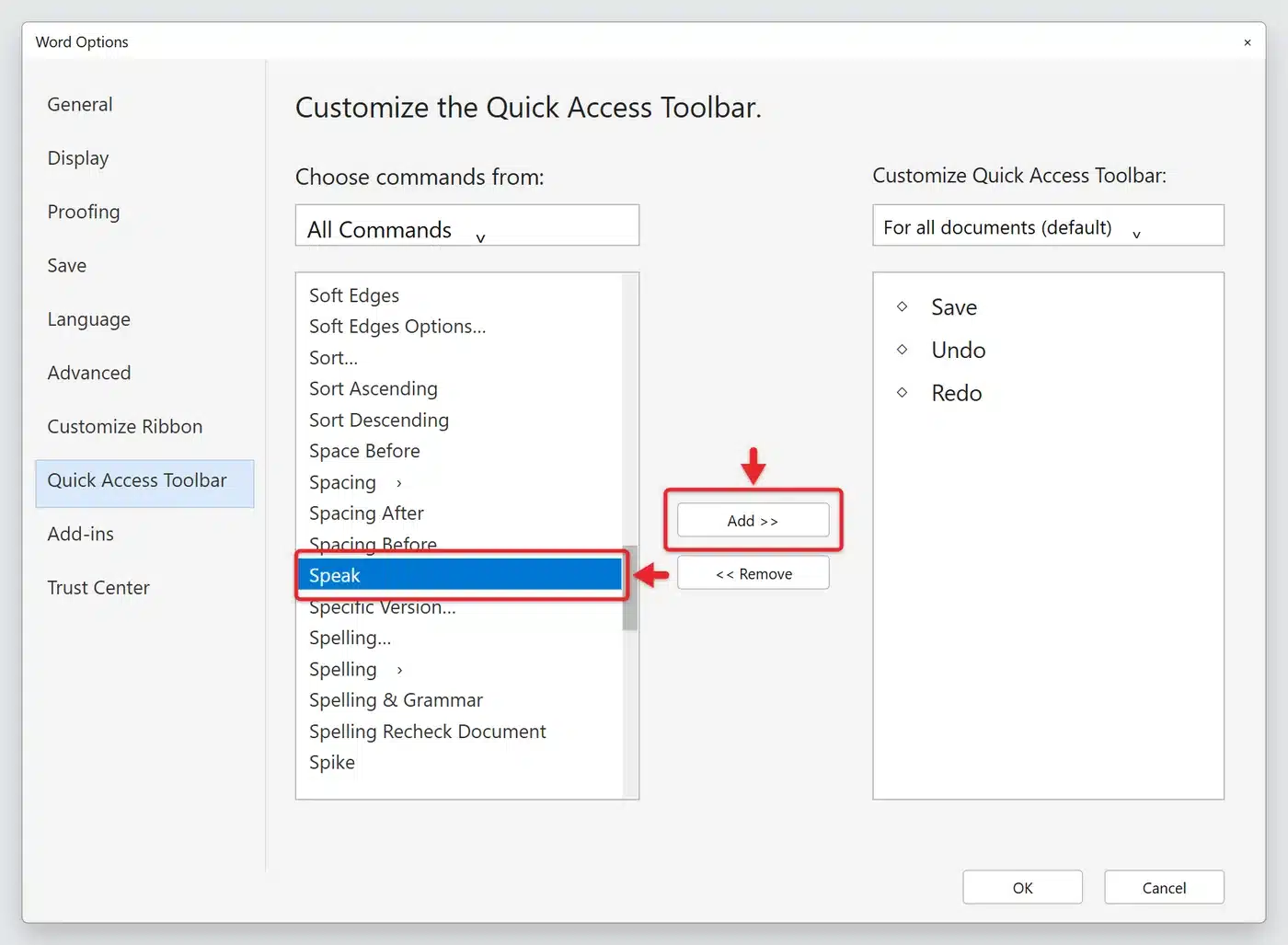
- Select the small arrow at the end of the Quick Access Toolbar and choose More Commands. (You can also go to File > Options > Quick Access Toolbar.)
- In Choose commands from, select All Commands.
- Scroll to Speak, select it, then select Add and OK.
- Select some text and click the new Speak button. To stop before the end, click it again.
The steps match Microsoft’s Speak instructions. If your Quick Access Toolbar is hidden, right-click the ribbon and choose Show Quick Access Toolbar.
On a Mac, Speak isn’t available, but macOS can read any selected text in any app. Open System Settings > Accessibility > Read & Speak, turn on Speak selection, then select text in Word and press Option + Esc (the default key, per Apple’s guide).
Which reading tool should you use?
- Read Aloud: proofreading or listening to a whole document with full controls.
- Immersive Reader: when you want fewer distractions, line focus or wider spacing, and in Word for the web.
- Speak: a quick listen to one sentence or paragraph, or when you’re on Word 2016 or earlier.
- Narrator: when you need everything on screen read, including menus and buttons. See how to turn on Narrator text-to-speech in Windows.
With a Microsoft 365 Copilot license, Word also offers an interactive version of Read Aloud. It reads like the regular one, but you can select Unmute and ask Copilot a question about the document out loud, then select Play or say “Return to reading” to carry on.
Troubleshooting
The Read Aloud button is missing
Check your version under File > Account. Word 2016 and older don’t include Read Aloud, so use Speak instead. On Microsoft 365, install the latest updates from Account > Update Options > Update Now. If you’ve customized the ribbon, the button may have been removed: right-click the ribbon, choose Customize the Ribbon, and select Reset for the Review tab.
Words are highlighted but there’s no sound
Turn up the volume and check the output device. In Windows, open the Volume mixer and make sure Word isn’t muted or set to a different device. The guide to fixing no sound in Windows 11 walks through each setting.
The natural voices are missing or reading won’t start
Check your internet connection and confirm you’re signed in to Word with your Microsoft 365 account. Microsoft’s own fix is to restart Word, or sign out and sign back in. To get more offline voices on Windows, add a voice under Settings > Time & language > Speech.
It reads with the wrong accent or language
Select the text, then go to Review > Language > Set Proofing Language and choose the right one. The same setting controls spell check, as explained in changing Word’s spell check to UK English.
It mispronounces names or technical terms
Text-to-speech guesses at unusual words, and Word doesn’t document a way to correct its pronunciation. For a document you’ll listen to often, a phonetic spelling in a copy of the file is a practical workaround.
Frequently asked questions
Can I save the Read Aloud audio as an MP3?
No. Word has no option to export or save Read Aloud audio, so you’d need separate text-to-speech software to create an audio file.
Can Word read a PDF aloud?
Yes, after conversion. In Word select File > Open, choose the PDF and select OK when Word says it will convert it to an editable document. Then use Review > Read Aloud. Complex layouts may shift, but the text reads normally. Scanned PDFs that are only pictures of text won’t convert to readable words. On a Mac, Word does this through an online conversion service, and our guide to converting a PDF to Word on a Mac covers it along with free options.
Does Read Aloud cost extra?
No. It’s included in Word for Microsoft 365, Word 2021 and Word 2019, and Immersive Reader in Word for the web works with a free Microsoft account. Only the interactive Copilot version needs an extra license.
Is there a way to type by voice instead?
That’s dictation, the reverse of Read Aloud. Here’s how to dictate in Word with the Dictate button or Windows voice typing.
Next time you finish a draft, try one listening pass with Read Aloud at slightly below normal speed before you send it. It’s a quick way to catch the mistakes your eyes skip over.

Matt Jacobs has been working as an IT consultant for small businesses since receiving his Master’s degree in 2003. While he still does some consulting work, his primary focus now is on creating technology support content for SupportYourTech.com.
His work can be found on many websites and focuses on topics such as Microsoft Office, Apple devices, Android devices, Photoshop, and more.