To insert a digital signature in Word, save your document, then go to Insert > Signature Line > Microsoft Office Signature Line, fill in the signer’s details and select OK. Right-click the new line, choose Sign, type your name (or pick a picture of your handwriting), confirm the certificate and select Sign. If you don’t need anything visible on the page, use File > Info > Protect Document > Add a Digital Signature instead. Either way, you need a digital ID (a signing certificate) installed on your PC.
Applies to: desktop Word on Windows: Word for Microsoft 365, Word 2024, Word 2021, Word 2019 and Word 2016, on Windows 11 and Windows 10. These are the versions listed on Microsoft’s page on adding or removing a digital signature, which labels every signing task “desktop.” Word for Mac, Word for the web and the phone apps aren’t covered there; see what to do on a Mac, in a browser or on a phone.
What a digital signature does (and what it doesn’t)
A digital signature is an encrypted stamp that Word attaches to the file using your certificate. It proves two things: who signed, and that the content hasn’t changed since. If anyone edits the signed text, Word flags the signature as invalid. Signing also makes the document read-only, so readers can’t change it by accident.
That’s different from the other things people call a “signature” in Word:
- A picture or drawing of your signature looks like a real signature but proves nothing. Anyone can copy it, and it doesn’t protect the text. That method is covered in electronically signing a Word document.
- An empty signature line is just a placeholder with an X. It becomes a digital signature only when someone signs it with a certificate. Every option in the setup box, plus plain lines for printed forms, is explained in how to insert a signature line in Word.
- Mark as Final only tells readers the document is finished. Anyone can turn it off, and it doesn’t record who approved the file.
A quick rule: if someone just wants a form signed and returned, a picture signature is usually fine. Use a certificate-based digital signature when the reader must be able to check who signed and that nothing changed afterward, for example an approved contract draft, a policy sign-off or an internal approval your organization audits.
Before you start
- Finish editing first. The signature covers the document exactly as it is when you sign. Any later change breaks it. Keep an unsigned copy (for example, Budget-2027-draft.docx) if you expect revisions.
- Save as .docx. If the title bar says Compatibility Mode, the file is in the older .doc format. Convert it first, as shown in getting out of Compatibility Mode in Word.
- Get out of Protected View. Files from email or the internet often open with a yellow bar and editing turned off. Select Enable Editing if you trust the source; enabling editing in Word covers the other read-only bars.
- Have a current digital ID. Microsoft’s rule is simple: you need a certificate that hasn’t expired. The next section shows where to get one.
Get a digital ID (certificate)
A digital ID, also called a digital certificate, is a file stored in your Windows certificate store or on a smart card. Word looks for it when you sign. Pick the source that matches who needs to trust your signature.
Option A: from your organization
Many employers, schools and government agencies issue signing certificates to staff, sometimes on an ID card. Ask your IT team before buying anything, because your organization may require a specific certificate.
Option B: from a certificate authority
If people outside your organization must verify your signature, Microsoft recommends a certificate from a reputable third-party certificate authority (CA). The CA checks your identity, much like a notary, and other computers trust its certificates automatically. Microsoft keeps a short list of providers on its digital ID services page, and Word also offers a link to providers if you try to sign without a certificate. Signing certificates usually last about a year and then need renewing.
Option C: a self-signed certificate for testing
Office includes a small tool called SelfCert that makes a certificate only your own PC trusts. It’s useful for practice or for signing files you keep yourself. Steps from Microsoft’s digital certificate page:
- Open File Explorer and go to C:\Program Files\Microsoft Office\root\Office16. If you have 32-bit Microsoft 365, look under C:\Program Files (x86)\Microsoft Office\root\ instead.
- Double-click SELFCERT.EXE. The Create Digital Certificate box opens.
- In Your certificate’s name, type a descriptive name, such as Alex Rivera test signature.
- Select OK, then OK again on the success message.
Warning: other people can’t verify a self-signed signature unless they deliberately choose to trust your certificate. On their PC it typically shows a problem instead of a clean valid status. Don’t send a self-signed document to someone who needs real proof of identity.
To check which certificates you already have, press Windows + R, type certmgr.msc and press Enter, then open Personal > Certificates. More detail is in opening Certificate Manager in Windows.
Method 1: Add a visible digital signature with a signature line
Choose this when you want a signature that people can see on the page, in the spot where a printed form would have a line. It works in Word and Excel.
Insert the signature line
- Click where the signature should go, usually at the end of the document.
- On the Insert tab, in the Text group, select the Signature Line arrow and choose Microsoft Office Signature Line. (Microsoft’s page calls this button Add a Signature Line; on a narrow window it may show only as a small pen-and-line icon.) The Signature Setup box opens.
- Fill in Suggested signer (for example, Jordan Lee), Suggested signer’s title and Suggested signer’s e-mail address (such as [email protected]). Add Instructions to the signer if they need to know anything.
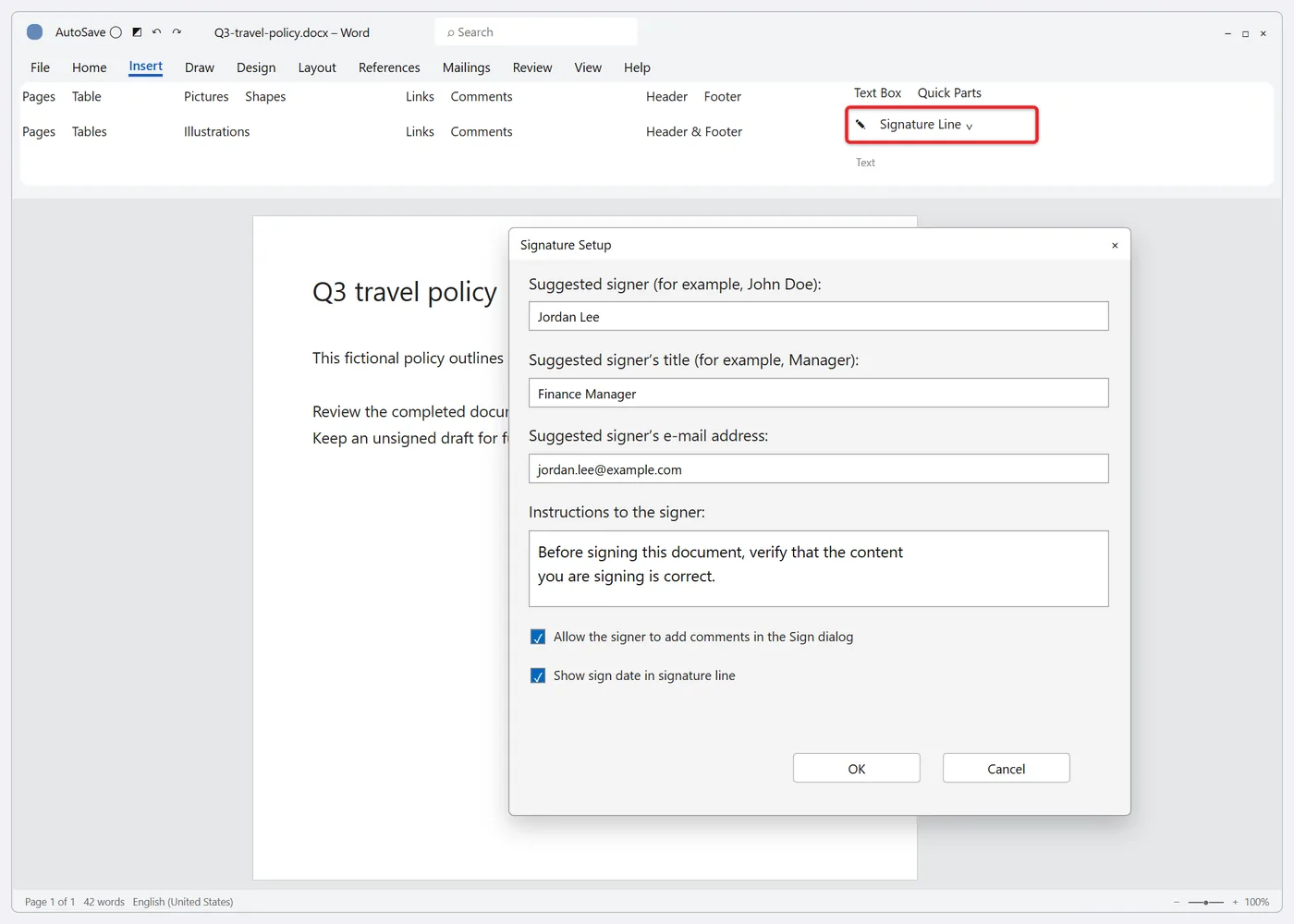
- Tick Allow the signer to add comments in the Sign dialog if you want them to be able to type a reason. Tick Show sign date in signature line to print the signing date under the line.
- Select OK. A signature box with an X and the signer’s name appears. Repeat for each person who must sign. Word doesn’t enforce a signing order, so tell people the order if it matters.
- Save the document. You can now sign it yourself or send it to the signer.
Sign the line
- Open the saved .docx. If a yellow Protected View bar appears, select Enable Editing (Microsoft’s wording is Edit Anyway) only if the file is from a source you trust.
- Right-click the signature line and choose Sign. Double-clicking the line does the same thing. The Sign box opens.
- Add the visible part of the signature: type your name next to the X, choose Select Image to use a saved picture of your handwritten signature, or write with a pen or finger on a touch screen.
- If the signer was allowed to add comments, type a purpose for signing.
- Check the certificate shown under Signing as. If you have more than one, select Change and pick the right one (a work certificate rather than a test one, for example).
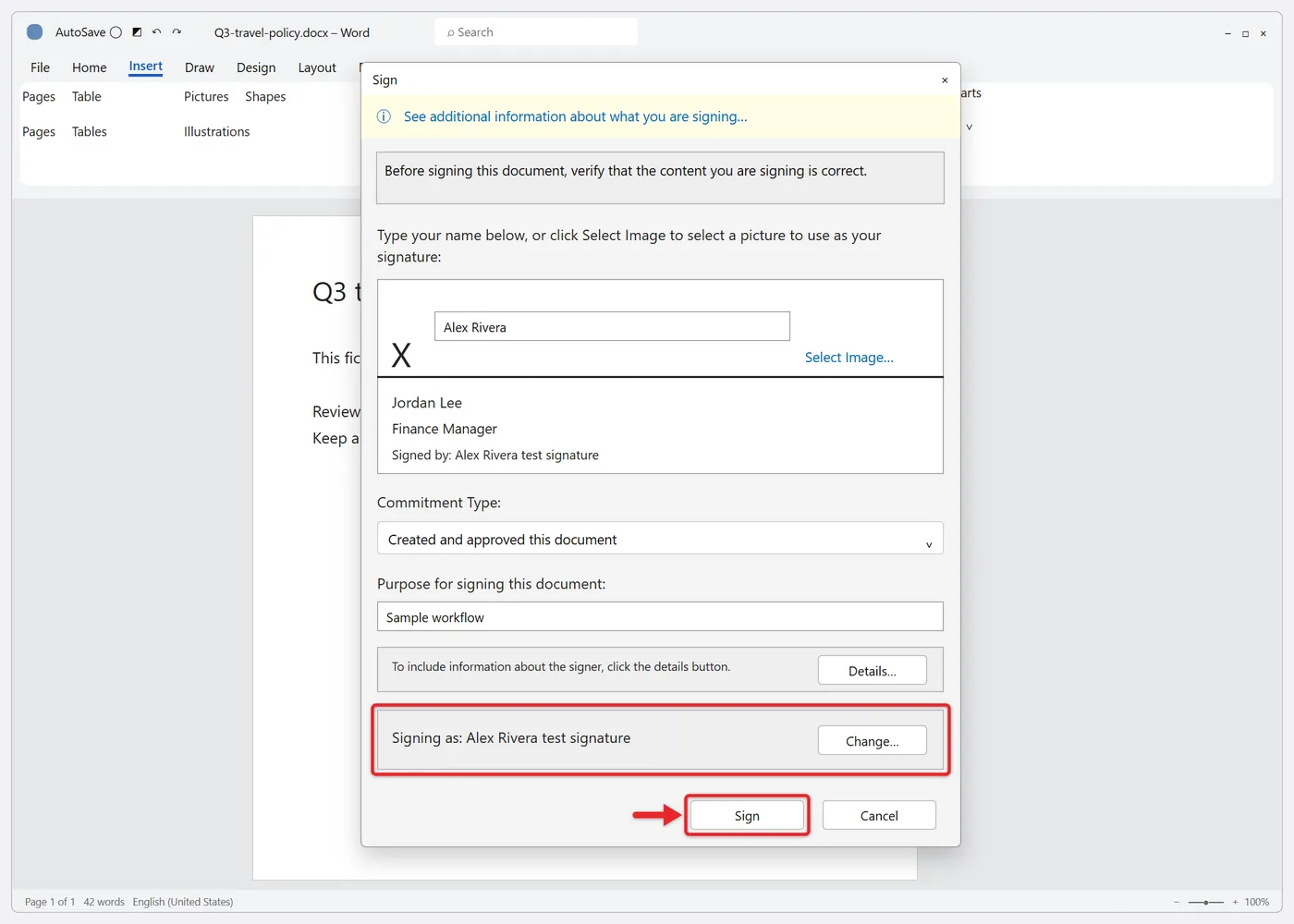
- Select Sign. If Word or Windows asks for a PIN or password, that’s the one for your certificate or smart card, not your Windows sign-in.
What you should see: the line now shows your typed name or image with the signing details, a Signatures button appears in the status bar at the bottom of the window, and the document becomes read-only with a bar saying it has been marked as final. If you see your name but no Signatures button, the digital part didn’t finish. Remove what you typed and sign again.
Method 2: Add an invisible digital signature
An invisible signature adds nothing to the page but gives the same proof: who signed and that the content hasn’t changed. Use it when a visible line would look out of place, or when you’re approving a document rather than signing a form. It also works in PowerPoint, which has no signature lines.
- Finish your edits and save the document.
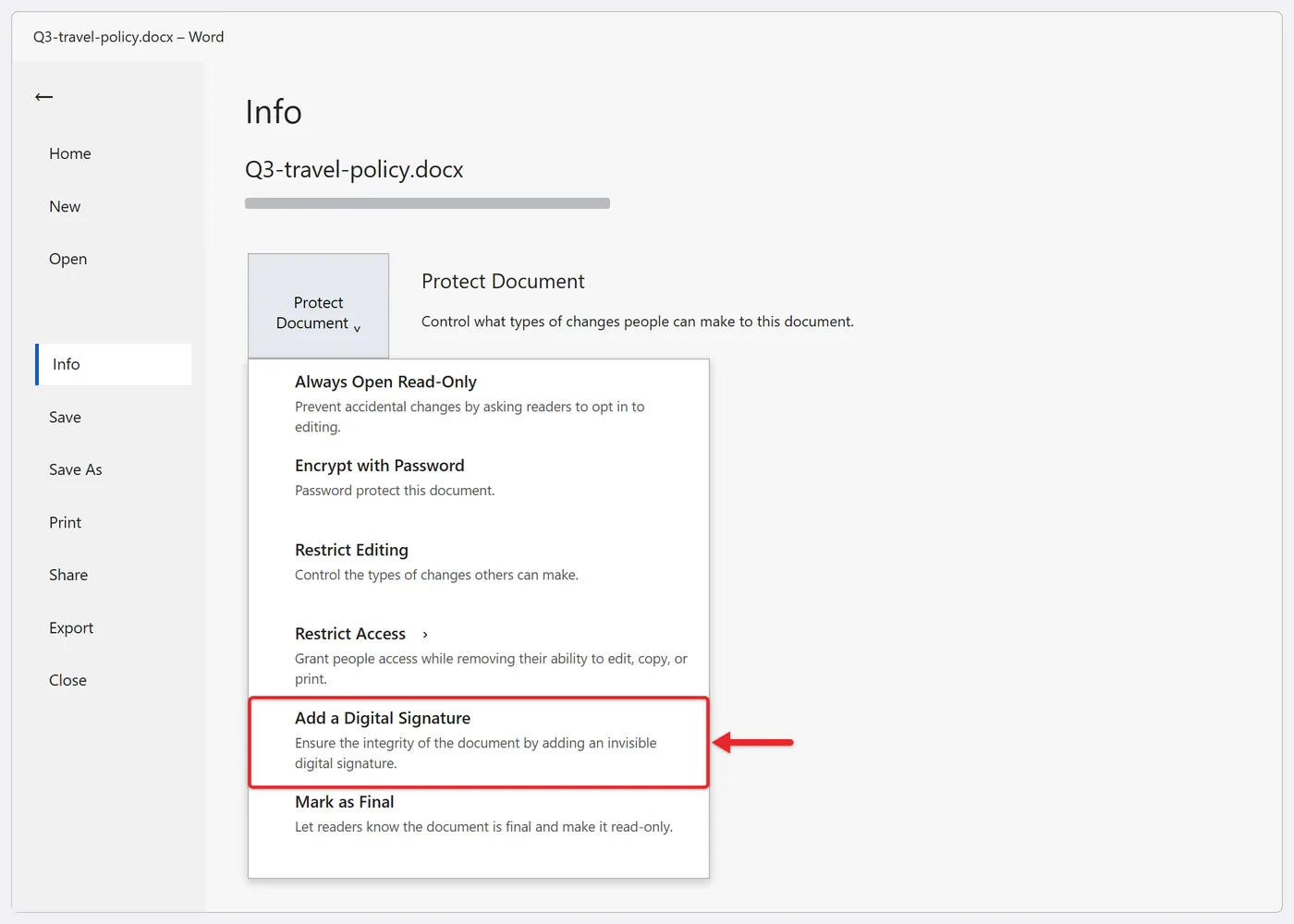
- Select File > Info.
- Select Protect Document and choose Add a Digital Signature. If Word shows an information message first, read it and select OK.
- In the Sign box, choose a Commitment Type that describes your role, and type a Purpose for signing this document if you want one (for example, Approved Q3 travel policy).
- Check the certificate under Signing as, then select Sign.
The Signatures button appears in the status bar, the signature is listed under File > Info, and the document becomes read-only.
Which method should you use?
- Someone else must sign: Method 1. Add the line, save, and send the file; the signer completes the signing on their own PC with their own certificate.
- The reader expects to see a signature: Method 1, because the signed line shows the name or image.
- You’re approving or sealing the file yourself: Method 2 is faster and leaves the layout untouched.
Check that a signature is valid
- Select the Signatures button in the status bar, or go to File > Info > View Signatures. The Signatures pane opens on the right.
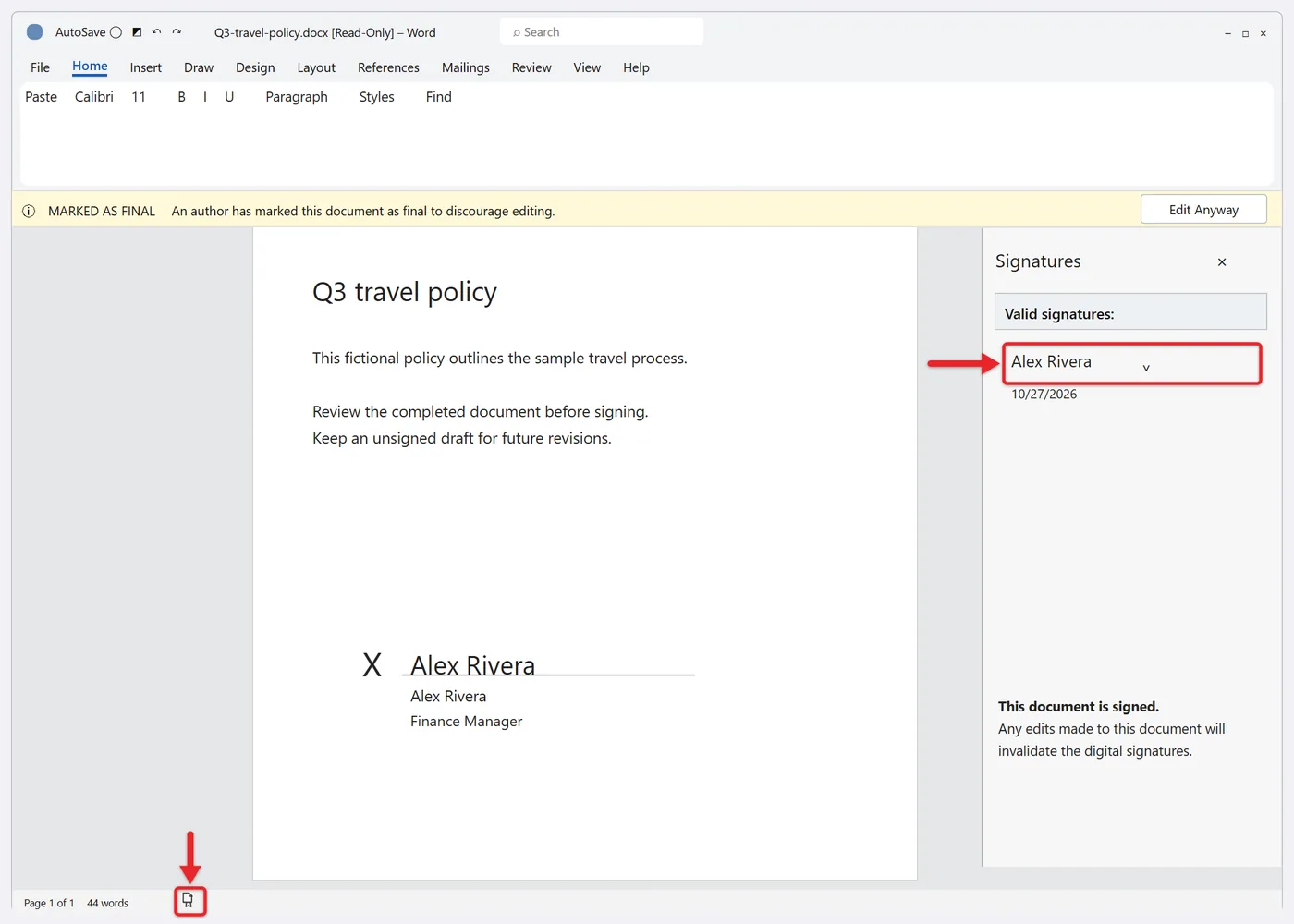
- Select the arrow next to a signer’s name and choose Signature Details.
- Read the status. Select View in the details box to see the certificate itself.
According to Microsoft’s page on viewing signature details, the status means:
- Valid: the certificate is trusted and hasn’t expired or been revoked. Nothing to do.
- Invalid: the certificate was revoked, or the signed content was changed. Don’t trust it; ask the signer for a freshly signed copy.
- Recoverable error: it isn’t valid right now but might be. Common causes are being offline, an expired certificate, or an issuer your PC doesn’t trust (normal for self-signed certificates).
- Partial signature: only part of the file is signed.
A signature that carried a valid time stamp when it was made stays valid even after the certificate later expires.
Remove a digital signature
- Visible signature: right-click the signed line, choose Remove Signature, then select Yes. You can also use the arrow next to the name in the Signatures pane.
- Invisible signature: go to File > Info > View Signatures, select the arrow next to the name, choose Remove Signature and confirm.
- Unsigned signature line: click the line once to select it and press Delete.
Only remove someone else’s signature if they agree, since they’ll have to sign again.
On a Mac, in a browser or on a phone
Microsoft’s step-by-step instructions for certificate-based signing are written for desktop Word on Windows. Its main signing page doesn’t list Word for Mac or Word for the web, and it gives no Mac, browser or phone steps. If you’re not on a Windows PC, you have three practical choices:
- Sign on a Windows PC with desktop Word, then send the signed .docx.
- Use a visible signature only, such as a drawn signature in the Word app. That’s covered in signing a Word doc on iPhone or iPad. Remember it isn’t a digital signature.
- Use your organization’s signing service. Some Microsoft 365 organizations turn on eSignature, which adds Insert > eSignatures fields to subscription desktop Word for documents stored in an enabled SharePoint site. Recipients sign a PDF copy, not the Word file. Requirements are on Microsoft’s eSignature request page; your admin has to enable it.
Troubleshooting
Signature Line or Sign is grayed out
The file is probably a .doc file in Compatibility Mode, open in Protected View, or already signed. Save it as .docx, select Enable Editing, and try again. If you’re in Word for the web or on a Mac, switch to desktop Word on Windows.
Right-clicking the line doesn’t show Sign
The “line” may be underscores or a drawn border, not a real Microsoft Office signature line. Click it once: a real signature line is selected as a single box. If it isn’t, delete it and insert a proper one.
Word says you don’t have a digital ID
No usable certificate is installed for your Windows account, or it has expired. Get one from IT or a certificate authority, or create a SelfCert certificate for testing. Then check it appears under Personal > Certificates in certmgr.msc.
The recipient sees “invalid” or “recoverable error”
If the text was changed after signing, the signature is invalid and needs a new signed copy. If the content is untouched, the recipient’s PC probably doesn’t trust the certificate (always the case with self-signed ones) or the certificate has expired. Sign with a certificate from your organization or a trusted CA, and renew expired certificates before signing again.
You need to change a signed document
Signed documents are read-only. Editing one removes or invalidates the signatures, so everyone would have to sign again. It’s cleaner to edit your unsigned copy, or remove the signatures yourself, make the change, save, and ask for new signatures. If you only want to stop casual changes without signing, see how to lock a Word document from editing.
Frequently asked questions
Is a digital signature in Word legally binding?
It can be, but that depends on where you are, the type of document and what the other party accepts. Some contracts need a particular kind of certificate or a specific signing service. Ask the person or organization requesting the signature which method and file format they’ll accept before you sign.
Does a digital signature survive if I save the file as a PDF?
Don’t count on it. The Word signature belongs to the .docx file, and Microsoft doesn’t document it carrying over to a PDF you save from it, so treat the PDF as unsigned. If the recipient needs a signed PDF, sign the PDF itself with a PDF signing tool; the process with a smart card is shown in digitally signing a PDF with a CAC card.
Can I use the same certificate on another computer?
Yes, if the certificate was issued with an exportable private key. Export it from Certificate Manager on the first PC as a password-protected .pfx file, then import it on the second. Smart card certificates move with the card instead.
Why does my signature show a warning only on other people’s computers?
Your PC trusts your own certificate, but theirs doesn’t unless the issuer is trusted there. That’s the expected behavior for SelfCert certificates and for some company certificates opened outside the company network.
Once you have a certificate installed, try Method 2 on a test copy first: sign it, open View Signatures, and confirm the status says valid before you sign the real document.

Matt Jacobs has been working as an IT consultant for small businesses since receiving his Master’s degree in 2003. While he still does some consulting work, his primary focus now is on creating technology support content for SupportYourTech.com.
His work can be found on many websites and focuses on topics such as Microsoft Office, Apple devices, Android devices, Photoshop, and more.