Last updated on November 10th, 2026 at 10:04 am
Word’s built-in signature line lives under Insert > Signature Line (in the Text group) > Microsoft Office Signature Line: click where it goes, type the signer’s name and title, and select OK. That button is in Word 2016 and later on Windows, as Microsoft’s guide to digital signatures in Office files shows. For a line signed with a pen, or in Word for Mac or the web, use an underlined tab or a table border.
Which kind of signature line do you need?
“Signature line” can mean two different things in Word: a special object that can hold a digital signature, or an ordinary line on the page. Pick the one that matches how the document will be signed.
| Microsoft Office Signature Line | Underlined tab line | Table border line | |
|---|---|---|---|
| Where you can create it | Word desktop app on Windows only | Windows, Mac and the web | Windows, Mac and the web |
| What it looks like | A line with an X, plus the signer’s name, title and optional date | A plain line after a label such as “Signature:” | A plain line that stays the same length; easy to place side by side |
| Best for | Documents signed in Word with a digital certificate | Letters and forms that are printed and signed by hand | Contracts with two or three signers, and forms people fill in on screen |
| Can be digitally signed | Yes | No (visual only) | No (visual only) |
A quick rule: if the signer has Word on Windows and you want proof the document wasn’t changed after signing, use Method 1. For everything else, a plain line is simpler and looks the same on every device.
Method 1: Insert a Microsoft Office Signature Line (Windows)
Before you start, save the file as a Word document (.docx). If the title bar shows Compatibility Mode or a yellow Protected View bar is showing, sort that out first (see Troubleshooting), because the command can be unavailable in those states.
- Click in the document where the signature should go, usually below the closing text or an approval statement. Press Enter first if you want some space above it.
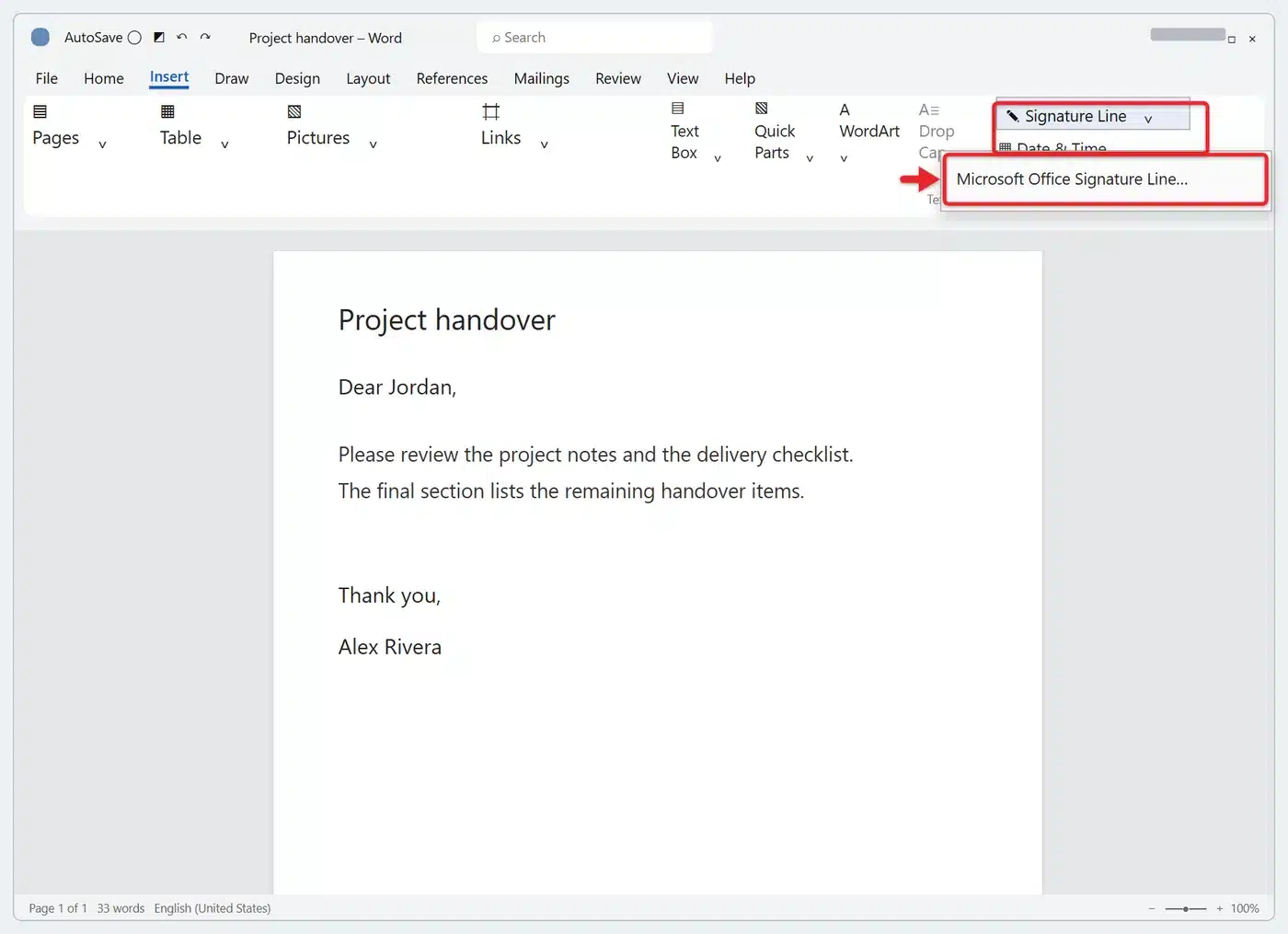
- Select the Insert tab. In the Text group near the right end of the ribbon, select the arrow next to Signature Line and choose Microsoft Office Signature Line. (In some versions the button is called Add a Signature Line.) The Signature Setup box opens.
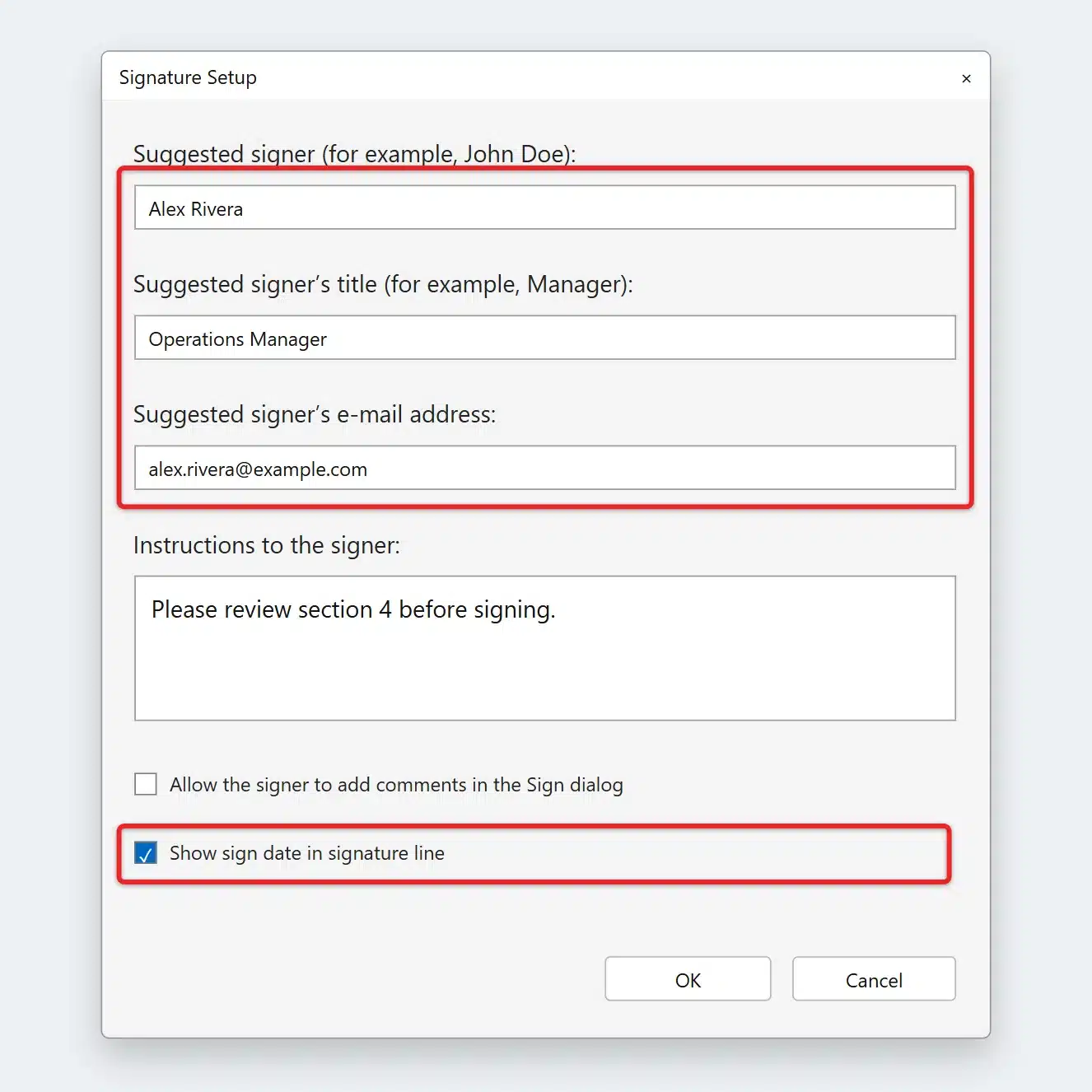
- Fill in the details that should print under the line. For example:
- Suggested signer: Alex Rivera
- Suggested signer’s title: Operations Manager
- Suggested signer’s e-mail address: [email protected]
- Choose the extra options you want:
- Instructions to the signer: text the signer sees when they sign, such as “Please review section 4 before signing.”
- Allow the signer to add comments in the Sign dialog: lets the signer type a purpose or note.
- Show sign date in signature line: adds the date automatically at the moment the person signs.
- Select OK. A box appears with an X at the left, a line, and the name and title underneath. It behaves like a picture, so you can drag a corner to resize it or use Home > Center to center it.
Add lines for more signers
Repeat the steps for each person, or select the first line, press Ctrl + C, click where the next one goes and press Ctrl + V. Then right-click the copy, choose Signature Setup, and change the name and title (for example, Jordan Lee, Finance Director).
To put two Office signature lines next to each other, insert a borderless table with two columns first (see Method 3) and add one signature line in each cell.
Change or delete an unsigned line
Right-click the line and choose Signature Setup to edit the details. To delete it, click the line once so it’s selected and press Delete. Once someone has signed it, the line is locked; see Check your work and undo.
Does a signature line make a document legally binding?
No. A line only shows where to sign. What counts as a valid signature depends on the type of document, the method used to sign and the laws where you are. If the other party has a required signing method, ask them before you prepare the document.
Can I save a signature block to reuse in other documents?
Yes. Build the line, name and title once, select all of it, then choose Insert > Quick Parts > Save Selection to Quick Part Gallery, give it a name and set Gallery to AutoText. Next time, insert it from Insert > Quick Parts > AutoText. Saved AutoText entries belong to the desktop app on that computer.
How do I stop people changing the rest of the document before they sign?
On the Review tab, select Restrict Editing, check Allow only this type of editing in the document, choose No changes (Read only), then select the signature area and check Everyone under Exceptions. Select Yes, Start Enforcing Protection and set a password. This blocks casual edits but isn’t encryption; to stop people opening the file at all, see how to password protect a Word doc.
Method 2: Underlined tab line (Windows, Mac and web)
This is the fastest way to make a line for a printed letter or form, and it’s the method Microsoft suggests for documents that will be signed on paper.
- Type a label such as Signature: and a space.
- Turn on underline with Ctrl + U (Windows and web) or Command + U (Mac).
- Press Tab two to four times. Each press adds about half an inch of line.
- Press Ctrl + U (or Command + U) again to turn underline off.
- Press Enter and type the signer’s printed name and title on the next line, for example “Priya Shah, Office Manager.”
Avoid typing rows of underscores or spaces. They change length when the font or size changes, and they can break across lines. Tabs keep a steadier length.
Make every line end at the same spot (desktop app)
If you have several lines, such as Signature, Printed name and Date, a right tab stop with a line “leader” makes them all end exactly at the same position.
- Select the lines (or click in an empty line where you’ll type them).
- On Windows, select Home, then the small launcher arrow in the corner of the Paragraph group, then Tabs at the bottom of the box. On a Mac, choose Format > Tabs.
- Under Tab stop position, type a position such as 4″, choose Right under Alignment, and pick the solid line option (4 ____ on Windows) under Leader.
- Select Set, then OK.
- Type your label, such as Signature:, and press Tab once. A line fills the space up to the tab stop.
Method 3: Table border line (best for side-by-side and on-screen forms)
A table cell with only its bottom border showing makes a line that doesn’t move or split when someone types on it. It’s also the neatest way to put two or three signature blocks across the page.
One line with a label
- Select Insert > Table and choose a 2×1 table (two cells across, one row).
- Type Signature: in the left cell. Drag the border between the cells so the left cell is just wide enough for the label.
- Select the whole table (click the small square handle at its top-left corner). On the Table Design tab, select the arrow under Borders and choose No Border.
- Click in the right cell only, open Borders again and choose Bottom Border. The line appears under that cell.
If you still see faint dotted lines around the cells after removing borders, those are gridlines that don’t print. Turn them off with Table Layout (called Layout in some versions) > View Gridlines.
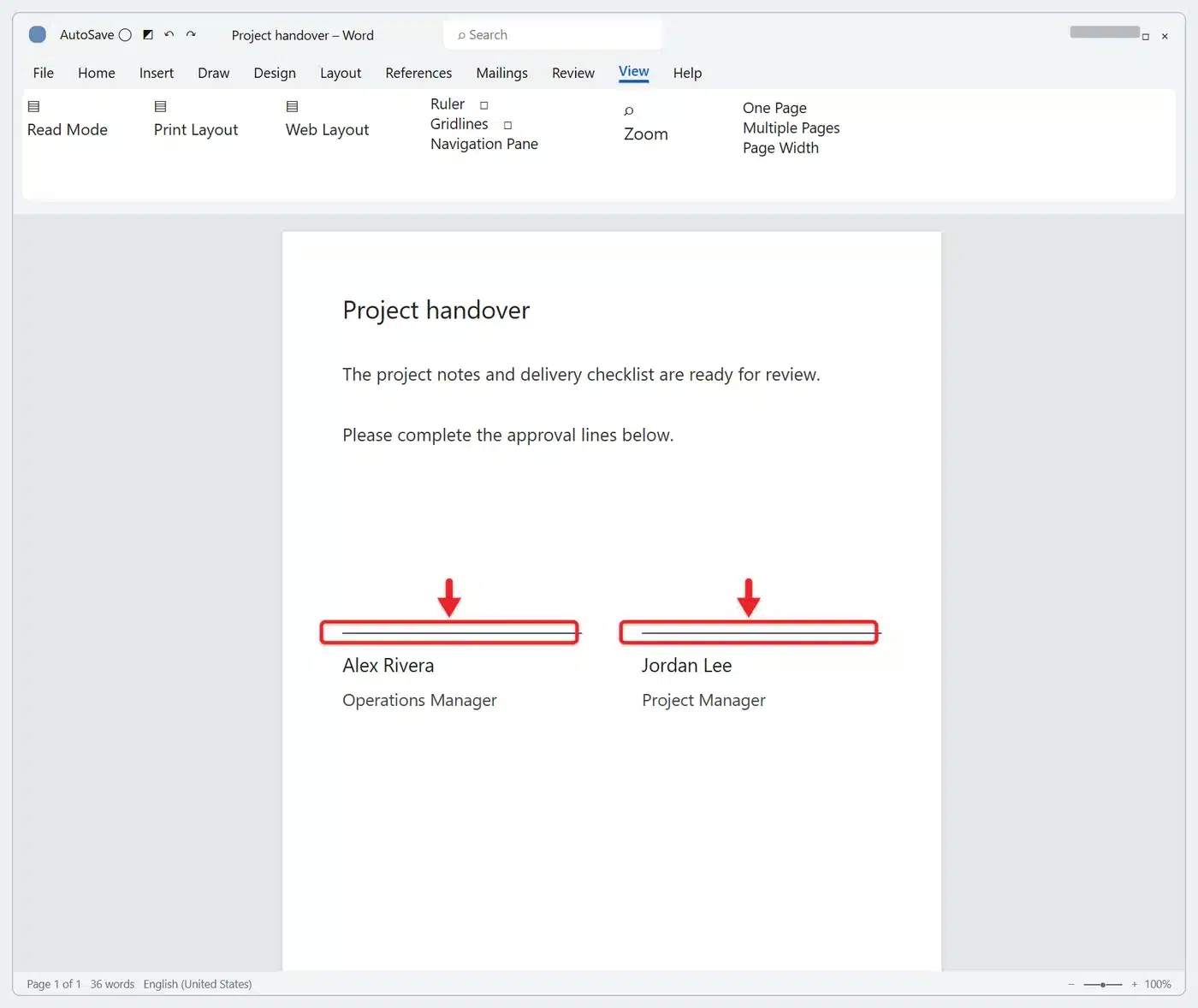
Two signers side by side
- Insert a table with 3 columns and 3 rows. The middle column is just a gap.
- Leave row 1 empty as signing space, type the names in row 2 (Alex Rivera on the left, Jordan Lee on the right) and titles or a date in row 3.
- Remove all borders as in step 3 above, then select only the left and right cells of row 1 and apply Bottom Border.
- Make the middle column narrow by dragging its borders, and drag the bottom edge of row 1 down to leave about half an inch of room to sign.
For three signers, use five columns (three for signers, two narrow gaps).
Add a date line
For a plain line, add a second label such as Date: on the same row using another tab, or give it its own table cell with a bottom border. If you’d rather print the date in advance, select Insert > Date & Time and leave Update automatically unchecked so it doesn’t change every time the file opens. With the Office Signature Line in Method 1, check Show sign date in signature line and Word fills in the date when the person signs.
How the line gets signed
The line itself is only a placeholder. Here’s how each kind is usually completed:
- Printed and signed by pen: works with every method. Print the page, sign, then scan it if you need to send it back.
- Office Signature Line with a digital certificate (Windows): the signer right-clicks the line, chooses Sign, and either types a name next to the X, selects Select Image to use a picture of their handwritten signature, or writes with a pen on a touch screen. If they have more than one certificate, they can select Change to pick a different one, then select Sign. This needs a digital ID (certificate); getting one is covered in our guide on how to insert a digital signature in Word.
- Drawn or pasted signature on a plain line: on the Draw tab, pick a pen and write over the line with a mouse, pen or finger, or insert a picture of your signature with Insert > Pictures. Microsoft’s steps to write or draw your signature cover Word on Windows, Mac and the web. The full set of options, including saving a signature to reuse, is in how to electronically sign a Word document.
- On a phone or tablet: open the file in the Word app and use the Draw tools, as shown in signing a Word doc on iPhone or iPad.
Warning: make every edit before anyone signs a Microsoft Office Signature Line. According to Microsoft, a digitally signed document becomes read-only, and changing it afterward means removing the signature and signing again. Keep an unsigned copy if you might need to revise the text.
There’s no Signature Line button
Word for Mac and Word for the web don’t have the Signature Line command, even though some Microsoft pages list them. Use Method 2 or 3. If someone sends you a document that already contains an Office signature line, Microsoft notes that Word for the web shows it as a placeholder you can’t edit, move or resize; open it in the Word desktop app on Windows to sign it.
Signature Line is grayed out
Check the title bar and the top of the document. If it says Compatibility Mode, select File > Info > Convert, or save a copy as a .docx file. If a Protected View bar is showing, select Enable Editing once you trust the file; our guide to enabling editing in Word covers read-only and other locks. Also make sure the cursor is in the main text, not in a header, footer or text box.
I want the line without the X
Signature Setup has no option to hide the X. Use a tab line or table border line instead; they look like a classic signature line with nothing in front of it.
The signer can’t find the Sign option
The Sign command only appears on a real Microsoft Office Signature Line in the Windows desktop app. If the line was made with underscores, a tab or a table, there’s nothing to sign digitally; the signer can draw on it, insert a picture, or print it.
The line moves or breaks when someone types on it
Typed underscores and underlined spaces stretch and wrap as text is added. Switch to the table method, where text sits above a fixed border. Our guide to typing on top of a line in Word has more ways to do this.
The table lines are there on screen but don’t print
You’re seeing gridlines, not borders. Select the cell and apply Bottom Border from Table Design > Borders. Check the result in File > Print, which shows only what will actually print.
Check your work and undo
- Preview it: open File > Print to see the lines exactly as they’ll print.
- See the hidden marks: select Home > Show/Hide ¶ to see tab arrows and table cell markers, which helps when a line is the wrong length.
- Undo a mistake: press Ctrl + Z (Windows) or Command + Z (Mac) right after.
- Remove a signature that’s already been added: right-click the signed line, choose Remove Signature, and select Yes. The empty line stays, and the document can be edited again.

Matt Jacobs writes and maintains the guides on Support Your Tech, which he started in 2017. He spent most of his career keeping small-business PCs running and still takes the occasional consulting job, so the steps here come from fixing the same problems on other people’s computers. Every guide is checked on his own Windows 11, Windows 10, Mac, iPhone and iPad before it goes up.