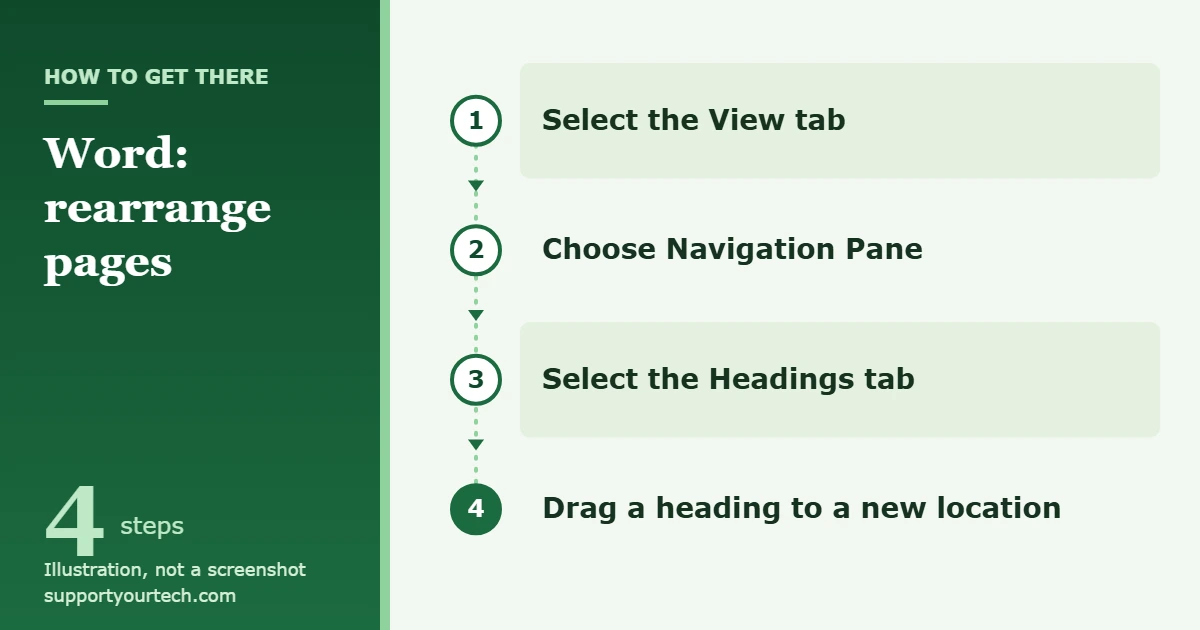
To rearrange pages in Word, open the View tab, choose Navigation Pane, select the Headings tab, and drag a heading to a new location. Word moves that heading and the content under it. If the document has no headings, select the content of the page, cut it with Ctrl+X, click where it should go, and paste it with Ctrl+V.
Applies to: Word for Microsoft 365, Word 2024, Word 2021, Word 2019 and Word 2016 on Windows. Checked against Microsoft Support on October 7, 2026.
Why Word has no “move page” command
Word does not store pages as separate objects the way PowerPoint stores slides. A page is simply wherever the text, pictures, tables and breaks happen to fall, and Word recalculates that every time you edit. So “move page 4 before page 3” really means “move the content that is currently on page 4.” That is why both methods below move content, and why the page boundaries can shift a little afterward.
Pick the method that matches your document:
| Your document | Best method |
|---|---|
| Uses Word’s built-in heading styles (reports, manuals, chapters) | Drag headings in the Navigation pane |
| No headings, or you need to move one exact page | Select the page, then cut and paste |
| Only a paragraph or two needs to move a short distance | Keyboard shortcut for moving paragraphs |
| Long document that you want to reorder from the keyboard | Outline view |
Before you start
- Save a copy first. Use a separate copy of the file for a large reorganization so you can go back to the original order if needed.
- Check whether your headings are real headings. The Navigation pane only lists text formatted with a heading style. Bold or enlarged text that only looks like a heading will not appear. To fix that, select the text and, on the Home tab, choose a heading style such as Heading 1 in the Styles gallery. If you do not see the style you want, select the More button to expand the gallery.
- Know where the breaks are. Turn on the Show/Hide (¶) button, or press Ctrl+Shift+8 (not on the numeric keypad), to display page breaks, section breaks and paragraph marks while you work. Press it again to hide them.
This is the fastest method when each part you want to move starts with a heading.
- Open the document and select the View tab, then choose Navigation Pane. You can also press Ctrl+F. The pane opens beside the document.
- In the Navigation pane, select the Headings tab. You should see a list of every heading in the document, indented by level.
- If the list is long, click the arrow next to a heading to hide its subheadings. This makes it easier to see the main parts.
- Select the heading for the part you want to move and drag it to a new location in the list. When you release it, Word moves the heading and the content that belongs to it, including its subheadings.
- Click the moved heading in the pane to jump to it, then scroll through the pages around it to confirm that everything arrived and that the page breaks still fall where you want them.
A few things to know about this method:
- The Navigation pane does not display headings that are inside tables, text boxes, or headers and footers, so those parts cannot be dragged this way.
- The Pages tab in the same pane shows a thumbnail of each page. Microsoft documents those thumbnails as a way to jump to a page; the documented way to move content is dragging on the Headings tab.
- To change a heading’s level, right-click the heading in the pane and choose the action you want.
Microsoft describes the pane in Use the Navigation pane in Word. For a wider tour of what the pane can do, see our guide on how to use the Navigation pane in Word.
Move a single page with cut and paste
Use this method when the document has no heading styles, or when you want to move exactly one page of content.
- Click anywhere on the page you want to move.
- Press Ctrl+G. In the Enter page number box, type \page.
- Press Enter, and then select Close. The whole page of content should now be highlighted. Check that the highlight starts and ends where you expect.
- Press Ctrl+X to cut the selection. The content disappears and the pages after it move up.
- Click at the exact spot where the content should go, normally the very start of the page that should now follow it.
- Press Ctrl+V to paste. The content appears at the cursor and everything after it moves down.
To move several pages in a row, select them by hand instead: place the cursor at the beginning of the first page, then click and drag to the bottom of the last page, and continue from step 4. Microsoft’s Copy a page in Word article uses the same click-and-drag selection.
If the pasted content should start on its own page, place the cursor in front of it and press Ctrl+Enter to insert a page break. If it picks up unwanted formatting, use Paste Options right after pasting to choose how the formatting is handled.
Nudge paragraphs up or down with the keyboard
For small changes, you do not need the Clipboard at all. Select the paragraphs you want to move and press Alt+Shift+Up arrow to move them up, or Alt+Shift+Down arrow to move them down. Each press moves the selection past one paragraph. In Word for Mac, Microsoft lists Control+Shift+Up arrow and Control+Shift+Down arrow for the same job.
This is handy for swapping two short sections or moving a paragraph across a page boundary, but it is slow for moving a full page a long way.
Reorder a long document in Outline view
Outline view reduces the document to its headings so you can reorder large parts from the keyboard. Like the Navigation pane, it depends on heading styles.
- Press Ctrl+Alt+O to switch to Outline view.
- Press Alt+Shift+1 to show only the headings that use the Heading 1 style. To show more levels, press Alt+Shift plus the heading level number, such as Alt+Shift+2.
- Click in the heading for the part you want to move. While its text is collapsed, the heading and the text under it move together.
- Press Alt+Shift+Up arrow or Alt+Shift+Down arrow until the heading sits where you want it.
- Press Alt+Shift+A to expand all the text again and check the result.
- Press Ctrl+Alt+P to return to Print Layout view and review the pages.
These shortcuts come from Microsoft’s Keyboard shortcuts in Word reference, which lists the full set for outlining.
Check the document after moving pages
Moving content changes more than the order. Work through these checks before you save or print:
- Page breaks. With formatting marks turned on, look for a page break left behind at the old location (it shows up as an empty page) or missing at the new one. Delete the stray break, or add one with Ctrl+Enter. Our guide on how to get rid of a page break in Word covers stubborn ones.
- Section breaks. A section break controls layout for its section, including page orientation, headers and footers, page numbering, columns and page borders. If you move content without its section break, or delete a section break while tidying up, that formatting can change. Microsoft notes that when a section break is deleted, the combined section takes on the formatting of the section that followed the break.
- Page numbers. Page number fields renumber as the document repaginates, so you normally do not have to fix them by hand. Check any section where numbering was set to restart.
- Table of contents. An automatic table of contents does not refresh on its own. On the References tab, select Update Table, choose Update entire table, and select OK. Microsoft explains the two options in Update a table of contents. A table of contents that was typed manually cannot be updated by Word and has to be edited by hand.
- Cross-references in the text. Phrases you typed yourself, such as “see the previous page” or “as shown above”, will not adjust. Read the moved content once in its new position.
Undo a move
Press Ctrl+Z right away to undo the previous action. Press it again to step back further. A drag in the Navigation pane is one action; a cut and paste is two, so press Ctrl+Z twice to put cut-and-pasted content back. If you have already made many other edits, it is usually easier to reopen the copy you saved before you started.
Troubleshooting
The Headings tab is empty
The document has no text formatted with heading styles. Apply a heading style from the Styles gallery on the Home tab to the first line of each part you want to move, and the headings appear in the pane immediately. If the document has no natural headings, you can add a temporary one at the top of each page, drag the parts into order, and then delete the temporary headings. Otherwise, use the cut-and-paste method.
A heading is missing from the Navigation pane
Headings inside tables, text boxes, headers or footers are not displayed there. Move that content with cut and paste instead.
Word will not let you drop a heading where you want it
Microsoft notes that if a document contains protected regions, you might be unable to drag a section beyond the last protected region. If the file comes from work or school and editing is restricted, ask the document owner to lift the restriction or to make the change for you.
More content moved than you expected
Dragging a heading moves everything up to the next heading of the same or a higher level, so dragging a Heading 1 also carries all of the Heading 2 and Heading 3 parts beneath it. Press Ctrl+Z, then drag the lower-level heading on its own.
The \page selection is not exactly one page
The selection follows where the page currently breaks, which can fall in the middle of a paragraph or table. After the selection appears, hold Shift and use the arrow keys to extend or shrink it before you cut.
The layout changed after pasting
The moved content probably crossed a section break, or a break was left behind. Turn on formatting marks with Ctrl+Shift+8, find the section breaks near the old and new locations, and compare them with your saved copy.
Frequently asked questions
Can I drag a page to a new position in Word?
Not as a page. Word has no command that picks up a page and drops it elsewhere. You drag a heading in the Navigation pane, which moves that heading’s content, or you cut and paste the content of the page.
How do I swap two pages?
Move one of them. Select the content of the second page with Ctrl+G and \page, cut it, click at the start of the first page, and paste. The two pages are now in the opposite order.
How do I move a page without headings?
Use the cut-and-paste method above. Alternatively, apply a heading style to the first line of each page so that the parts appear in the Navigation pane, then drag them.
Will page numbers update after I rearrange pages?
Page numbers inserted with Word’s page number feature update as the content moves. A table of contents needs References > Update Table, and any page numbers you typed by hand must be corrected manually.
How do I copy a page instead of moving it?
Select the page the same way, but press Ctrl+C instead of Ctrl+X. Then click where the copy should go and press Ctrl+V. To put the copy in a different file, see how to copy a page from one Word document to another.
Can I move a page to a different document?
Yes. Cut or copy the page’s content, open the other document, click where it should go, and paste. Use Paste Options to decide whether it keeps its original formatting.
Once the order looks right, update the table of contents if the document has one and save the file. If you reorganize documents often, applying heading styles as you write will make the Navigation pane method available every time.

Matt Jacobs has been working as an IT consultant for small businesses since receiving his Master’s degree in 2003. While he still does some consulting work, his primary focus now is on creating technology support content for SupportYourTech.com.
His work can be found on many websites and focuses on topics such as Microsoft Office, Apple devices, Android devices, Photoshop, and more.