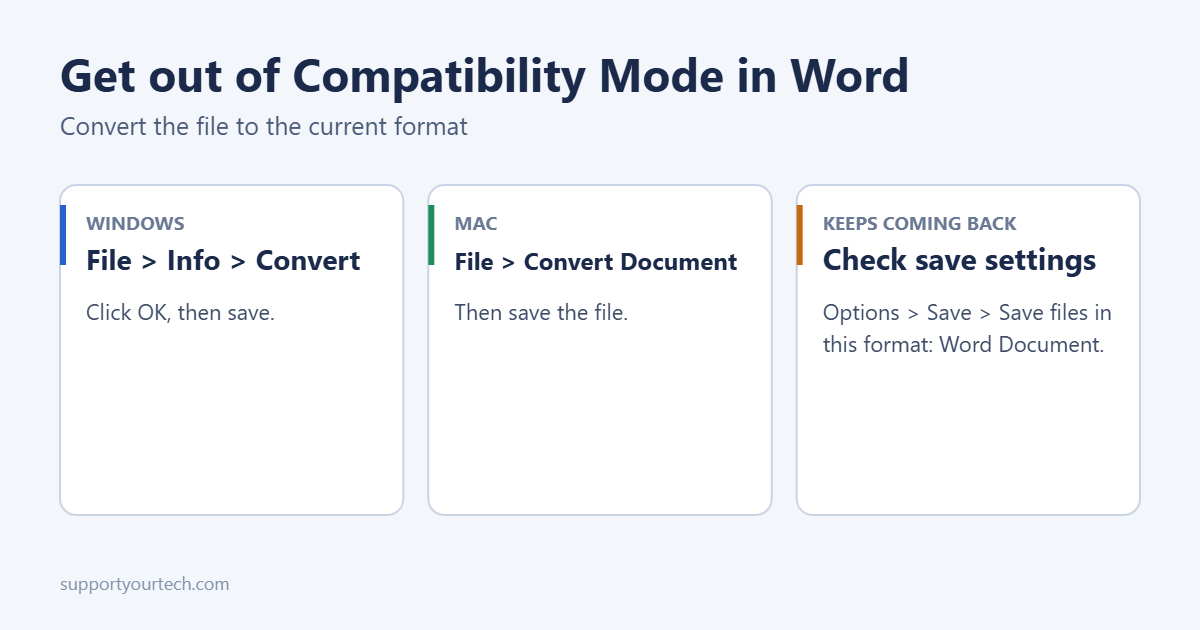
To get out of Compatibility Mode in Word, open the document and go to File > Info > Convert, click OK, then save. Word upgrades the file to the current format and “Compatibility Mode” disappears from the title bar, unlocking newer features such as modern equations, SmartArt and improved layout. On a Mac, use File > Convert Document.
What Compatibility Mode means
Word opens files made in older versions, such as .doc files from Word 97-2003 or .docx files created in Word 2007 or 2010, in Compatibility Mode. It turns off features those versions can’t display so the layout looks the same for anyone using them. If everyone who opens the file has a recent version of Word, there’s no reason to stay in it.
Convert the document (Windows)
- Open the document.
- Click File > Info.
- Click Convert. If you don’t see it, the file is already in the current format.
- Read the message and click OK.
- Press Ctrl + S to save.
A .doc file is saved as a new .docx file next to the original. A .docx is updated in place. Check the layout afterwards, since spacing and table widths can shift slightly.
Convert with Save As
- Click File > Save As and choose a location.
- Set Save as type to Word Document (*.docx).
- Untick Maintain compatibility with previous versions of Word if you see it.
- Click Save and confirm the upgrade.
This keeps the original file untouched, which is handy if someone else still needs the old version.
On a Mac
Open the document, choose File > Convert Document, click OK, then save. Or use File > Save As and pick Word Document (.docx).
In Word for the web
When you open a .doc file, Word for the web offers to Convert it so you can edit. The converted copy is saved as a .docx next to the original in OneDrive or SharePoint.
If new documents open in Compatibility Mode
This usually means Word’s default save format or template is set to an old version:
- Go to File > Options > Save and set Save files in this format to Word Document (*.docx).
- If the problem continues, the default template may be old. Close Word, find
Normal.dotmin your Templates folder (type%appdata%\Microsoft\Templatesinto File Explorer), rename it to Normal.old, and reopen Word. Word creates a fresh template.
Should you convert?
| Situation | Recommendation |
|---|---|
| Everyone uses Word 2013 or later | Convert |
| You share with someone on Word 2003 or 2007 | Stay in Compatibility Mode, or send them a PDF |
| Strict layout, such as a form or legal template | Convert a copy and check it before replacing the original |
| File will be opened in Google Docs or LibreOffice | Either works; .docx is more reliable |
To check what might change before converting, use File > Info > Check for Issues > Check Compatibility. To share a file that looks exactly the same everywhere, see how to convert Word to PDF.
Troubleshooting
Convert is missing or greyed out
The document is read-only or protected. Click Enable Editing in the yellow bar, or remove restrictions. See how to unlock a document in Word.
The layout changed after converting
Newer Word uses slightly different spacing rules. Press Ctrl + Z right after converting to undo, or fix spacing with Layout > Spacing and table AutoFit.
Compatibility Mode came back after emailing the file
The recipient saved it as .doc. Ask them to save as .docx, or convert it again when it comes back.
Frequently asked questions
Is there a Compatibility Mode for programs too?
Yes, but it’s unrelated: Windows can run old programs in compatibility mode. See how to run a program in compatibility mode in Windows 11.
Will converting lose any content?
No. Text, images and formatting are kept. Only the file format and layout engine change.
How do I know which version a file is in?
The title bar shows [Compatibility Mode] after the file name. For more detail, go to File > Info > Check for Issues > Check Compatibility and click Select versions to show, which lists the Word version the document is set up for.
Summary
- Windows: File > Info > Convert, then save.
- Mac: File > Convert Document, then save.
- Or Save As Word Document (.docx).
- Set Options > Save to .docx so new files don’t start in Compatibility Mode.

Matt Jacobs has been working as an IT consultant for small businesses since receiving his Master’s degree in 2003. While he still does some consulting work, his primary focus now is on creating technology support content for SupportYourTech.com.
His work can be found on many websites and focuses on topics such as Microsoft Office, Apple devices, Android devices, Photoshop, and more.