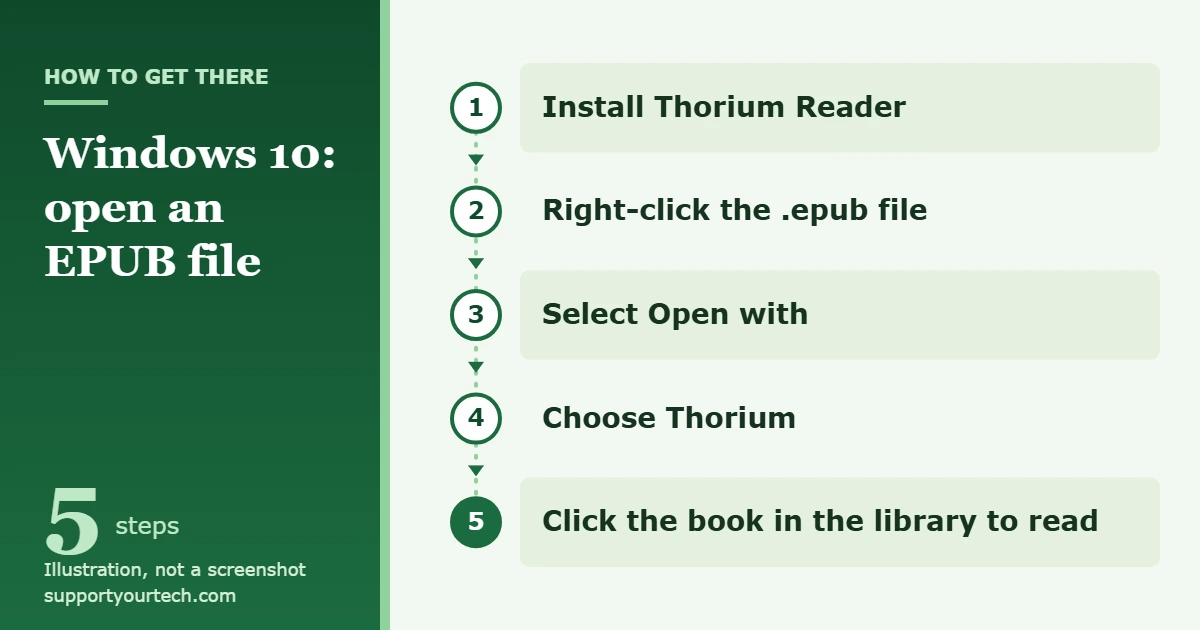
Windows 10 has no built-in app that opens EPUB files, and Microsoft Edge no longer reads them. The shortest reliable route is to install a free e-book reader such as Thorium Reader, then right-click the .epub file, select Open with, and choose Thorium. The book opens in a reading window.
Applies to: Windows 10 (version 22H2), with notes for Windows 11.
Why Microsoft Edge no longer opens EPUB files
An EPUB file (the name ends in .epub) is an e-book. Unlike a PDF, its text reflows to fit the window, so you can change the text size without zooming and scrolling sideways.
Older Windows 10 tutorials tell you to double-click the file and read it in Microsoft Edge. That advice is out of date. Edge no longer supports e-books that use the .epub file extension, and Microsoft now points readers to the Microsoft Store for an EPUB app. The change is explained on Microsoft’s Download an ePub app to keep reading e-books page.
Microsoft worked with partners, including the DAISY Consortium (a group focused on accessible reading), on a set of recommended, accessible EPUB apps in the Microsoft Store. So nothing is broken on your PC if Edge will not display the book or Windows asks which app to use. All you need is a reader app, and good ones are free.
What you need before you start
- The EPUB file saved on your PC. If it arrived by email or download, save it somewhere easy to find, such as the Documents or Downloads folder.
- Permission to install apps. On a work or school computer, installs may be blocked. SumatraPDF, covered below, has a portable version that runs without installation.
- A book from a source you trust. A reader app is all you need. Skip any download that calls itself an “EPUB codec” or asks you to run a program just to see a book.
- A book you are allowed to open. Some purchased and library books are copy-protected and only open in the seller’s or library’s approved app. That case is covered below.
Open an EPUB file with Thorium Reader
Thorium Reader is a free, open-source reader made by EDRLab. It has no ads, runs on Windows 10 and newer, and is offered both in the Microsoft Store and as a direct installer. It needs no account and works offline, which makes it a good first choice for beginners.
- Get the app. Go to the official Thorium Reader website and choose either the Microsoft Store version or the Windows installer. The installer downloads as an .exe file.
- Install it. If you downloaded the installer, open it from your Downloads folder and follow the prompts. When it finishes, Thorium appears in the Start menu.
- Find your book in File Explorer. Open the folder that holds the .epub file.
- Right-click the file and select Open with. A list of apps appears.
- Choose Thorium. The book opens in a reading window. Thorium is both a reader and a library for storing your books.
- Read. In Thorium’s library, click a book, or select it and press Enter, to open it.
You can also start Thorium first and add books from inside it: the library screen has an add-book button marked with a plus sign. The Thorium quick-start documentation describes both routes.
Make the book comfortable to read
Once a book is open, press Ctrl + S to open Thorium’s reading settings. From there you can change the text size, switch between a scrolling layout and a paginated one, and choose one or two columns. Press Shift + Ctrl + N to open the navigation panel with the table of contents and your bookmarks. Thorium can also read a book aloud with a synthetic voice, which helps if you prefer listening or use assistive technology.
Other free readers, and when to pick them
Thorium is not the only choice. The right reader depends on how many books you have and how much control you have over the PC.
| Reader | Best for | Good to know |
|---|---|---|
| Thorium Reader | Comfortable everyday reading and accessibility | Free, no ads; Microsoft Store or installer; supports EPUB 3 and EPUB 2 |
| calibre | Organizing a large collection of books | Free library manager with its own e-book viewer; will not convert copy-protected books |
| SumatraPDF | A quick look at a file, older PCs, or PCs where you cannot install apps | Free and small; also opens PDF and MOBI; has a portable version |
| Adobe Digital Editions | Books from library websites and booksellers that require it | Free download from Adobe |
Open an EPUB file in calibre
calibre is a free e-book manager. It keeps all your books in one library, which is useful once you have more than a handful. Download it from the official calibre website.
- Install calibre and open it from the Start menu.
- Select the Add books button and pick your .epub file in the file chooser. The book appears in the library list.
- Select the book in the list, then press the View button. The book opens in calibre’s e-book viewer.
- Turn pages by clicking the left or right margin, or with the spacebar, Page Up, Page Down, or the arrow keys.
In the viewer, Ctrl + T shows or hides the table of contents, and Ctrl with the plus or minus key changes the font size. Right-click the text or press Esc to bring up the viewer controls. The calibre viewer manual covers these controls in more detail.
Open an EPUB file in SumatraPDF
SumatraPDF is a small, free, open-source reader for PDF files, e-books, and comics. It supports Windows 7, 8, 10, and 11, and it has no ads or bundled software. Get it from the official SumatraPDF website.
- Install SumatraPDF, or download the portable version, which runs without installation.
- Open the app and press Ctrl + O.
- Browse to your .epub file and open it.
- Use the Right Arrow and Left Arrow keys to move between pages, and the plus and minus keys to zoom.
Press F12 to show the table of contents, Ctrl + F to search the book, and F11 for full screen. SumatraPDF is a quick viewer rather than a library manager, so pair it with calibre if you want to organize a collection.
Make EPUB files open with a double-click
After you install a reader, you can tell Windows to use it for every EPUB file, so a double-click is all it takes.
- Open the Settings app.
- Go to Apps > Default apps.
- Set the default by file type: type the file extension, in this case .epub, in the search bar and select the result. If your screen looks different, look on the same page for the option to set defaults by file type and find .epub in the list.
- Pick your reader from the list.
If you get stuck, Microsoft’s Change default apps in Windows page walks through the same setting. There is also a shortcut: right-click an .epub file, select Open with, choose your reader, and tick the option to always use that app. This has to be done once for each file format, so setting it for .epub does not change how PDF files open.
How to confirm it worked, and how to undo it
Double-click any .epub file. If the book opens in the reader you chose, the setup is complete.
To switch to a different reader later, repeat the Default apps steps and pick another app. Changing the default never alters the book itself. To remove a reader you no longer want, uninstall it the same way you remove any other Windows app; your .epub files stay where you saved them.
Copy-protected books from stores and libraries
Many e-books sold by stores or lent by libraries are protected by Digital Rights Management, or DRM. DRM ties the book to an account or an approved app, so a general-purpose reader may refuse to open it or show an error. This is working as designed, and it is not a fault with Windows.
The legitimate fix is to read the book in the app the seller or library tells you to use, signed in with the account you bought or borrowed it with. Two examples:
- Thorium Reader supports a protection system called LCP, which many libraries and booksellers use. You enter the passphrase supplied with the book.
- Adobe Digital Editions is a free app for reading e-books downloaded from library websites or popular booksellers.
If you are unsure which app a book needs, check the help pages of the store or library where you got it. calibre will not convert protected books, and this guide does not cover removing protection.
Troubleshooting
The EPUB opens in the wrong app, or Windows asks what to use every time
No default is set, or another app claimed the .epub type. Follow the steps under “Make EPUB files open with a double-click” and choose your reader.
Edge does not show the book
That is expected now that Edge has no EPUB support. Save the file to your PC, find it in File Explorer, and open it with a reader app.
You cannot install apps on a work or school PC
Organizations often block installers and sometimes the Microsoft Store. SumatraPDF offers a portable version that can run without installation, even from a USB drive. Check your organization’s rules first, and ask your IT help desk if you are not sure the tool is allowed.
The reader reports the book is protected or cannot be opened
The book probably has DRM. Open it in the app named by the store or library, as described above. If the book has no protection and still fails, the download may be incomplete. Download it again from the original source and try once more.
The file is not really an EPUB
Look at the full file name. Books in other formats, such as .mobi or .pdf, need a reader that supports that format. SumatraPDF opens both of those; Thorium opens EPUB and PDF. A file whose name ends in .exe is a program, not a book, and should not be run.
The text is too small or the page looks cramped
Use the reader’s own controls rather than Windows zoom: Ctrl + S in Thorium for text size and layout, or Ctrl with the plus key in calibre’s viewer.
A note on Windows 10 support
Microsoft ended support for Windows 10 on October 14, 2025, and version 22H2 is its final version. Thorium Reader and SumatraPDF both still list Windows 10 as supported, so you can keep reading on your current PC. If your computer can run Windows 11, the process is nearly identical.
Frequently asked questions
Can Windows 10 open EPUB files without extra software?
No. Windows 10 includes no EPUB reader, and Microsoft Edge no longer supports the format. You need a reader app, and the ones in this guide are free.
Why did EPUB files open in Edge before?
The original version of Microsoft Edge could display EPUB books. Microsoft then announced that Edge would no longer support the .epub file extension and pointed users to EPUB apps in the Microsoft Store.
Which free EPUB reader is best for a beginner?
Thorium Reader is a sensible starting point: it is free, has no ads, needs no account, and can be installed from the Microsoft Store. Choose calibre if you want to manage a large collection, or SumatraPDF if you want the lightest possible app.
Is it safe to install an EPUB reader?
Yes, when you get it from the Microsoft Store or the publisher’s own website, such as the links in this guide. Avoid download sites that bundle extra software, and avoid anything described as a codec for e-books.
Can I read an EPUB without installing anything on my PC?
You can use a portable reader such as SumatraPDF, which runs without installation. Another option is an online library: Google Play Books lets you upload PDF and EPUB files to your own library and read them while signed in to your Google account.
Will the same steps work on Windows 11?
Yes. Thorium Reader supports Windows 10 and newer, and SumatraPDF lists Windows 11 as supported. The default-app setting is in the same place: Settings > Apps > Default apps.
Can I change the font or text size in an EPUB?
Yes, and that is the main advantage of EPUB over PDF. Because the text reflows, readers let you enlarge it without cutting off the page. Use the reading settings in Thorium or the font size control in calibre’s viewer.
Next step: install one reader, set it as the default for .epub files, and open your book with a double-click. If the book came from a store or library and will not open, use the app that seller or library recommends.
Other unfamiliar file types can be opened too, such as a .pages file in Windows 11.

Matt Jacobs writes and maintains the guides on Support Your Tech, which he started in 2017. He spent most of his career keeping small-business PCs running and still takes the occasional consulting job, so the steps here come from fixing the same problems on other people’s computers. Every guide is checked on his own Windows 11, Windows 10, Mac, iPhone and iPad before it goes up.