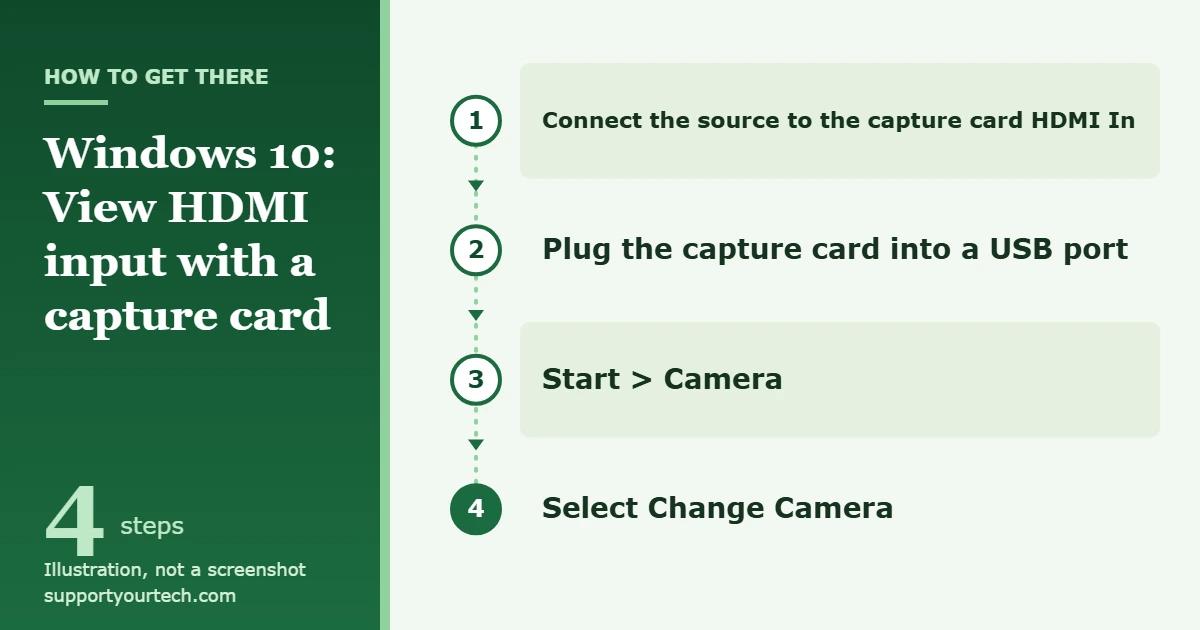
To view an HDMI source such as a game console, camera or streaming box on a Windows 10 PC or laptop, connect it to a USB HDMI capture card, plug the card into the PC, then open Start > Camera and select Change Camera until the source’s picture appears. A plain HDMI cable from the console to the laptop won’t work on most PCs, because their HDMI ports only send video out. The exception is the small number of all-in-one PCs whose specifications list an HDMI input.
Applies to: Windows 10 PCs and laptops. Checked against Microsoft Support, Elgato Help, OBS Studio and PlayStation Support on October 7, 2026.
Why a normal HDMI cable won’t show the picture
An HDMI port is either an output (it sends a picture to a screen) or an input (it receives a picture from a device). Laptop and desktop HDMI ports are almost always outputs, which is why they work for connecting a laptop to a TV but can’t receive a console’s picture. Connecting two outputs together does nothing, and no Windows setting, driver or adapter cable turns an output port into an input.
You have three legitimate ways to see another device’s picture on your PC:
- A USB HDMI capture card (the main method below). It works with almost any HDMI source and any Windows 10 PC with a free USB port.
- A built-in HDMI input, found on some all-in-one PCs. Check your model’s specifications or user guide.
- A wireless option for devices that support it, such as Projecting to this PC for phones and other PCs, or PS Remote Play for a PlayStation 5. These don’t use HDMI at all.
Check whether your PC has an HDMI input
- Look at the label next to each HDMI port. An input is usually marked HDMI In. A port with no label, or one marked HDMI Out, is an output.
- Check the specifications. Search for your exact model number on the manufacturer’s support site and look for “HDMI in” or “HDMI input” in the port list. If the list only says “HDMI”, treat it as an output.
- Read the user guide for the switching method. All-in-ones with an HDMI input switch the screen between Windows and the HDMI source in different ways, often with a button on the PC or a key combination. The method varies by model, so follow your manufacturer’s guide rather than a generic tip.
If your PC has no HDMI input, use a capture card.
What you need for the capture card method
- A USB HDMI capture card. It has an HDMI In port for the source and a USB connection to the PC. Many models use the standard USB video class (UVC) driver, so Windows treats them like a webcam with no extra driver. Elgato, for example, describes its HD60 S+ as working out of the box with Windows thanks to UVC.
- A USB 3.0 port if the card needs one. Check the card’s box or manual for its USB requirement.
- An HDMI cable from the source to the card.
- An app to show the picture. The built-in Windows Camera app is enough for a quick look. For sound and lower delay, use the card maker’s app or OBS Studio.
How to view HDMI input with a capture card and the Camera app
- Connect the source to the card. Plug an HDMI cable from the console, camera or other device into the capture card’s HDMI In port.
- Connect the card to the PC. Plug the card into a USB port on the PC, ideally a USB 3.0 port. Windows 10 installs the standard driver automatically on most cards.
- Turn on the source. Power on the console or camera so the card receives a signal. If the card has an HDMI Out (passthrough) port, you can also connect a TV to it now; this is optional.
- Open the Camera app. Select Start, then select Camera in the list of apps.
- Switch to the capture card. If your PC has a built-in webcam, the Camera app may open on it first. Select Change Camera at the top right until the source’s picture appears.
- Check the picture. You should now see the console’s or camera’s live picture. You can maximize the Camera window to fill the screen.
If you don’t hear the source’s sound, or the delay makes games hard to play, use one of the options in the next section.
Get sound and lower delay with OBS Studio
OBS Studio is a free app that can show a capture card’s picture and play its sound through your speakers. The steps below use the labels from OBS Studio’s guide to video capture sources.
- Install OBS Studio from obsproject.com and open it.
- Add a Video Capture Device source. Add a new source and choose Video Capture Device.
- Choose the card. In the source’s properties, pick your capture card from the Device drop-down list. The preview should show the source’s picture.
- Turn on the sound. Set Audio Output Mode to Output desktop audio (DirectSound/WaveOut). This sends the card’s sound to your default playback device. The default setting, Capture Only, records the sound without letting you hear it unless you turn on audio monitoring.
- Reduce delay. Set Buffering to Disable. OBS notes that disabling buffering helps reduce delay, while enabling it helps if the picture stutters.
Many capture card makers also offer their own viewing app. Elgato, for example, uses its 4K Capture Utility for viewing and capturing with its cards. Check your card’s support page for the app it recommends.
Play without lag using passthrough
Any capture card adds some delay between the console and the PC screen. Elgato documents a preview delay of about 50 to 100 milliseconds on its 4K60 S+, for example. For fast games, connect a TV or monitor to the card’s HDMI Out port and play on that screen, which Elgato describes as real-time passthrough. The PC still gets a copy of the picture for viewing or recording.
Wireless alternatives that don’t use HDMI
Project a phone or another PC to your Windows 10 PC
Windows can act as a wireless display for phones and other PCs that support Miracast screen mirroring. Microsoft’s guide to screen mirroring and projecting to your PC covers the setup:
- Go to Start > Settings > System > Projecting to this PC.
- If the page asks for it, select Optional features and add the Wireless Display optional feature.
- Back on Projecting to this PC, choose when the PC can be projected to.
- Type connect in the taskbar search box and open the Connect app. The PC is now ready to receive.
- On the phone or other PC, start screen mirroring and choose your PC from the list. Make sure Wi-Fi is turned on for both devices.
For phone-specific steps, see our guide to casting an Android screen to a Windows 10 PC. Game consoles, cable boxes and cameras can’t use this feature; they still need a capture card.
Play a PlayStation 5 on your PC with PS Remote Play
If you only want to play PS5 games on your PC, Sony’s PS Remote Play for PC streams the console over your network instead of HDMI. Sony lists Windows 10 (64-bit) or Windows 11 as supported and recommends a connection of at least 15 Mbps for the best performance (5 Mbps minimum).
- On the PS5, go to Settings > System > Remote Play and turn on Enable Remote Play.
- Install the PS Remote Play app on the PC and sign in with the same account you use on the console.
- Connect your controller to the PC with a USB cable and follow the app’s prompts to find the console.
Troubleshooting
The capture card doesn’t appear in the Camera app
- Try another USB port, preferably a USB 3.0 port directly on the PC rather than a hub, and check that the cable is firmly connected.
- Check Device Manager. Search for Device Manager on the taskbar and open it. Look for the card under Cameras, Imaging devices or Sound, video and game controllers. If it’s missing, select Action > Scan for hardware changes.
- Check camera permissions. Go to Start > Settings > Privacy > Camera. Make sure camera access for this device is on, Allow apps to access your camera is on, and the Camera app is allowed. For OBS and other desktop apps, turn on Allow desktop apps to access your camera. Microsoft explains these settings in its camera and microphone permissions guide.
- Install the maker’s driver or app if your card isn’t a UVC device. Check the card’s support page.
The card is detected but the picture is black
- Copy protection (HDCP). Elgato explains that its capture devices can’t capture HDMI signals protected by HDCP. Blu-ray players and set-top boxes always use it, PS4 and PS5 consoles have it on by default, and Xbox Series X|S and Nintendo Switch turn it on when you open apps such as Netflix. Other capture cards are generally limited the same way.
- Turn off HDCP on a PS5 for gameplay: go to Settings > System and turn off Enable HDCP. Elgato suggests connecting the PS5 directly to a TV first so you can see the menu. Protected video apps will still show a black picture.
- Check the source is on and sending a signal, and that the HDMI cable is in the card’s HDMI In port, not HDMI Out.
There is a picture but no sound
- Use OBS Studio or the maker’s app with the audio output setting described above.
- Check that Windows sees the card’s audio. Right-click the speaker icon on the taskbar, select Sounds and open the tab that lists recording devices. The capture card should be listed there and not muted. If it isn’t, right-click in the list and select Show Disabled Devices, then enable it.
Work or school PCs
On a PC managed by an employer or school, the camera, USB devices or projection settings may be turned off by policy. If a setting is greyed out or a card isn’t allowed, ask your IT administrator.
Frequently asked questions
Can I use my laptop as a monitor for a PS5, Xbox or Nintendo Switch?
Not with an HDMI cable alone, unless the laptop has a labeled HDMI input. Use a USB capture card and the Camera app or OBS Studio. For a PS5, PS Remote Play is a cable-free alternative.
Will an HDMI adapter or a different cable make my HDMI port an input?
No. Adapters and cables only change the connector shape. Receiving a picture needs input hardware, which is what a capture card provides.
Can I enable HDMI input in Windows settings or Device Manager?
No. Windows has no setting that changes a port’s direction. If you need help with an HDMI output that isn’t working, see how to get HDMI working on Windows 10.
Why is there a delay when I play games through the capture card?
The card has to process and send the picture over USB, which adds a short delay. Disable buffering in OBS, or play on a TV connected to the card’s passthrough port.
Why can’t I see Netflix or a Blu-ray movie through the capture card?
Those sources use HDCP copy protection, which capture cards can’t record or display. Watch them on a TV, or use the streaming service’s app on the PC.
Once the picture appears, try the source’s resolution and frame rate settings to get the sharpest image your capture card supports.

Matt Jacobs has been working as an IT consultant for small businesses since receiving his Master’s degree in 2003. While he still does some consulting work, his primary focus now is on creating technology support content for SupportYourTech.com.
His work can be found on many websites and focuses on topics such as Microsoft Office, Apple devices, Android devices, Photoshop, and more.