Last updated on October 27th, 2026 at 09:23 pm
To share a contact by text on an iPhone 14, open the Contacts app, tap the person’s name, scroll down and tap Share Contact, uncheck any details you don’t want to send, then tap Messages. Add the recipient in the To field and tap the send arrow. The other person gets a contact card they can save with one tap, and nothing changes on your own phone.
Applies to: iPhone 14, iPhone 14 Plus, iPhone 14 Pro and iPhone 14 Pro Max running iOS 27, the current iOS version. All four models are on Apple’s list of iPhone models compatible with iOS 27. The same steps work on iOS 26 and iOS 18, and on any other iPhone running those versions.
Contact card or plain text: which should you send?
There are two ways to put someone’s details into a text, and the right one depends on who is receiving it.
- A contact card (also called a vCard, a small file ending in .vcf) carries the name, numbers, emails and other fields in one attachment. The recipient taps it and saves everything at once. This is the best choice for another iPhone user, and it usually works on Android phones too.
- Plain text puts the details right in the message, like “Jordan Lee, (555) 010-4477.” Anyone can read it on any phone, even over basic SMS, but the recipient has to save it by hand.
If you’re not sure what phone the other person has, send the card first. If they say it won’t open, follow up with the plain-text method.
Before you start
- The contact must be saved. You can only share a card for someone who is in your Contacts. If you only have a number in a text or call, save it first by following the steps for creating a new contact on iPhone.
- Know how your message will travel. A contact card is an attachment, so it needs iMessage (blue bubbles), RCS or MMS. Plain SMS can carry only text. Apple explains the differences in What is the difference between iMessage, RCS and SMS/MMS?
- Get permission. You’re passing along someone else’s personal details. If you’re not sure Priya wants her number shared, ask her first.
This is the main method and the one most people need. It follows the Contacts app layout described in Apple’s guide to adding and using contact information on iPhone.
- On the Home Screen, tap Contacts (the gray icon with a person’s silhouette). If you can’t find it, swipe down on the Home Screen and type “Contacts” in the search box. You can also open the Phone app and tap Contacts, which shows the same list.
- Scroll to the person, or tap the search bar and start typing their name. Tap the name to open the full contact card.
- Scroll to the bottom of the card and tap Share Contact. It sits in a list of blue text options near the bottom, along with choices such as Send Message and Add to Favorites.
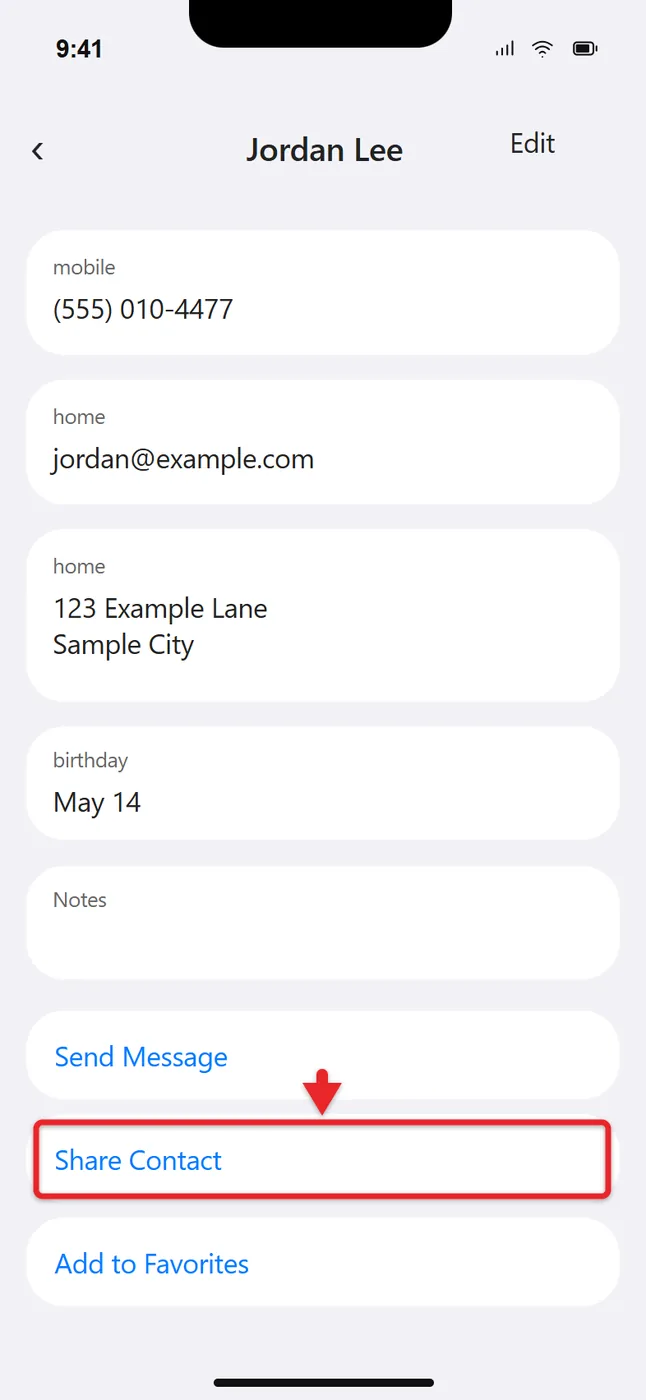
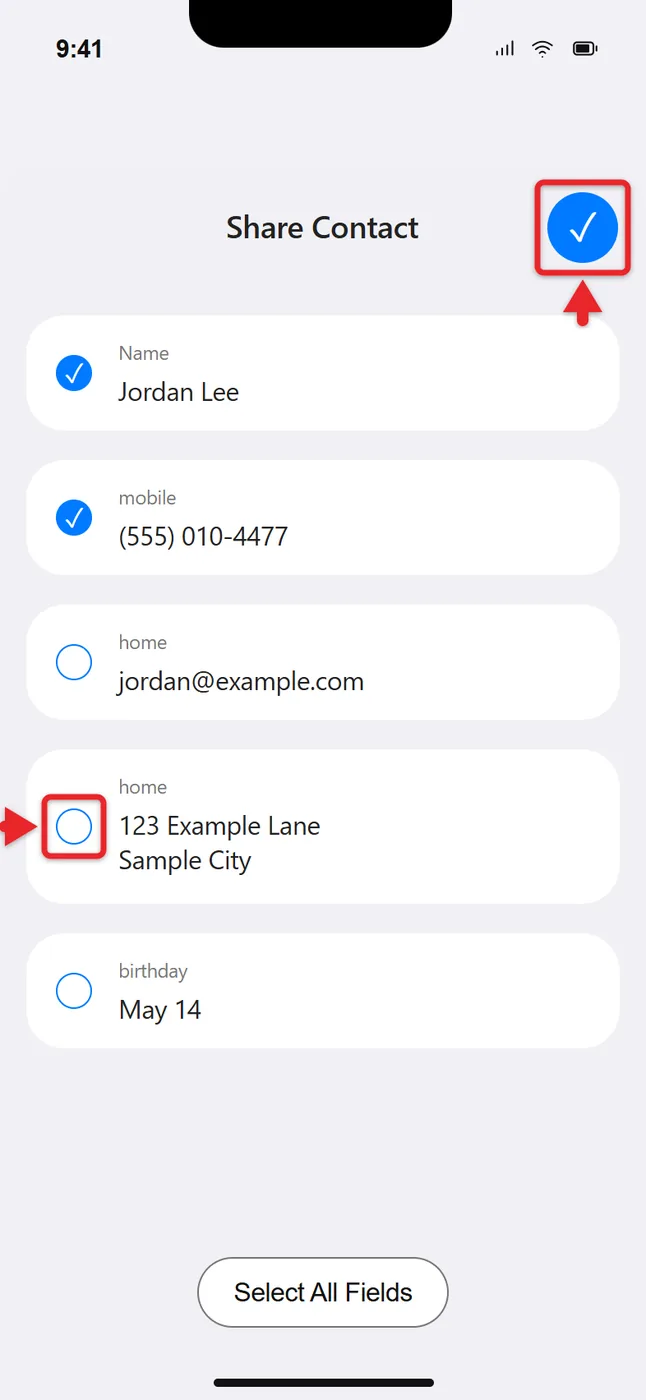
- A list of the contact’s details appears with checkmarks beside each one. Tap any item the recipient doesn’t need, such as a home address, birthday or a second phone number, so its checkmark disappears. Then tap Done. Unchecking a field here only leaves it out of this one share; it stays on your saved contact.
- The share sheet opens. Tap Messages in the row of app icons. If you don’t see it, swipe the row left and tap More. People you’ve texted recently may also appear at the top of the sheet; tapping one of them skips the next step.
- A new message opens with the contact card already attached. In the To field, type the recipient’s name or number and tap the right match, or tap the + button to pick them from your contacts. Check that you’ve chosen the correct person, especially if you have two people with similar names.
- If you like, type a short note in the text field, such as “Here’s the plumber I mentioned.” Then tap the send arrow.
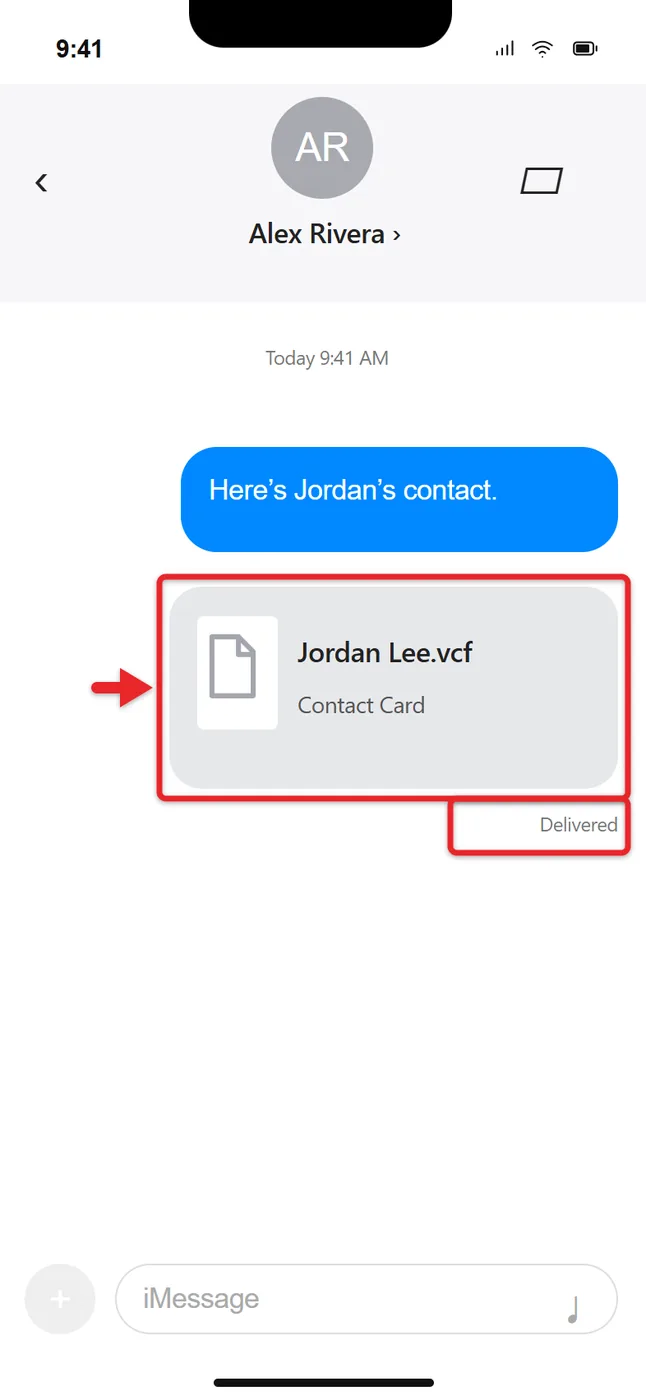
The card appears in the conversation as a small bubble showing the contact’s name and photo, if they have one. Below it, you should see Delivered for iMessage, or no error for RCS and MMS.
If you just spoke with the person, starting from the Phone app can be quicker.
- Open the Phone app and find the call in your recent calls.
- Tap the Info button (the small “i” in a circle) next to the call to open the person’s details.
- Scroll down and tap Share Contact, then continue from step 4 of the main method.
This works only if the number belongs to a saved contact. For an unknown number, save it as a new contact first, then share it.
Insert contact details as text without leaving Messages
Since iOS 17, you can drop a saved contact’s phone number, email or address into a conversation as ordinary text. This is handy when the recipient’s phone won’t open contact cards, or when they only need one detail.
- Open the conversation in Messages.
- Tap the text field, then tap it again (or touch and hold it) until a small menu appears above it.
- Tap AutoFill. If you see an arrow instead, tap the arrow to see more options first.
- Tap Contact, then choose the person from your contacts list.
- Tap the detail you want to insert, such as their mobile number. It appears in the text field as text.
- Add a name or a short explanation so the recipient knows whose number it is, then tap the send arrow.
The recipient sees a regular message. On most phones, they can tap the number to call it or save it as a new contact.
You can also copy details straight from a card: in Contacts, touch and hold a phone number or email, tap Copy, then paste it into any message.
Sending your own details works the same way, starting from your own card.
- Open Contacts and tap My Card (your name) at the top of the list.
- Scroll down and tap Share Contact.
- Uncheck anything you don’t want to share, tap Done, then tap Messages and send it as described above.
If your card is missing details or has an old number, tap Edit on My Card and fix it before you share. If you’re standing next to another iPhone user, NameDrop is faster: hold the top of your iPhone a few centimeters above theirs until NameDrop appears on both screens, then choose whether to share or only receive. Both phones need iOS 17 or later. Apple’s NameDrop safety page explains how to pick which fields go out and how to turn the feature off under Settings > General > AirDrop > Bringing Devices Together.
If the contact card won’t send or open
The message is green and fails with “Not Delivered”
A green bubble means the message is going by RCS or SMS/MMS instead of iMessage. A card can’t travel by plain SMS, so make sure the right option is on:
- Open Settings and tap Apps, then Messages.
- Check that iMessage is on if the recipient has an iPhone.
- Under the text messaging options, turn on MMS Messaging. If the switch isn’t there, your carrier or plan may not support MMS.
- For Android recipients, turn on RCS Messaging if you see it. RCS needs iOS 18 or later and a carrier that supports it on iPhone; Apple’s RCS setup page notes that the switch doesn’t appear when RCS isn’t available.
MMS and RCS also need cellular data or a working connection, so a phone with weak signal may fail to send a card even when ordinary texts go through. Try again on Wi-Fi with iMessage, or with a stronger signal. For more on blue and green bubbles, see the explainer on turning on iMessage.
The recipient sees an attachment they can’t open
Some messaging apps, especially on older or basic phones, show a contact card as a file icon or don’t show it at all. Send the details as text with the AutoFill method, or share the card by email from the same share sheet. Most email apps and contact apps can import a .vcf file.
You don’t see Share Contact
- Make sure you opened the person’s card in the Contacts app (or from the Phone app) and scrolled all the way to the bottom.
- If you opened the person’s details from inside a Messages conversation, the Share Contact option may not be on that screen in recent iOS versions. Close Messages, open Contacts, and share from there.
- Contacts that come from a work or school account may be limited by your organization’s settings. Copy the number or email by touching and holding it instead.
Messages doesn’t appear in the share sheet
Swipe the row of app icons to the left and tap More. Find Messages in the list and tap it. You can tap Edit on that screen to add Messages to your favorites so it appears first next time.
How to tell it worked (and what the recipient does next)
On your iPhone, the card shows in the conversation with no red “Not Delivered” warning. With iMessage, Delivered (or Read) appears under it.
On the recipient’s iPhone, they tap the card, then tap Create New Contact to save it, or Add to Existing Contact to merge it with a card they already have. On Android, they usually tap the attachment and choose to import or save it in their contacts app; the exact wording depends on their phone and messaging app.
Keep in mind that the card is a copy. If you later edit the contact on your phone, the recipient’s saved copy doesn’t update. If you sent the wrong person or the wrong details, you can send a corrected card. On iMessage, you can also touch and hold the sent card and tap Undo Send within two minutes, as Apple explains in how to unsend messages on your iPhone. This doesn’t work for RCS, MMS or SMS messages.
Frequently asked questions
Can I send several contacts in one text?
Not from a single contact card screen. The simplest route is to share each contact separately into the same conversation, which keeps every card easy to save. If you need to send a long list, emailing an exported file is usually easier than texting it.
Does the recipient get my notes, photo and every field?
They get only the fields that stay checked on the selection screen. If you leave a field checked, it goes along, so scan the list before tapping Done. A home address or birthday is easy to send by accident when you only meant to share a phone number.
Can I share a contact with someone on Android?
Usually, yes. The card goes as a .vcf attachment by RCS or MMS, and most current Android phones can save it to their contacts. If it arrives as an unreadable file, send the details as text instead. The article on group texting on iPhone covers how iMessage, RCS and MMS mix when Android users are in the chat.
Can I share a contact card through WhatsApp or email instead?
Yes. After you tap Share Contact and Done, the share sheet lists Mail, AirDrop and any messaging apps you’ve installed, such as WhatsApp. Pick one and follow that app’s prompts. Email is a good fallback when a text won’t go through.
Will the person I’m sharing be notified?
No. Sharing a card doesn’t tell the contact that you passed their details along. That’s why it’s worth checking with them first, especially for a personal number.
Does sharing a contact cost anything?
iMessage uses Wi-Fi or cellular data, not your text allowance. RCS and MMS are carrier services, and depending on your plan, an MMS message may count differently from a regular text. Check with your carrier if you’re on a limited plan.
Next step
Before you send your own details to anyone, open Contacts, tap My Card and make sure your number, email and name are current. A complete card saves you from re-sending it later, and the same card is used when you share with NameDrop.

Matt Jacobs writes and maintains the guides on Support Your Tech, which he started in 2017. He spent most of his career keeping small-business PCs running and still takes the occasional consulting job, so the steps here come from fixing the same problems on other people’s computers. Every guide is checked on his own Windows 11, Windows 10, Mac, iPhone and iPad before it goes up.