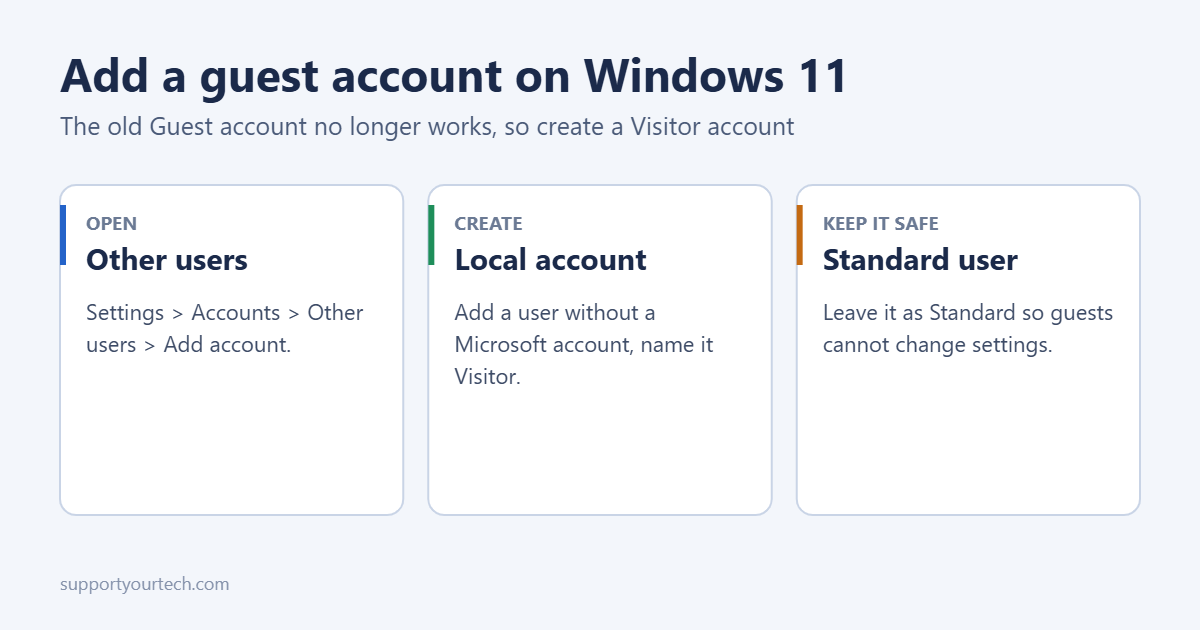
Windows 11 has a built-in Guest account, but it’s disabled and can’t be used to sign in, even if you turn it on. To give visitors their own space, create a local standard account instead: go to Settings > Accounts > Other users > Add account, choose I don’t have this person’s sign-in information, then Add a user without a Microsoft account, and name it something like Visitor. Guests get their own desktop and files and can’t see yours or change system settings.
Create a Visitor account in Settings
- Press Windows key + I to open Settings.
- Go to Accounts > Other users. On some versions it’s called Family & other users.
- Next to Add other user, click Add account.
- Click I don’t have this person’s sign-in information.
- Click Add a user without a Microsoft account.
- Enter a user name such as Visitor. “Guest” is reserved, so Windows won’t accept it.
- Leave the password blank for easy access, or set one and answer the three security questions.
- Click Next.
The account appears under Other users as a Local account with Standard user rights. Don’t change it to Administrator.
Create it with Command Prompt
Open Terminal (Admin) from the Start button’s right-click menu and run:
net user Visitor /add
This creates a standard account with no password. Add a password with net user Visitor *. Windows 11 Pro users can also use lusrmgr.msc to create and manage local accounts.
What guests can and can’t do
| Guests can | Guests can’t |
|---|---|
| Browse the web and use installed apps | See files in your account |
| Save their own files | Install most software or change system settings |
| Print and use Wi-Fi | Change other users’ passwords or accounts |
| Change their own wallpaper | Open Settings pages that need admin rights |
If a visitor only needs a browser for a few minutes, a private or guest window in Edge or Chrome may be enough, and it doesn’t need a separate account at all.
Make it more locked down
- No password, but signed out after use: remind guests to sign out from Start. Their session data stays in the Visitor account until you delete it.
- One app only: Windows 11 Pro can turn an account into a kiosk with Settings > Accounts > Other users > Set up a kiosk, which runs a single app such as Edge in full screen.
- Family members: for children, add them as family members instead, so you can set screen time and content limits.
Remove the account later
Go to Settings > Accounts > Other users, click the Visitor account, then Remove > Delete account and data. This deletes everything the guest saved. See how to remove an account from Windows 11.
Why the built-in Guest account doesn’t work
Microsoft disabled sign-in for the built-in Guest account in Windows 10 version 1607, and Windows 11 kept that change. You can still run net user guest /active:yes, but the account won’t appear on the sign-in screen or let anyone in. A standard local account does the same job and is more secure.
Troubleshooting
“Add account” asks for a Microsoft account
Click I don’t have this person’s sign-in information, then Add a user without a Microsoft account. Both links are small text near the bottom of the window.
The Visitor account doesn’t appear on the sign-in screen
Click Other user at the bottom-left of the sign-in screen, or restart the PC. If you’re signed in, use Start > your account picture > Visitor to switch.
First sign-in is slow
Windows sets up a new profile the first time. Later sign-ins are quick.
Frequently asked questions
Can a guest see my files?
No. A standard account can’t open other users’ folders. Files you put in the Public folder are visible to everyone.
How do I do this on Windows 10?
See how to create a guest account on Windows 10. For a full account for a family member or coworker, see how to add another user in Windows 11.
Summary
- Settings > Accounts > Other users > Add account.
- Choose I don’t have this person’s sign-in information, then Add a user without a Microsoft account.
- Name it Visitor and leave it as a Standard user.
- Delete it when you no longer need it.

Matt Jacobs has been working as an IT consultant for small businesses since receiving his Master’s degree in 2003. While he still does some consulting work, his primary focus now is on creating technology support content for SupportYourTech.com.
His work can be found on many websites and focuses on topics such as Microsoft Office, Apple devices, Android devices, Photoshop, and more.