To remove Microsoft Family Safety from a Windows 11 account, the family organizer signs in at family.microsoft.com, selects the three dots next to the person’s name and chooses Remove from family group. Adults can also leave a family group themselves. Children can’t remove themselves; a parent or organizer has to do it, or change the limits instead. Removing someone from the group turns off screen time limits, content filters and activity reporting on all their devices.
Applies to: Microsoft Family Safety with Windows 11, Windows 10, Xbox and the Family Safety app. Last reviewed October 8, 2026.
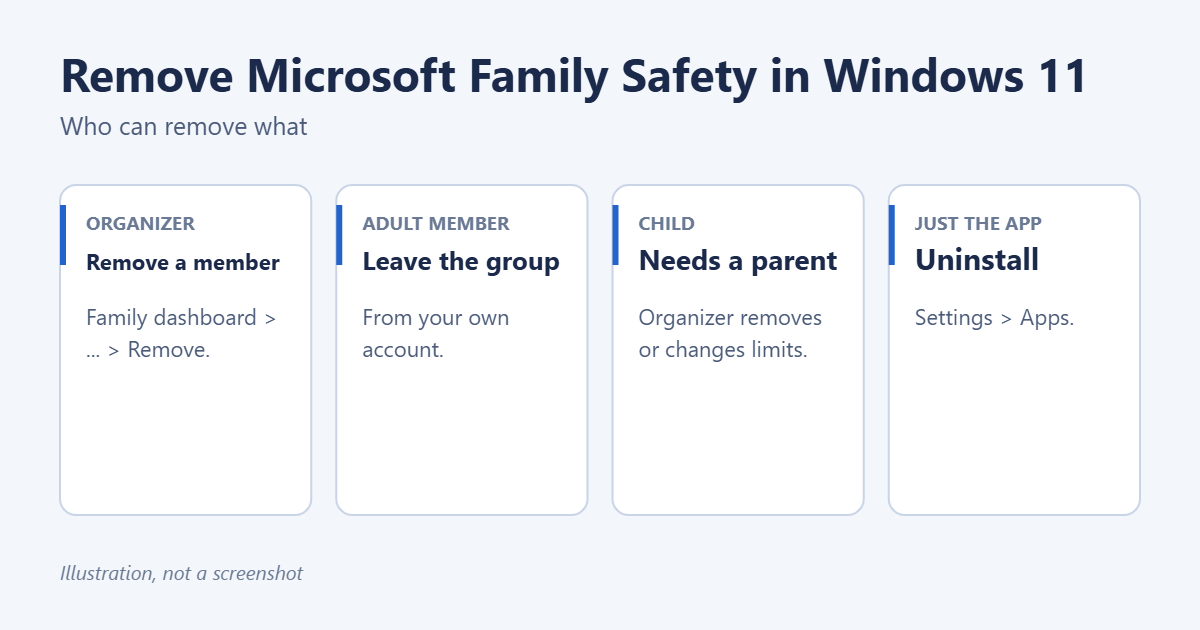
Who can remove whom
- Organizers (usually parents) can remove any member.
- Adult members (18 or older) can remove themselves.
- Members under 18 can’t leave on their own. For young children, only the adult who gave consent for the account can remove them.
Removing someone doesn’t delete their Microsoft account or files. It only removes them from the family group and its settings.
Remove a member (organizers)
- On a computer, go to family.microsoft.com and sign in with the organizer’s Microsoft account. On a phone, open the Family Safety app.
- Find the member, select the three dots next to their name, and choose Remove from family group.
- Select Remove to confirm.
For a child account, you may first need to select Remove consent or change the account’s age-related permissions, then remove them. Both the organizer and the removed person get an email.
Leave a family group (adults)
- Go to family.microsoft.com and sign in with your own Microsoft account.
- Find your name and select Leave family group (or select the three dots > Leave family group).
- Confirm.
If you were sharing a Microsoft 365 Family subscription, you lose access to it when you leave.
Delete the whole family group
There’s no single delete button. The organizer removes every other member one by one, then leaves the group last.
Change limits instead of removing them
If a child just needs more time or access, adjust settings rather than leaving the group:
- Screen time: in the family dashboard, select the child > Screen time and change or turn off the schedule.
- Content filters: select Content filters to allow specific websites or apps, or raise the age rating.
- Requests: approve “Ask for more time” requests from the Family Safety app or email.
For setting limits on a PC, see how to set screen time limits on Windows 11.
Remove the family account from the PC
Family members also appear in Settings > Accounts > Family on Windows 11. To stop someone signing in to this PC, select them there and choose Remove (or Block sign in). This removes their access to the PC only; they stay in the family group. See how to remove an account from Windows 11.
Uninstall the Family Safety app
On Windows 11, open Settings > Apps > Installed apps, find Microsoft Family Safety and select Uninstall. This removes the app only; any limits set on the account still apply until the organizer changes them.
Frequently asked questions
Will the person know they were removed?
Yes. Microsoft emails both the organizer and the removed member.
Can I add them back later?
Yes. From the family dashboard, select Add a family member and send a new invitation. Previous limits aren’t restored automatically, so set them up again.
Does removing someone affect their Xbox account?
Their Xbox profile and purchases stay, but Xbox family settings, such as content limits and purchase approvals, stop applying.
Troubleshooting
“Remove from family group” is missing
You’re signed in with a member account, not the organizer’s. Sign in as the organizer.
Limits still apply after removing someone
Restart the PC and make sure it’s online so it can sync. Changes can take a few minutes to reach all devices.
The organizer account is lost
Recover it at account.live.com/acsr. Microsoft can’t transfer a family group to another account without the organizer.
Related guides
Related: how to set up parental controls on Windows 10.

Matt Jacobs has been working as an IT consultant for small businesses since receiving his Master’s degree in 2003. While he still does some consulting work, his primary focus now is on creating technology support content for SupportYourTech.com.
His work can be found on many websites and focuses on topics such as Microsoft Office, Apple devices, Android devices, Photoshop, and more.