Last updated on November 10th, 2026 at 10:31 am
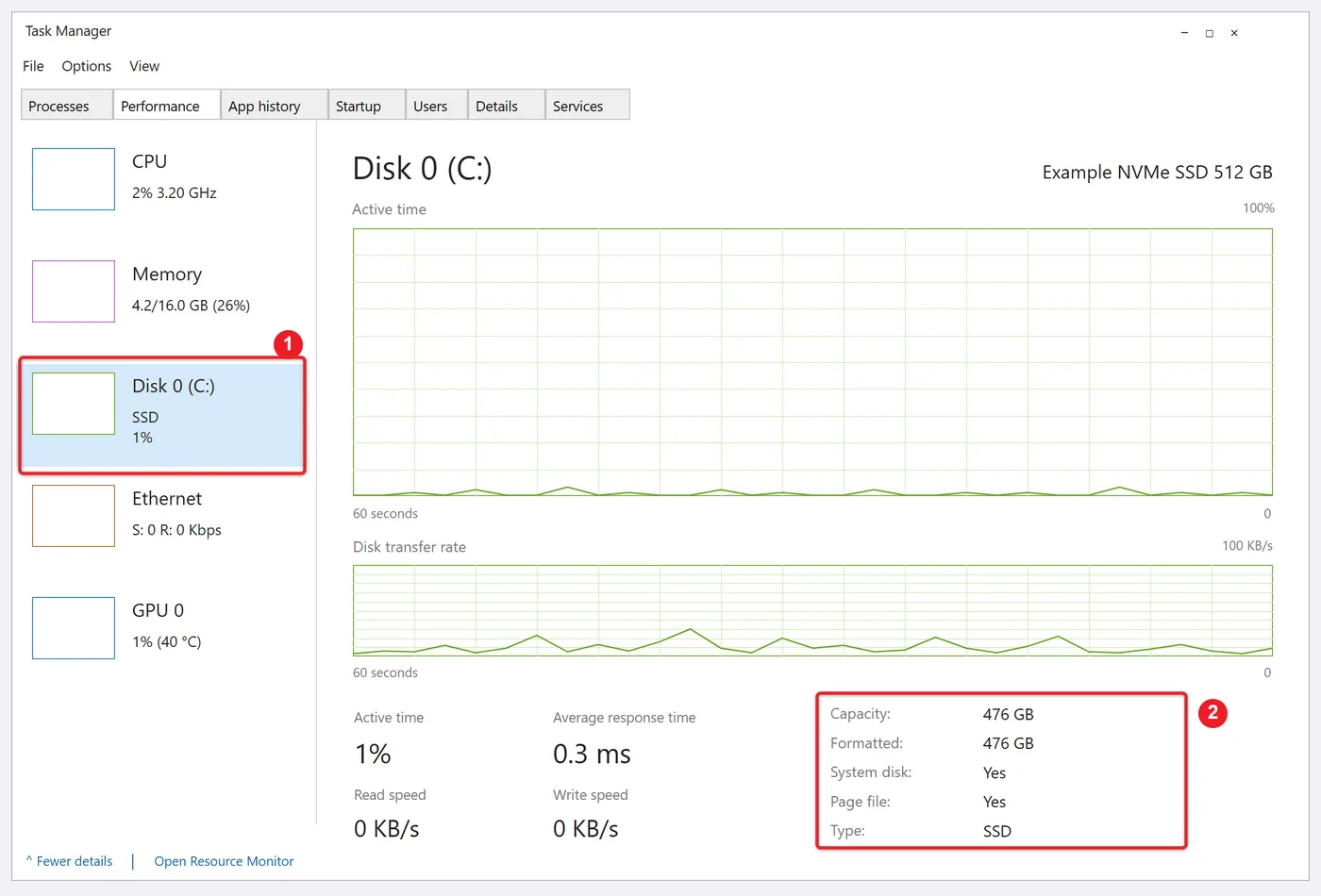
In Windows 10, version 22H2, Task Manager shows your SSD’s size fastest. Press Ctrl + Shift + Esc, open the Performance tab and click Disk 0. The left column labels it SSD or HDD, and the details under the graph list its Capacity and Type. Versions back to 2004 show that label too. For the C: drive alone, open File Explorer and click This PC to see something like 180 GB free of 237 GB.
Disk size, drive size and SSD type: what each number means
Windows shows several sizes, and they rarely match the number on the box. Knowing which is which saves confusion:
- Disk (physical drive): the whole SSD. Task Manager, Disk Management and PowerShell show this. Windows numbers disks from Disk 0.
- Volume or partition (such as C:): a slice of the disk with a drive letter. File Explorer shows this, so C: is always a bit smaller than the whole SSD.
- Type: SSD (solid-state drive) or HDD (spinning hard disk drive).
- Bus or interface: how the SSD connects, usually SATA or the faster NVMe. This matters when you buy a replacement.
Method 1: Task Manager (size and SSD or HDD in one place)
- Press Ctrl + Shift + Esc, or right-click the taskbar and choose Task Manager.
- If you only see a short list of apps, click More details at the bottom.
- Select the Performance tab.
- In the left column, click Disk 0. The entry shows the drive letters it holds, such as (C:), and the type underneath, such as SSD.
- Look at the right side. The drive’s model name appears at the top. Below the activity graphs, Capacity is the size of the whole disk, Formatted is the space the partitions use, and Type repeats SSD or HDD.
- If your PC has more than one drive, click Disk 1, Disk 2 and so on.
Microsoft added the disk type label to Task Manager in the Windows 10 May 2020 Update (version 2004). On an older, unupdated version you’ll see the disk but no SSD or HDD label; use PowerShell or Optimize Drives instead.
Method 2: This PC in File Explorer (free and used space)
- Press Windows + E to open File Explorer.
- Click This PC in the left pane.
- Under Devices and drives, each drive has a bar showing how full it is, with free and total space below. The bar turns red when the drive is nearly full.
- For exact figures, right-click the drive and choose Properties. The General tab lists Used space, Free space and Capacity in both bytes and GB.
This is the right view when your real question is “how much room do I have left?” It does not tell you whether the drive is an SSD, and it only shows partitions that have a drive letter. For more ways to measure free space, including commands that list every drive, see checking disk space in Windows 10. If the size is right but the drive misbehaves, you can run CHKDSK in Windows 10 to scan it for errors.
Method 3: Disk Management (whole SSD and every partition)
- Right-click the Start button and choose Disk Management. You can also press Windows + R, type diskmgmt.msc and press Enter.
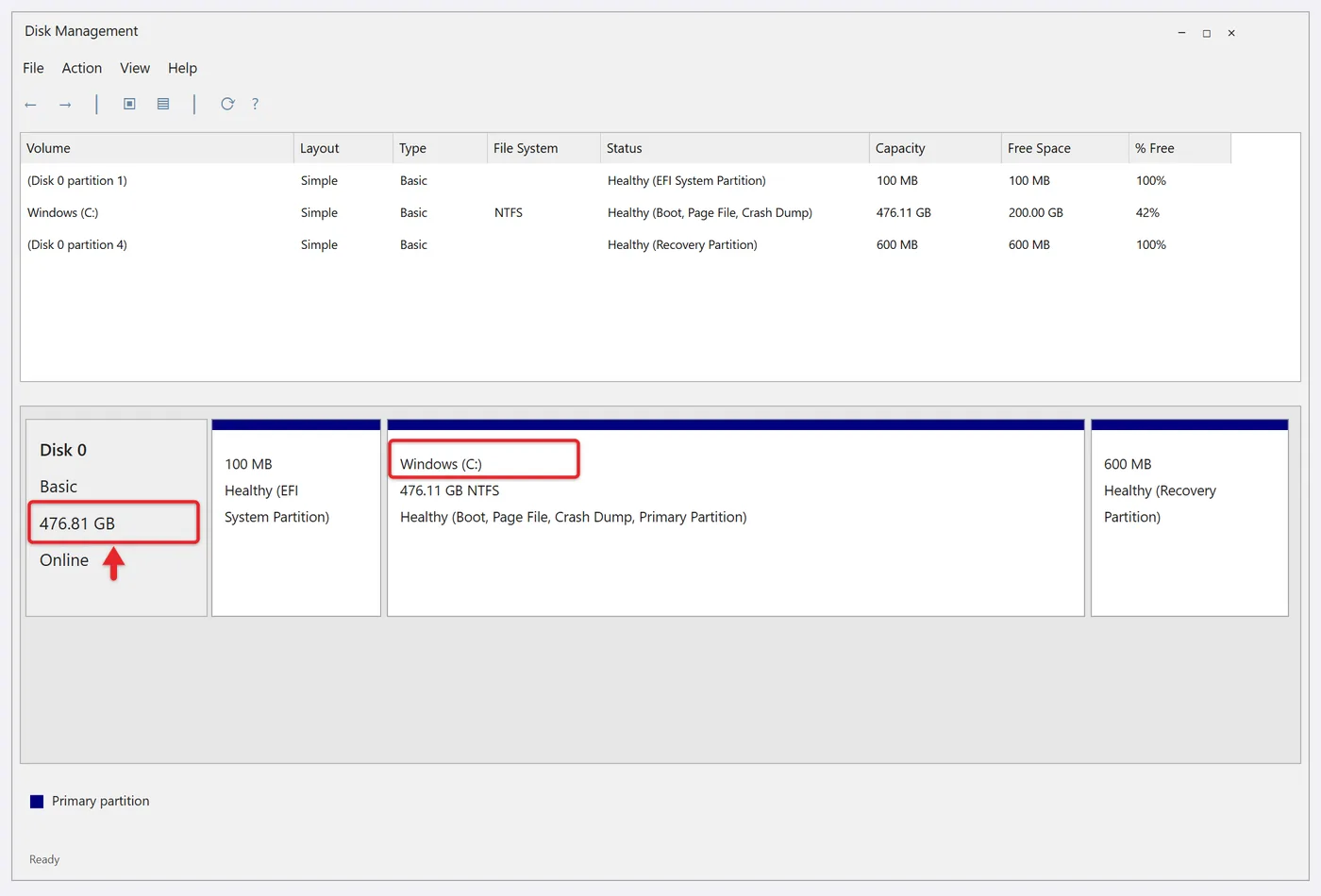
- In the lower half of the window, find the gray box on the left for each disk, for example Disk 0, Basic, 476.81 GB, Online. That number is the full size of the SSD.
- To the right of it, colored blocks show each partition: usually a small EFI system partition, the C: drive and a recovery partition.
Black blocks labeled Unallocated are space that belongs to no partition. You’ll often see this after moving Windows to a larger SSD, and you can add it to C: by extending the C drive. Disk Management doesn’t say SSD or HDD, and Microsoft’s Disk Management help page confirms it works the same in Windows 10 and Windows 11. Look, but don’t click Delete Volume or Format unless you mean to erase data.
Method 4: PowerShell (size, type and SATA or NVMe)
One command lists every physical drive with its model, type, connection and size, which is handy on a PC with several drives.
- Right-click Start and choose Windows PowerShell. Administrator rights aren’t needed for this.
- Paste this command and press Enter:
Get-PhysicalDisk | Format-Table FriendlyName, MediaType, BusType, HealthStatus, @{n='Size (GB)';e={[math]::Round($_.Size/1GB,1)}} - Read the columns. MediaType shows SSD, HDD or Unspecified; BusType shows NVMe, SATA, USB or RAID; Size (GB) is the whole disk in the same units Windows uses elsewhere.
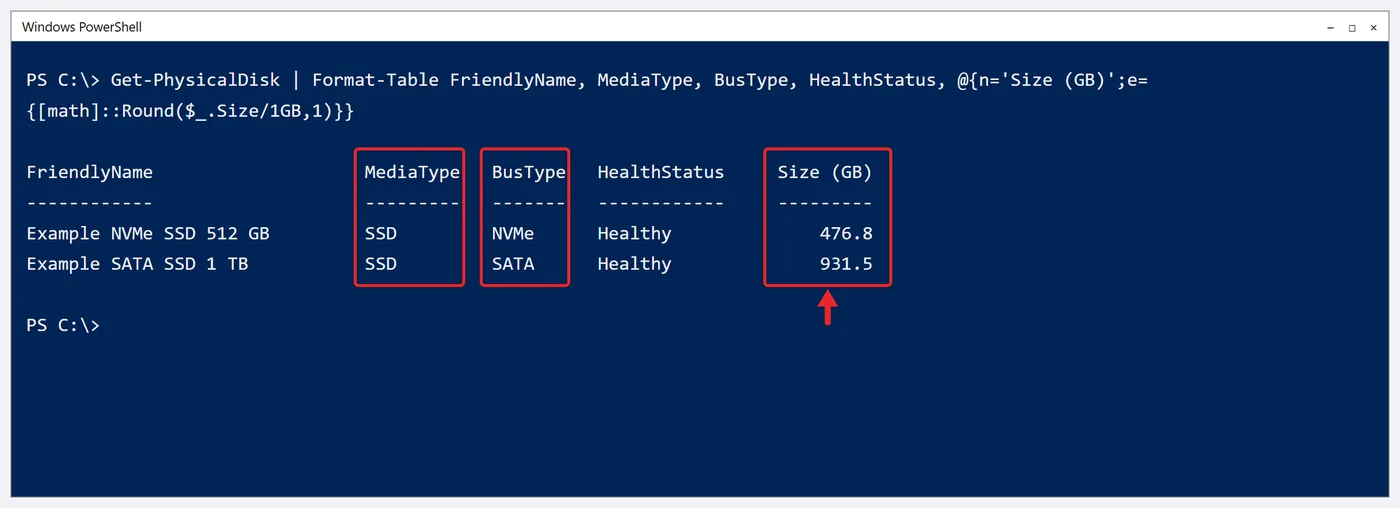
The command is documented on Microsoft’s Get-PhysicalDisk page, and the MSFT_PhysicalDisk reference defines the media and bus types and confirms that size is reported in bytes. If MediaType says Unspecified, Windows couldn’t read the type from the drive or controller; this can happen with some USB enclosures and RAID setups. Check Task Manager or the model name instead.
Older guides suggest wmic diskdrive get model,size in Command Prompt. It still runs on Windows 10, but Microsoft deprecated WMIC in version 21H1 and recommends PowerShell, and its size is in raw bytes.
How do I know if my SSD is NVMe or SATA?
Run the PowerShell command in Method 4 and read the BusType column. A model name containing “NVMe” in Device Manager is another clue. An M.2 slot can hold either type, so the connector shape alone doesn’t settle it.
Method 5: Settings
- Open Settings (Windows + I) and select System > Storage.
- The top of the page shows the C: drive’s used and total space, with a breakdown of what’s using it (apps, temporary files, documents and more).
- To see other drives, scroll to More storage settings and select View storage usage on other drives.
Settings is best for finding what’s filling the drive rather than checking the hardware. When the bar is nearly full, these tips for freeing up space in Windows 10 show what is safe to remove.
Other ways to confirm the drive is an SSD
- Optimize Drives: search the taskbar for defrag and open Defragment and Optimize Drives. The Media type column lists each drive as Solid state drive or Hard disk drive. Microsoft’s Optimize Drives page explains that Windows trims SSDs here rather than defragmenting them.
- Device Manager: right-click Start, choose Device Manager and expand Disk drives. The model name often includes the capacity and sometimes “NVMe”. Search that model number on the maker’s website for its full specifications.
- System Information: press Windows + R, type msinfo32, then open Components > Storage > Disks for the model and size in bytes.
Which method should you use?
| You want to know | Best place to look |
|---|---|
| Is it an SSD, and how big is it? | Task Manager > Performance > Disk 0 |
| How much free space is left on C: | File Explorer > This PC |
| Full disk size, partitions and unallocated space | Disk Management |
| SATA or NVMe, for several drives at once | PowerShell (Get-PhysicalDisk) |
| What is taking up the space | Settings > System > Storage |
Why your SSD shows less space than the box says
Drive makers count 1 GB as 1,000,000,000 bytes. Windows counts 1 GB as 1,073,741,824 bytes (strictly a gibibyte), so the same number of bytes looks about 7% smaller in Windows:
| Advertised | Shown in Windows (approx.) |
|---|---|
| 256 GB | 238 GB |
| 500 GB | 465 GB |
| 512 GB | 476 GB |
| 1 TB | 931 GB |
| 2 TB | 1.81 TB |
The C: drive is smaller again, because Windows keeps small EFI and recovery partitions on the same disk. A 512 GB SSD showing about 475 GB for C: is normal.
A gap far bigger than this is not normal. If a new 1 TB drive shows 120 GB, check Disk Management for unallocated space first. If there’s none, the drive may be faulty or counterfeit (fake-capacity drives are mostly cheap USB sticks and external SSDs from unknown sellers). Stop copying important files to it and contact the seller or maker.
If something doesn’t look right
The SSD isn’t in This PC
A brand-new SSD has no partition or drive letter until you set it up, so File Explorer ignores it. If Disk Management shows it as Not Initialized or Unallocated, follow the steps for initializing a hard drive in Windows 10, which work for SSDs too. If it’s missing from Disk Management entirely, shut down and check the cable or reseat the M.2 drive, then check that it appears in your PC’s UEFI/BIOS setup.
Task Manager shows the disk but no SSD label
Your Windows 10 is probably older than version 2004. Check with Windows + R > winver, install the latest updates, or use Optimize Drives or PowerShell in the meantime.
Task Manager shows Disk 0 and Disk 1, but I have one SSD
A plugged-in USB drive, SD card or virtual disk also counts. Check the model name at the top right, or unplug external drives and look again.
Check the SSD’s health while you’re there
The HealthStatus column in the PowerShell command above gives a basic Healthy, Warning or Unhealthy reading. For NVMe SSDs, Windows also monitors estimated remaining life, available spare and temperature, and shows a critical warning if they cross a threshold; Microsoft’s storage critical warning page explains what those mean and says to back up first. Windows doesn’t monitor SATA SSDs this way, so for detailed health and firmware updates use the free utility from your SSD’s maker, downloaded from the maker’s own site.
When the SSD is too small
- Clear temporary files and old update files from Settings > System > Storage.
- Move photos and videos to an external drive or cloud storage.
- Explore the ways to add more storage to Windows 10, or buy a bigger SSD and move Windows 10 to it without reinstalling. Note the BusType from PowerShell first, so the new drive fits the same slot.

Matt Jacobs writes and maintains the guides on Support Your Tech, which he started in 2017. He spent most of his career keeping small-business PCs running and still takes the occasional consulting job, so the steps here come from fixing the same problems on other people’s computers. Every guide is checked on his own Windows 11, Windows 10, Mac, iPhone and iPad before it goes up.