To see the USB devices connected to Windows 11, open Settings > Bluetooth & devices > Devices. Every mouse, keyboard, webcam, drive, and other device plugged into your PC is listed there. USB flash drives and external hard drives also appear in File Explorer under This PC.
For a complete, technical list that includes USB hubs and devices with problems, use Device Manager, as shown below.
Applies to: Windows 11.
See connected devices in Settings
- Select Start > Settings, or press Windows + I.
- Select Bluetooth & devices, then Devices.
- Scroll through the list. Devices are grouped under headings such as Mouse, keyboard, & pen, Audio, and Other devices (drives, webcams, and similar).
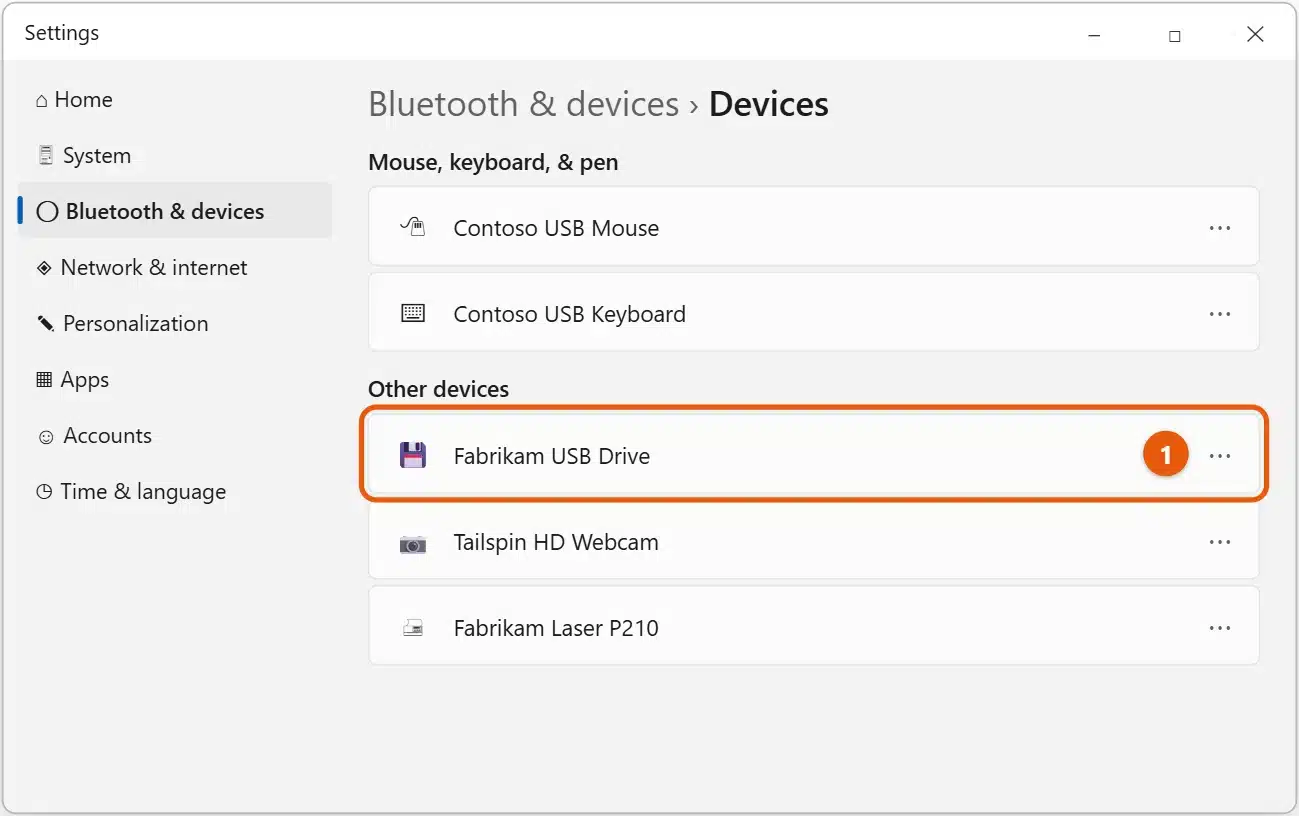
Settings also lists Bluetooth devices that have been paired, even when they’re not connected. USB devices only appear while they’re plugged in. A USB scanner that’s plugged in but not listed may still need to be added as a scanner in Windows 11.
Find USB drives in File Explorer
Press Windows + E and select This PC in the left pane. Flash drives, external hard drives, and memory cards appear under Devices and drives with their own drive letters, such as USB Drive (E:).
A drive that’s plugged in but doesn’t appear here may need a drive letter or formatting. See If a USB device doesn’t show up below.
See every USB device in Device Manager
Device Manager shows more detail, including USB hubs, controllers, and devices that aren’t working properly.
- Right-click Start and select Device Manager.
- Select View > Devices by connection.
- Expand the entries under your PC’s name to follow each USB controller down to the devices plugged into it.
To see your USB ports and hubs, switch back to View > Devices by type and expand Universal Serial Bus controllers. Drives are under Disk drives, and webcams are under Cameras.
A yellow warning triangle next to a device means Windows has a problem with it, usually a missing or faulty driver. Right-click it and select Update driver. To see devices that were connected before but are unplugged now, select View > Show hidden devices. They appear faded.
List USB devices with a command
In Terminal, this command lists the USB devices plugged in right now:
Get-PnpDevice -PresentOnly | Where-Object InstanceId -like 'USB*'
The FriendlyName column shows each device’s name, and Status shows OK for devices that are working.
See USB devices in System Information
System Information gives a read-only list that is easy to copy or save:
- Press Windows + R, type msinfo32, and press Enter.
- In the left pane, expand Components and select USB.
You see each USB controller and device with its name and PNP device ID. To keep a copy, select File > Export and save it as a text file. This is handy when a support technician asks what is plugged in.
Turn on USB connection warnings
Windows 11 can tell you when a USB device has a problem. Open Settings > Bluetooth & devices > USB and turn on Connection notifications. You’ll then see a message if, for example, a device draws more power than the port can supply or is plugged into a slower port than it supports. The same page has USB battery saver, which stops USB devices from charging while the screen is off, to save battery.
Tell which USB ports are faster
A slow transfer is often just a slow port. Look at the markings next to each port:
- An SS logo (SuperSpeed) means USB 3.x. Many USB 3 ports also have a blue plastic tab inside, though not all makers follow that.
- A lightning bolt next to a USB-C port usually means Thunderbolt, which is also the fastest choice for drives and docks.
- A port with no marking is often an older USB 2.0 port. It is fine for a mouse or keyboard but slow for copying large files.
In Device Manager, under Universal Serial Bus controllers, an entry named USB 3.x eXtensible Host Controller (or a USB4 entry) confirms the PC has fast ports. Plug drives into those and keep slower devices on the others.
Safely remove a USB drive
Before you unplug a drive, eject it so you don’t lose data:
- In File Explorer, right-click the drive and select Eject.
- Or select Show hidden icons on the taskbar, right-click Safely Remove Hardware and Eject Media, and choose the drive.
Wait for Safe To Remove Hardware before unplugging.
If a drive won’t eject
If Windows says the device is currently in use, an app still has a file open on it.
- Close any File Explorer windows and apps that use files on the drive, then try Eject again.
- If that doesn’t work, press Windows + R, type resmon, and press Enter to open Resource Monitor.
- On the CPU tab, type the drive letter (for example E:) in the Associated Handles search box. The list shows which program is holding the drive. Close that program.
Signing out or restarting the PC also releases the drive.
If a USB device doesn’t show up
- Try another port. Use one directly on the PC rather than a hub or the front panel of a desktop.
- Try another cable. Some USB cables only charge and don’t carry data.
- Scan for changes. In Device Manager, select Action > Scan for hardware changes.
- Check Disk Management for drives. Right-click Start and select Disk Management. If the drive appears without a letter, right-click it, select Change Drive Letter and Paths, and add one. Don’t format the drive unless you’re sure it has nothing you need.
- Update or reinstall USB drivers. The steps are in updating USB drivers in Windows 11.
- Reset the USB ports if nothing works in any port, following resetting USB ports on Windows 11.
- Test the device on another PC. If it doesn’t work there either, the device itself may be faulty.
Frequently asked questions
How do I see which USB devices were connected in the past?
Device Manager shows previously connected devices when you select View > Show hidden devices. Windows doesn’t show a simple history with dates in Settings.
Why does my USB drive show up but I can’t open it?
It may use a format Windows can’t read, or it may be damaged. You can format it in Windows 11, but copy anything you need off the drive first on another device if you can, because formatting erases it.
How many USB devices can I connect?
The USB standard allows up to 127 devices on each USB controller, counting hubs. In practice, the limit is usually power: a hub without its own power adapter may not run several drives at once. Use a powered hub for external hard drives.
Why do I hear the USB connect sound when nothing is plugged in?
A device is disconnecting and reconnecting, often because of a loose cable, a worn port, or a power-saving setting. Open Device Manager with View > Devices by type and watch which entry disappears and comes back when you hear the sound.
Is it safe to unplug a mouse or keyboard without ejecting?
Yes. Ejecting only matters for storage devices such as flash drives and external hard drives.
On Windows 10, the steps differ a little: seeing connected USB devices on Windows 10. Microsoft covers ejecting in Safely remove hardware in Windows.
Wireless headphones, mice and keyboards connect over Bluetooth instead, so turn on Bluetooth in Windows 11 for those. To learn what each port on your PC can do, read about checking USB ports on Windows 11.

Matt Jacobs has been working as an IT consultant for small businesses since receiving his Master’s degree in 2003. While he still does some consulting work, his primary focus now is on creating technology support content for SupportYourTech.com.
His work can be found on many websites and focuses on topics such as Microsoft Office, Apple devices, Android devices, Photoshop, and more.