Last updated on November 9th, 2026 at 12:59 pm
For a few files, use Nearby sharing: turn it on in Settings > System > Nearby sharing on both PCs, then right-click a file, select Share, and pick the other PC. For lots of files, copy them to a USB drive or put them in OneDrive and open them on the other PC.
Applies to: Windows 11 (Nearby sharing also works with Windows 10).
Which way should I use?
- A few files, PCs side by side: Nearby sharing.
- Lots of files or big videos: a USB flash drive or external drive.
- Files you want on both PCs: OneDrive.
Send files with Nearby sharing
Do these first two steps on both PCs.
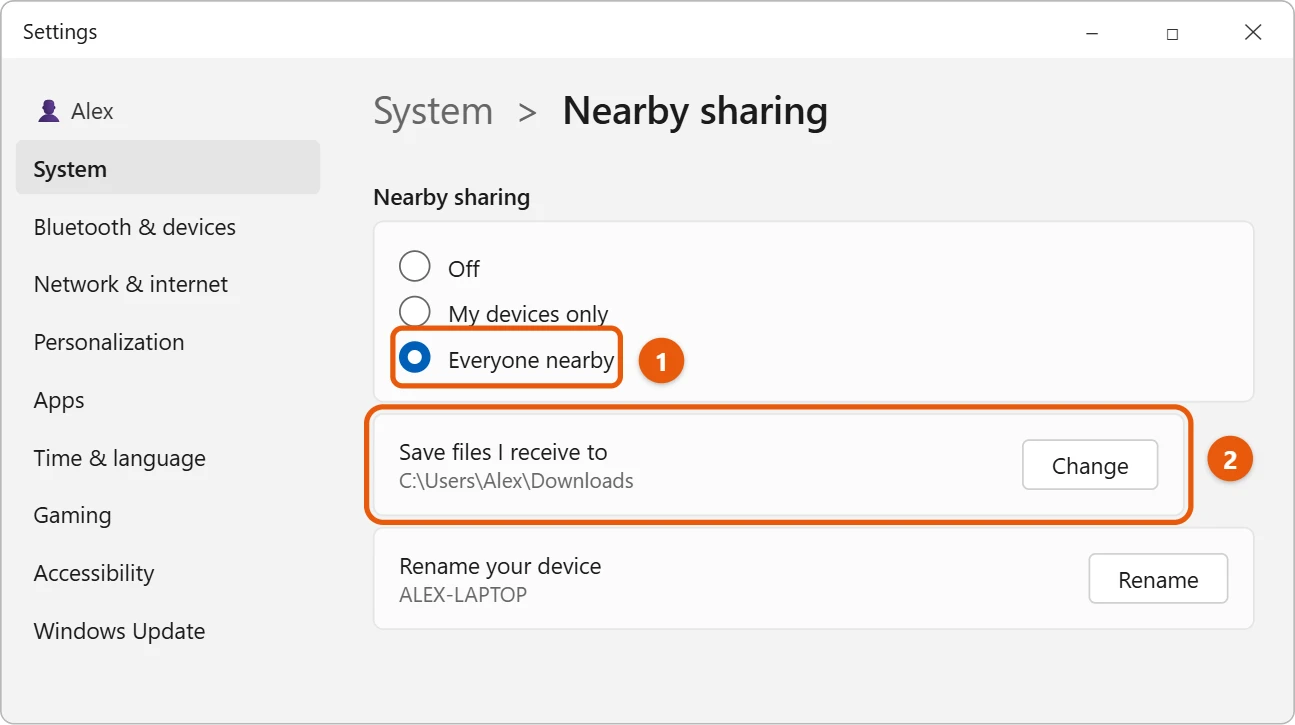
- Select Start > Settings > System > Nearby sharing.
- Choose Everyone nearby. (My devices only works if both PCs use the same Microsoft account.)
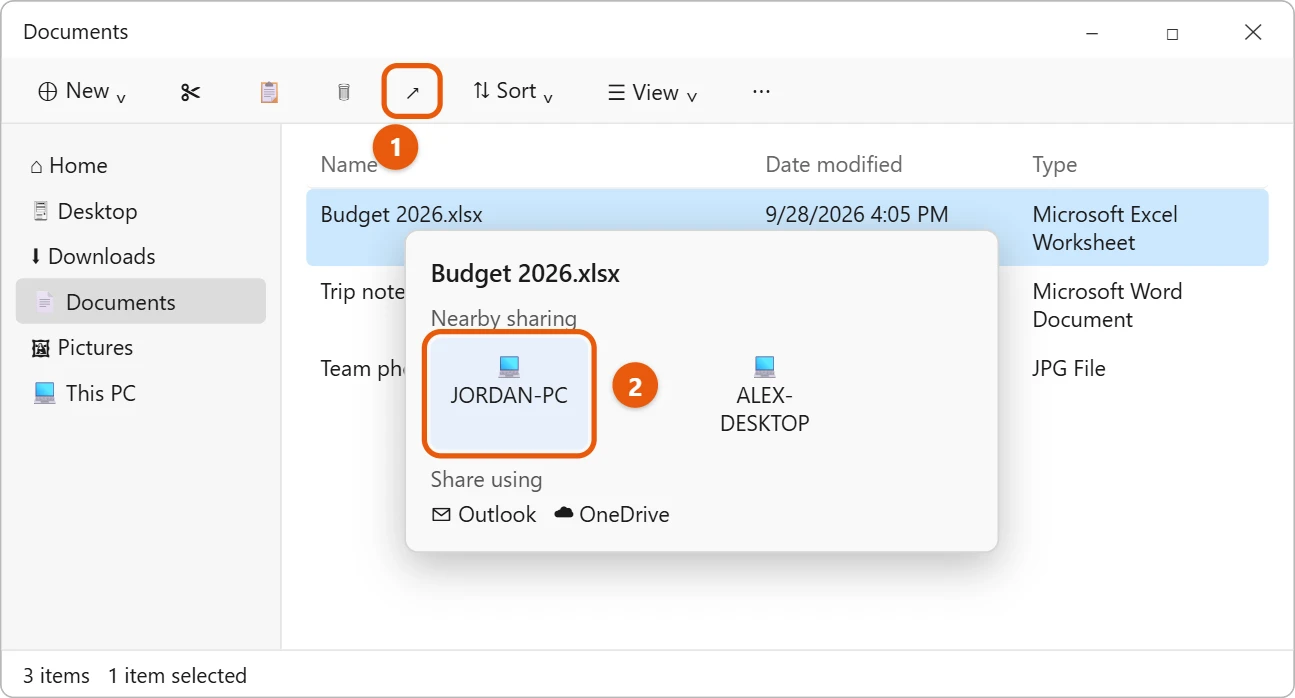
- On the PC with the files, open File Explorer and select the file.
- Select Share on the toolbar, or right-click the file and select Share.
- Select the other PC under Nearby sharing.
- On the other PC, select Save or Save & open when the notification appears. Files go to the Downloads folder.
Keep both PCs close together with Bluetooth on. It’s fastest when both are on the same private Wi-Fi network. When you’re done, you can set Nearby sharing back to Off.
Can I send files to a Windows 10 PC?
Yes. Nearby sharing works with Windows 10 version 1803 or later, and the Windows 10 side works much the same as transferring files from PC to PC in Windows 10.
Use a USB drive
- Plug the USB drive into the first PC.
- Copy the files or folders onto it.
- Safely remove the drive, plug it into the second PC, and copy the files off.
Moving a whole drive of files? Backing up Windows 11 to an external hard drive copies everything in one go.
Use OneDrive
Move the files into your OneDrive folder on the first PC and wait for them to upload. On the second PC, open OneDrive with the same account. The files appear there. Free OneDrive storage is limited, so this works best for documents and photos. For Word files in particular, transferring Word documents covers saving straight to OneDrive from Word and bringing your templates along.
If both PCs are on the same Wi-Fi or wired network and you move files between them often, a shared folder saves carrying a USB drive around.
- On the PC with the files, right-click the folder and select Properties > Sharing > Advanced Sharing.
- Check Share this folder and select OK.
- On the other PC, open File Explorer, type
\\PC-NAMEin the address bar, and press Enter. Use the first PC’s name, found in Settings > System > About. - Sign in with an account and password from the first PC when asked, then copy the files across.
Make sure the network is set to Private on both PCs, or they won’t see each other.
Moving everything to a new PC
For a whole new computer, use the Windows Backup app on the old PC. Sign in with your Microsoft account, back up your folders, settings, and app list, and then sign in with the same account while setting up the new PC. Windows offers to restore your backup during setup. Apps themselves aren’t copied, so you’ll reinstall them, but Store apps are pinned and ready to download.
Is there a direct PC-to-PC transfer in Windows?
Microsoft briefly offered a Transfer information to a new PC option in the Windows Backup app, but it is no longer available. Use Windows Backup and restore during setup instead.
More Nearby sharing details are on the Share things with nearby devices in Windows page. Upgrading from an older PC? Here’s how to transfer data from Windows 10 to Windows 11.
What Windows Backup moves, and what it doesn’t
Windows Backup is the easiest way to move to a new PC, but it doesn’t copy everything:
- Moved: the folders you choose (Desktop, Documents, Pictures and so on, through OneDrive), your settings such as wallpaper, accessibility, and language, saved Wi-Fi networks, and your list of Microsoft Store apps.
- Not moved: desktop programs you installed from websites or discs, files stored outside your backed-up folders, and anything on a second drive.
- Needs a Microsoft account: a local account can’t use Windows Backup, so use a USB drive or a shared folder instead.
Can I transfer apps to the new PC?
Not with Windows’ built-in tools. Store apps reinstall from the Microsoft Store, and other programs need to be installed again from their makers. Paid migration tools can copy some desktop apps, but reinstalling is usually more reliable.
Before you wipe or give away the old PC
- Look for files outside your user folders, such as on drive D or in folders at the top of drive C.
- Sign in to your browser’s sync, or export your bookmarks and saved passwords, so they come across.
- Write down license keys for paid programs, and sign out of or deactivate apps that limit how many PCs you can use.
- Open a few files on the new PC to check they copied correctly before you erase anything.
When you’re sure everything is across, reset Windows 11 to erase the old PC safely.
If the transfer fails or is slow
- Nearby sharing doesn’t find the other PC. Turn on Bluetooth on both, keep them within a few meters, and check both are set to Everyone nearby. It turns itself off after a while, so check again.
- Nearby sharing is very slow. It’s fastest when both PCs are on the same Wi-Fi network. For large videos, use a USB drive instead.
- A big file won’t copy to the USB drive. Drives formatted as FAT32 can’t hold files over 4 GB. Reformat the drive as exFAT after moving its files off.
- OneDrive reports you’re out of space. Free accounts have 5 GB. Move large files with a USB drive, or free up space in OneDrive.

Matt Jacobs writes and maintains the guides on Support Your Tech, which he started in 2017. He spent most of his career keeping small-business PCs running and still takes the occasional consulting job, so the steps here come from fixing the same problems on other people’s computers. Every guide is checked on his own Windows 11, Windows 10, Mac, iPhone and iPad before it goes up.