To insert a Word document into another one, click where you want it, select Insert > the arrow next to Object > Text from File, choose the document and select Insert. Its text, images and tables become part of your document, as if you’d typed them there. If you’d rather keep the file separate, select Insert > Object > Create from File to embed it as a box or icon instead.
Applies to: Word for Microsoft 365, Word 2024, 2021, 2019 and 2016 on Windows and Mac. Word for the web doesn’t have these options; copy and paste instead.
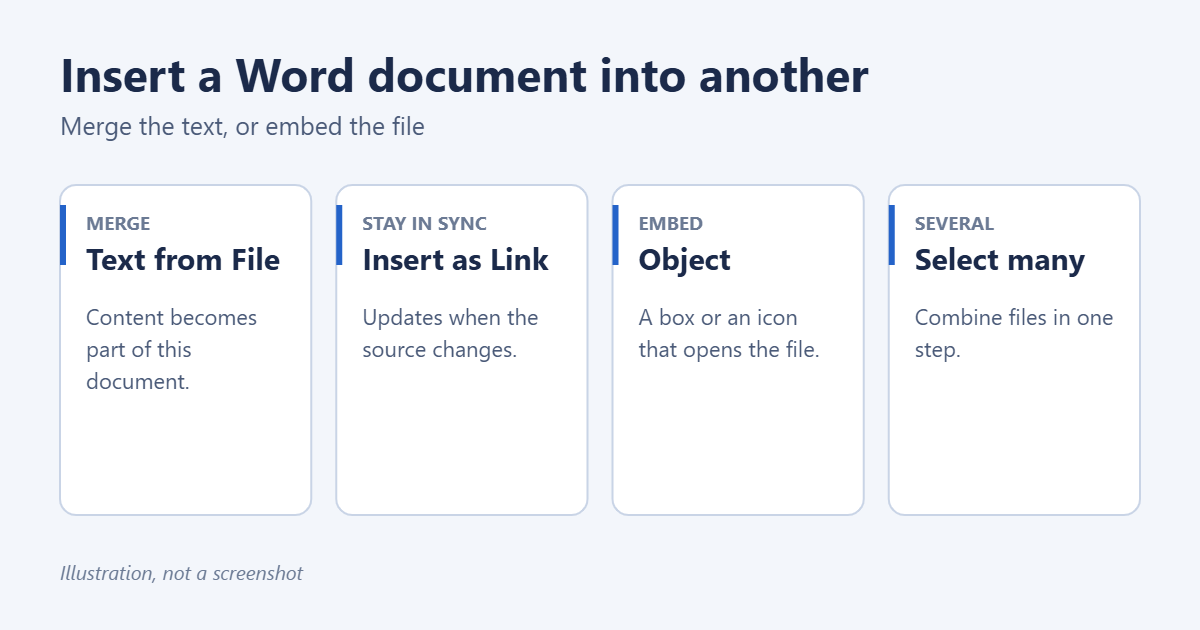
Method 1: Merge the text with Text from File
- Open the main document and click where the other document’s content should go.
- Select Insert, then the arrow next to Object in the Text group, and choose Text from File.
- Select the document to insert. To combine several, hold Ctrl and select each one; check the order afterwards, and insert them one at a time if the order matters.
- Select Insert.
The content is now part of your document and can be edited normally. Changes to the original file won’t appear here. On a Mac, select Insert > Object > Text from File (or Insert > File in some versions). Combining files this way is also how to print multiple Word documents at once in a single print job with your own settings.
Keep formatting consistent
If the inserted text uses different fonts or headings, it’s because the two documents have different styles. Select the inserted text and apply your document’s styles, or select Design and pick the same theme in both documents before inserting.
Insert just part of a document
In the source document, select the text and choose Insert > Bookmark to name it. Then in Text from File, select Range, type the bookmark name and insert. When you only need one page, copy that page from one Word document to another instead.
Method 2: Insert it as a link that updates
- Follow Method 1, but instead of selecting Insert, select the arrow next to it and choose Insert as Link.
- When the source document changes, click in the inserted text and press F9 to update it.
Edit the content in the source file, not in the main document, or your changes will be overwritten the next time it updates. Keep both files in the same place so the link doesn’t break.
Method 3: Embed the document as an object
- Select Insert > Object > Create from File.
- Select Browse and choose the document.
- Choose how it appears:
- Leave both boxes clear to show the first page inside a box.
- Tick Display as icon to show an icon that opens the document when double-clicked. Good for attachments such as contracts or appendices.
- Tick Link to file to link to the original rather than storing a copy.
- Select OK.
Embedded documents make the file bigger. They’re best for documents people need to open separately, rather than read in line. The same steps work when you insert a Word document into PowerPoint.
Method 4: Copy and paste
- Open the source document, press Ctrl + A and Ctrl + C.
- Switch to the main document, click where it should go and press Ctrl + V.
- Select the Paste Options button to choose Keep Source Formatting, Merge Formatting or Keep Text Only.
This is the only option in Word for the web, and it’s fine for short documents.
Which method should you use?
- Building one combined document: Text from File.
- Reusing a standard section that changes, such as terms and conditions: Insert as Link.
- Attaching a separate document people can open: Object with Display as icon.
- A few paragraphs: copy and paste.
Troubleshooting
Page layout changed after inserting
The inserted document brought its own section break and page settings. Show formatting marks with Home > Show/Hide and delete the extra section break. More on breaks is in creating sections in Word.
Text from File is missing
Look under the arrow next to Object, not the Object button itself. In Word for the web, it isn’t available.
The linked content won’t update
The source file moved or was renamed. Press Alt + F9 to see the field code, correct the file path, and press Alt + F9 again, then F9.
Related: How to convert a table to text in Word.

Matt Jacobs has been working as an IT consultant for small businesses since receiving his Master’s degree in 2003. While he still does some consulting work, his primary focus now is on creating technology support content for SupportYourTech.com.
His work can be found on many websites and focuses on topics such as Microsoft Office, Apple devices, Android devices, Photoshop, and more.