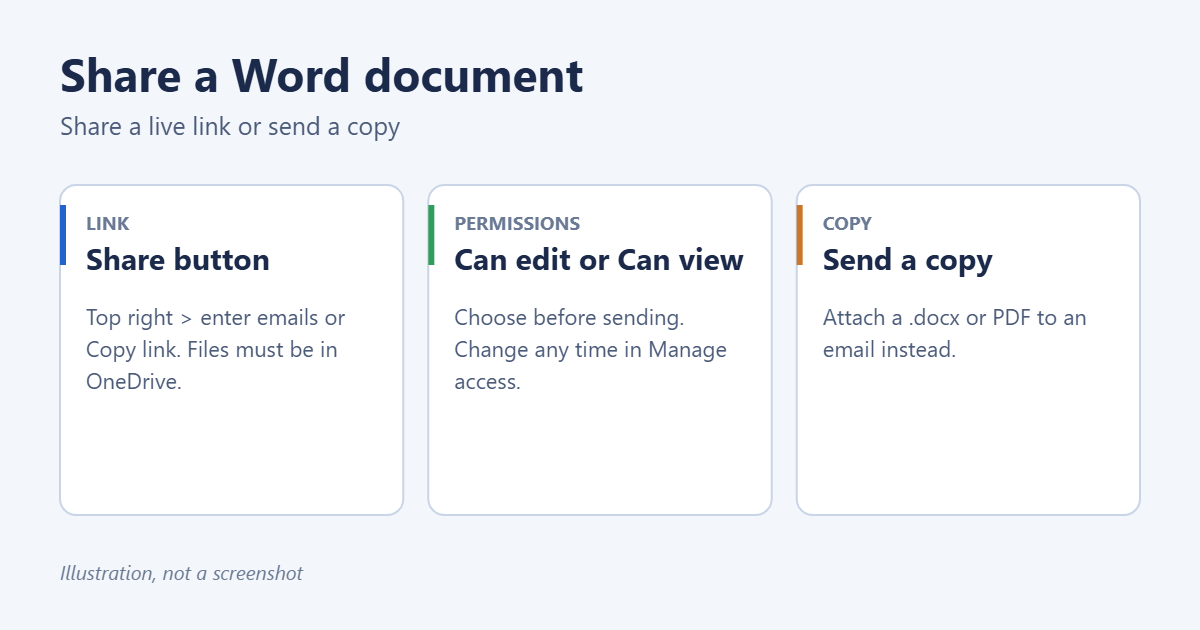
To share a Word document, select Share at the top right of the Word window. If the file isn’t in OneDrive yet, Word asks you to upload it. Then type the names or email addresses of the people you want, choose Can edit or Can view, and select Send. Everyone works on the same file, so there’s only ever one version. To send a separate copy instead, choose Share > Send a copy and attach it as a Word file or PDF.
Applies to: Word for Microsoft 365 on Windows and Mac, and Word for the web. Sharing a link needs a Microsoft account and OneDrive (or SharePoint at work). Last reviewed October 8, 2026.
Method 1: Invite people by email
- Open the document and select Share at the top right.
- If asked, choose a OneDrive folder to save it to, and select OK.
- Type names or email addresses in the box.
- Select the pencil icon (or the permission drop-down) and choose Can edit or Can view. Choose Can review if your version offers it, so edits show as suggestions.
- Add a message if you like, and select Send.
People get an email with a link. They can open the document in Word for the web without installing Word.
Method 2: Copy a link
- Select Share > Copy link.
- Select the link settings to choose who it works for: Anyone, People in your organization, People with existing access, or Specific people.
- Choose edit or view permission. Microsoft 365 subscribers can also set an expiration date or a password, and tick Block download for view-only links.
- Paste the link into a chat, text or email.
Links set to Anyone work for whoever has them, even if forwarded. Use Specific people for anything private. The same steps work in Excel; see how to share an Excel file as a link.
Method 3: Send a copy as an attachment
- Select Share > Send a copy (or File > Share > Email in older versions).
- Choose Word document to send an editable .docx, or PDF to send a version people can’t easily change.
- Outlook opens a new email with the file attached. Add recipients and send.
Copies don’t update. If you change the document later, you’ll need to send it again.
Work on it together
- When others are editing, their initials appear at the top right and colored flags show where they’re working.
- Changes save automatically while AutoSave is on; see how to turn on AutoSave in Word.
- Turn on Review > Track Changes to see who changed what; see how to use Track Changes in Word.
- Use @mentions in comments to notify a specific person.
Change or stop sharing
- Select Share > Manage access (the three dots in the Share box, on some versions).
- Change a person’s permission, remove them, or delete a link.
Removing someone takes effect immediately; they can no longer open the file from the link.
Troubleshooting
There’s no Share button
You’re using Word 2019 or 2016 without a subscription, or you’re not signed in. Use File > Share, or save the file to OneDrive in a browser and share it from there.
The other person can’t open the link
The link may be set to Specific people and they’re signed in with a different email, or the link expired. Send it to the address they use for their Microsoft account, or create an Anyone link.
They can view but not edit
Their permission is Can view. Change it in Manage access.
Comments disappeared from a shared copy
Copies sent as PDF don’t keep editable comments. Share the .docx or a link. To move comments between files, see how to copy comments from one Word document to another.
Frequently asked questions
Can people without Microsoft 365 edit it?
Yes. Anyone with an edit link can use Word for the web for free, though they may need to sign in with a free Microsoft account.
Can I share a Word document to Google Docs?
Upload the .docx to Google Drive and open it with Google Docs. Changes there won’t sync back to the Word file.
Related: How to Turn a Word Doc Into a Google Doc.
Related: How to Download a Word Document.
Related: how to get Microsoft Word for free.

Matt Jacobs has been working as an IT consultant for small businesses since receiving his Master’s degree in 2003. While he still does some consulting work, his primary focus now is on creating technology support content for SupportYourTech.com.
His work can be found on many websites and focuses on topics such as Microsoft Office, Apple devices, Android devices, Photoshop, and more.