Last updated on November 17th, 2026 at 03:06 pm
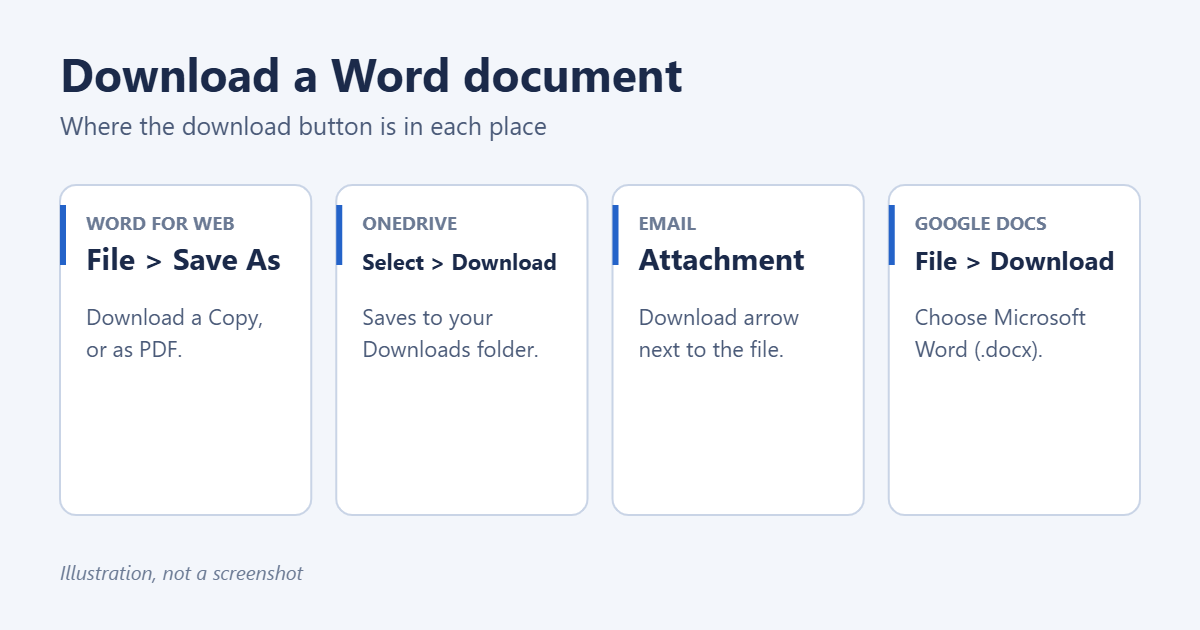
Where the document lives decides how you download it. In Word for the web, select File > Save As > Download a Copy. In OneDrive, select the file and choose Download. For an email attachment in Outlook or Gmail, select the download arrow next to the file. Google Docs and phones work a little differently, as shown below. The document is saved as a .docx file in your Downloads folder, ready to open in Word.
From Word for the web
- Open the document in Word for the web, at office.com or from OneDrive.
- Select File > Save As (or File > Download in some versions).
- Choose Download a Copy for a Word file, Download as PDF for a PDF, or Download as ODT for other word processors.
- If your browser asks, choose where to save it.
- Go to onedrive.com and sign in, or open your SharePoint site.
- Select the circle next to the document, without opening it.
- Select Download on the toolbar, or right-click the file and choose Download.
If you select several files or a folder, OneDrive downloads them as a .zip file. Right-click it in File Explorer and choose Extract All.
If you see Download greyed out, the person who shared the file may have blocked downloads. Ask them for a copy.
Can I download a document someone shared with me as view-only?
Usually yes, unless they blocked downloads. With work or school accounts, owners can turn off downloading.
From an email attachment
- Outlook (new Outlook and the web): select the arrow next to the attachment and choose Download.
- Classic Outlook: right-click the attachment and choose Save As, then pick a folder.
- Gmail: hover over the attachment and select the download icon.
- Apple Mail: drag the attachment to your Desktop, or right-click it and choose Save Attachment.
From Google Docs
- Open the document in Google Docs.
- Select File > Download > Microsoft Word (.docx).
Most formatting converts well. Check fonts, tables and comments once it opens in Word. Going the other way works too: turn a Word doc into a Google Doc.
From Microsoft Teams
Open the Files tab in the chat or channel, select the three dots next to the document and choose Download.
On a phone or tablet
- iPhone and iPad: tap the attachment or file, tap the Share button and choose Save to Files. In the Word app, documents in OneDrive can be made available offline from the file’s menu.
- Android: tap the download icon next to an attachment. Files go to the Downloads folder in the Files app.
Find the file after downloading
Downloads usually go to the Downloads folder. On Windows, press Ctrl + J in your browser to see recent downloads and select Show in folder. If the file still isn’t there, try these ways to find downloads on Windows 11.
Open the downloaded document
Double-click the .docx file to open it in Word. Files from the internet and email open in Protected View; select Enable Editing in the yellow bar if you trust the file and want to change it. Without the Word app, you can upload the file to OneDrive and open it in Word for the web for free. If the bar keeps coming back or you still can’t type, see how to enable editing in Word.
How do I send the downloaded document to someone else?
Attach it to an email, or share it from OneDrive so you both work on the same copy. The sharing options are explained in sharing a Word document.
No Word app on this computer? Here’s how to get Microsoft Word for free.
Files that download as .zip or show as corrupt
The file downloads as .zip or .htm
A .zip contains several files; extract it. An .htm file means you saved the page rather than the document. Go back and use the download option described above.
Word reports that the file is corrupt
The download may not have finished. Delete it and download it again, then try File > Open > Browse, select the file and choose Open and Repair from the Open button’s menu.

Matt Jacobs writes and maintains the guides on Support Your Tech, which he started in 2017. He spent most of his career keeping small-business PCs running and still takes the occasional consulting job, so the steps here come from fixing the same problems on other people’s computers. Each guide follows Microsoft, Apple and Google’s own documentation and is updated when the steps change. Screenshots marked “Recreated” are illustrations of the real screens.