To test your RAM in Windows 10, save your work, press Windows logo key + R, type mdsched, and press Enter. Select Restart now and check for problems (recommended). Windows restarts, tests the memory, and shows the result after you sign back in.
Test your RAM if your PC freezes, restarts on its own, or shows blue-screen errors such as MEMORY_MANAGEMENT.
Applies to: Windows 10. Checked against Microsoft Support on September 25, 2026.
Signs your RAM may be failing
- Blue screens with codes such as MEMORY_MANAGEMENT, PAGE_FAULT_IN_NONPAGED_AREA or IRQL_NOT_LESS_OR_EQUAL
- Random restarts or freezes, especially during games or other heavy tasks
- Apps crashing in different ways, or files that become damaged after you save them
- The PC beeping at startup or not starting at all after you add new memory
Check your RAM details first
- Open Task Manager (Ctrl + Shift + Esc), select More details if needed, then Performance > Memory. It shows how much RAM you have, its speed, and how many slots are used.
- For each stick’s maker and size, run this in PowerShell:
Get-CimInstance Win32_PhysicalMemory | Select-Object Manufacturer,Capacity,Speed,PartNumber
Run Windows Memory Diagnostic
- Save your work and close your apps.
- Press Windows logo key + R, type
mdsched, and press Enter. - Select Restart now and check for problems (recommended).
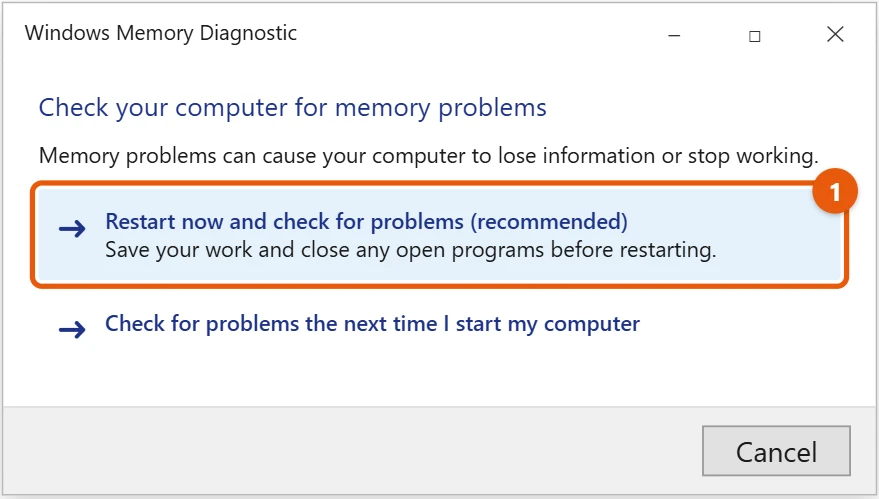
The test runs before Windows starts and can take 15 minutes or more.
Run a more thorough test
- While the test screen is showing, press F1.
- Under Test Mix, use the arrow keys to choose Extended.
- Press F10 to start.
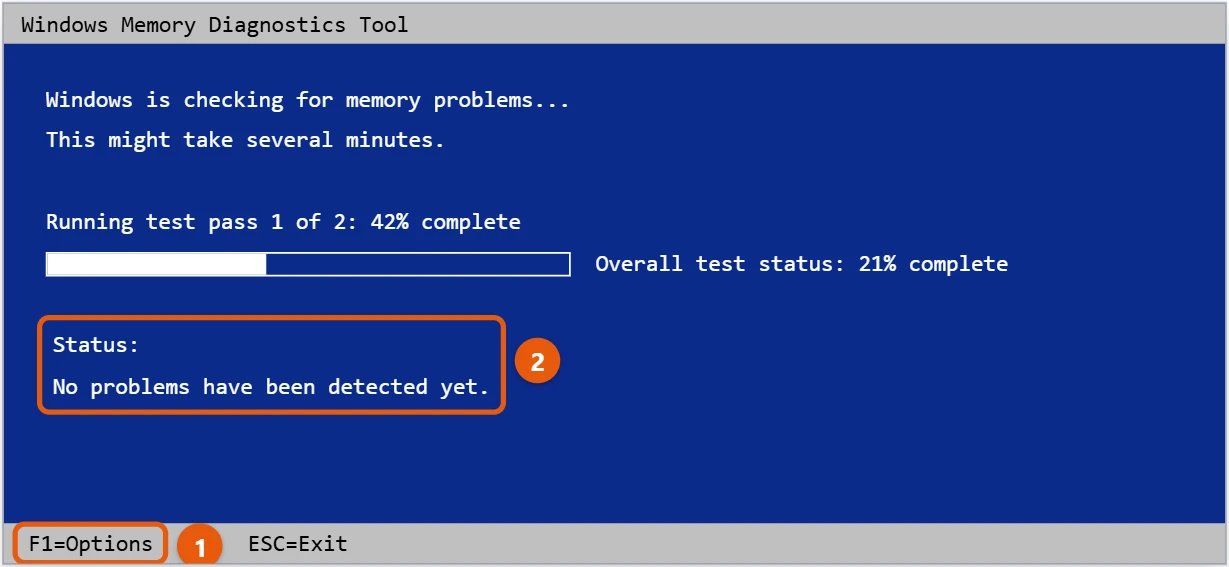
The extended test takes much longer, sometimes hours, but finds more problems.
Find the results
After the test, Windows restarts. When you sign in, a notification near the clock shows the result.
If you missed it:
- Right-click Start and select Event Viewer.
- Open Windows Logs > System, then select Find and search for
MemoryDiagnostics-Results.
Microsoft also lists the results under Applications and Services Logs > Microsoft > Windows > MemoryDiagnostics-Results.
If the test finds errors
- Turn off the PC and reseat the memory sticks if you can. Then test again.
- Test one stick at a time to find the faulty one.
- Replace faulty RAM. On many laptops, the memory can’t be replaced, so contact the maker.
- The test looks stuck: progress can pause on one percentage for a while. Give it time; the Extended test can take hours.
- Errors only with a memory overclock: if XMP or EXPO is turned on in your PC’s BIOS, turn it off and test again. Some RAM isn’t stable at its rated speed in every PC.
- The test passes but crashes continue: run the Extended test overnight, or try a free bootable tester such as MemTest86, which runs more passes.
Other built-in checks
If the memory passes but problems continue, check your system files and drive. See how to repair Windows 10 and how to run CHKDSK in Windows 10.
Frequently asked questions
How do I see how much RAM I have?
See how to check RAM in Windows 10.
My PC blue-screens. Where do I start?
See how to fix the blue screen of death in Windows 10.
How long does the test take?
The standard test usually takes 10 to 30 minutes, depending on how much RAM you have. The Extended test can take several hours.
Can I use the PC while it tests?
No. The test runs before Windows starts, so the PC is busy until it finishes and restarts.
Should I test new RAM after installing it?
Yes. Run the test once after you add or replace memory, ideally the Extended test. It’s the easiest way to catch a faulty stick while you can still return it.
If you recently changed your memory speed, see how to change RAM speed in BIOS to undo it.
To see how much memory a Windows 11 PC has, see how to check how much RAM you have in Windows 11.
Microsoft’s guide is How to fix Error 0xA: IRQL_not_less_or_equal (Check the Windows device’s memory). More help is on our Windows Help & Guides page.
Related: check crash logs on Windows 11.

Matt Jacobs has been working as an IT consultant for small businesses since receiving his Master’s degree in 2003. While he still does some consulting work, his primary focus now is on creating technology support content for SupportYourTech.com.
His work can be found on many websites and focuses on topics such as Microsoft Office, Apple devices, Android devices, Photoshop, and more.