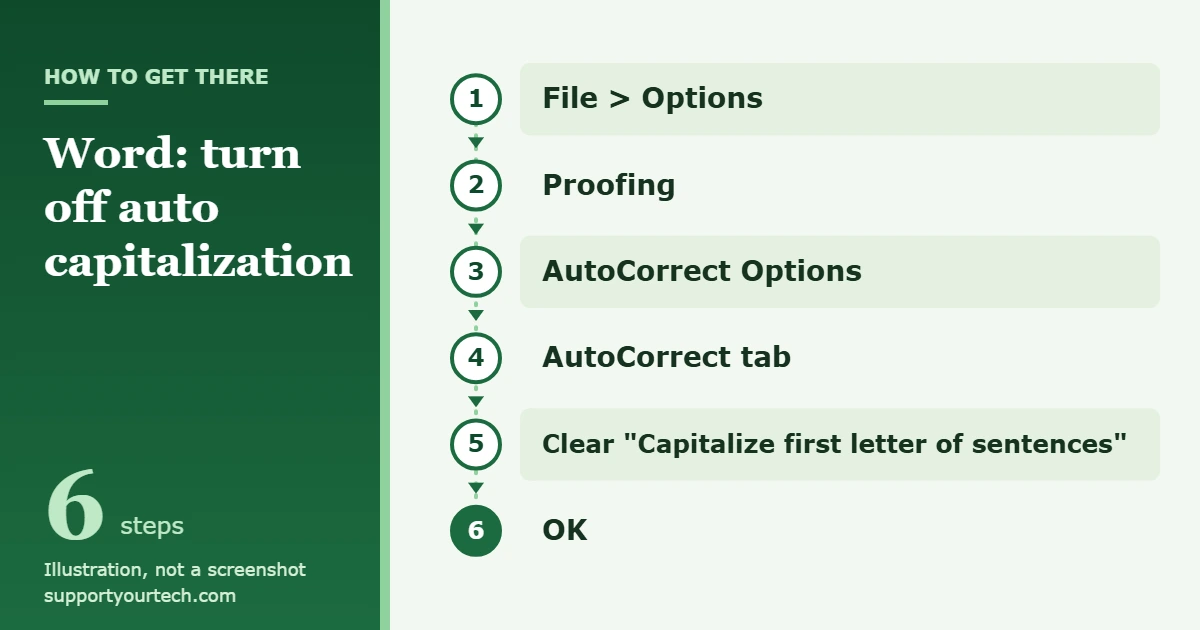
To turn off auto capitalization in Word for Windows, go to File > Options > Proofing > AutoCorrect Options, open the AutoCorrect tab, clear Capitalize first letter of sentences, and select OK. The other capitalization rules sit in the same window, so you can switch off only the one that is getting in your way.
Applies to: Word for Microsoft 365, Word 2024, Word 2021, Word 2019 and Word 2016 on Windows, with notes for Word for Mac, Word for the web and the mobile apps. Checked against Microsoft Support on October 6, 2026.
What auto capitalization is in Word
Auto capitalization is part of AutoCorrect, the Word feature that changes text while you type. It is not a spelling or grammar setting, so turning off spell check or grammar check will not stop it. AutoCorrect has several separate capitalization rules, and each one has its own check box: If it is the spelling switches you are after, see how to turn on spell check in Windows 10.
| Rule | What it does | Turn it off when |
|---|---|---|
| Capitalize first letter of sentences | Capitalizes the first word after a period and the first word of each new paragraph, which includes every item in a bulleted or numbered list. | You write lists, code, poetry, notes or product names that should start in lowercase. |
| Capitalize first letter of table cells | Capitalizes the first word you type in each table cell. | Your table holds lowercase codes, units, email addresses or short labels. |
| Capitalize names of days | Changes monday to Monday, and so on. | You use day names as lowercase labels or in another language. |
| Correct TWo INitial CApitals | Changes a word that starts with two capitals, such as THursday, to Thursday. | You type names or terms that really do start with two capitals. |
| Caps Lock correction | Fixes text typed with Caps Lock left on by accident, such as tHIS. | You deliberately type text in that pattern. |
For most people the first rule is the one causing trouble. Because Word treats every new paragraph as a new sentence, it is also the rule that capitalizes the first word of each list item.
Turn off auto capitalization in Word for Windows
- Open Word and any document. The setting applies to Word as a whole, so it does not matter which document is open.
- Select File in the upper-left corner, then select Options. The Word Options window opens.
- Select Proofing in the list on the left side of the window.
- Select the AutoCorrect Options button. A smaller AutoCorrect window opens on top.
- Make sure the AutoCorrect tab is selected. The capitalization check boxes are on this tab, along with the Replace text as you type option.
- Clear the check box for Capitalize first letter of sentences. Clear any of the other capitalization boxes you do not want, and leave the rest checked.
- Select OK to close the AutoCorrect window, then select OK again to close Word Options. Word stops making that change from now on.
Microsoft lists the same path in its guide to turning AutoCorrect on or off in Word. Changing these boxes does not alter text that is already in your document. It only affects what you type afterward.
Keep auto capitalization but add exceptions
If Word is right most of the time and wrong about a few specific words, an exception is a better fix than switching the rule off. Exceptions tell AutoCorrect to leave certain words alone.
- Go to File > Options > Proofing > AutoCorrect Options and open the AutoCorrect tab.
- Select Exceptions.
- Pick the tab that matches the problem. Use First Letter to stop Word from capitalizing the word that follows an abbreviation ending in a period, such as appt. Use INitial CAps to protect a word with mixed capitals, such as IDs.
- Type the abbreviation or word in the box and select Add. To remove an exception later, select it in the list and select Delete.
- Select OK in each window to save.
Microsoft describes these exception tabs in its AutoCorrect features documentation for Office.
Undo one automatic capital letter
You do not have to change any setting to reject a single correction. Right after Word capitalizes a letter, press Ctrl+Z (Cmd+Z on a Mac). Undo reverses the automatic change and leaves the letter as you typed it, and you can keep typing.
When Word capitalizes the start of every line, it is because each press of Enter starts a new paragraph. Pressing Shift+Enter (Shift+Return on a Mac) inserts a line break inside the same paragraph instead, which is useful for addresses and verses.
Fix capital letters that are already in the document
Turning off the AutoCorrect rule does not lowercase anything Word has already changed. To fix existing text:
- Select the text you want to change.
- On the Home tab, select Change case.
- Choose lowercase, Sentence case, UPPERCASE, Capitalize Each Word or tOGGLE cASE.
As a shortcut, select the text and press Shift+F3 to switch between lowercase, uppercase and title case. Microsoft covers both in its article on how to change the capitalization or case of text.
Turn off auto capitalization in Word for Mac
Word for Mac has no File > Options screen. The AutoCorrect settings are reached from the menu bar at the top of the screen.
- With Word open, select the Word menu in the menu bar, then select Preferences.
- Select AutoCorrect. You can also open the same settings from the Tools menu by choosing AutoCorrect.
- Clear the check box for Capitalize first letter of sentences, then close the window.
The spelling and grammar preferences on a Mac only control what Word checks and underlines. They do not control automatic capitalization.
Word for the web and the mobile apps
The steps are different in Word for the web. Microsoft keeps the browser steps on a separate Web tab of its AutoCorrect help page linked above.
In the Word apps for phones and tablets, automatic capitalization comes from the device keyboard, not from Word. Microsoft’s guidance for iPhone and iPad is to open the device’s Settings app, go to General > Keyboard, and turn off auto-capitalization there. On Android the steps vary by device and keyboard app, so check the keyboard settings from your phone’s manufacturer. A keyboard change like this affects every app on the device, not only Word.
Confirm the change, or turn it back on
To check that it worked, type a short lowercase sentence, end it with a period, press the spacebar and type another lowercase word. The word should stay lowercase. If you turned off the table or day-name rules, type a lowercase word in a table cell or type monday to test those as well.
To turn auto capitalization back on, return to File > Options > Proofing > AutoCorrect Options, check the boxes again and select OK.
Troubleshooting
- Word still capitalizes list items or lines. Check that Capitalize first letter of sentences is the box you cleared. Each list item and each new line made with Enter is a new paragraph, and this is the rule that capitalizes it.
- Word still capitalizes text in tables. Table cells have their own rule. Clear the table cells check box on the same tab.
- You cannot find Options. You may be in Word for the web or Word for Mac, which do not use the File > Options path.
- Words are replaced, not just capitalized. That comes from the Replace text as you type option on the AutoCorrect tab, not from the capitalization rules. You can remove the specific entry or clear that box.
- The setting is greyed out or keeps coming back. On a work or school computer, Office settings can be managed by the organization, so ask your IT administrator. If the box is checked again after an Office update, repeat the steps to clear it.
- Everything you type is in capitals. That is usually the Caps Lock key and not AutoCorrect. See our guide to turning off Caps Lock in Windows 10.
Frequently asked questions
Why does Word keep capitalizing the first letter?
The AutoCorrect rule Capitalize first letter of sentences is on by default. Word applies it after a period and at the start of every new paragraph, so it also affects lists and single lines.
Does turning off auto capitalization turn off spell check?
No. Spelling and grammar checking are separate settings on the Proofing screen. If the underlines are what bother you, see how to hide spelling and grammar errors in Word.
Can I turn off auto capitalization for one document only?
No. The AutoCorrect capitalization boxes are application settings, so they apply to every document you open in Word on that computer. For a single document, use Ctrl+Z on the corrections you do not want, or turn the rule off while you work and back on afterward.
Will my existing text change when I turn the setting off?
No. AutoCorrect only acts while you type. Use Change case on the Home tab or Shift+F3 to fix capitals that are already there.
How do I stop Word from capitalizing after an abbreviation?
Add the abbreviation, including its period, on the First Letter tab under Exceptions. Word then stops treating that period as the end of a sentence.
Does this change other Office apps?
Each Office app has its own AutoCorrect Options window, reached through the same File > Options > Proofing path in apps such as Excel. Do not assume a change in Word carries over; open that window in each app where automatic capitals bother you and check the boxes there.
Once the capitalization rules are set the way you want, look through the Replace text as you type entries on the same tab and remove any automatic replacements you never use.
Related: how to turn off Grammarly in Word.
Related: capitalize each word in Excel.

Matt Jacobs has been working as an IT consultant for small businesses since receiving his Master’s degree in 2003. While he still does some consulting work, his primary focus now is on creating technology support content for SupportYourTech.com.
His work can be found on many websites and focuses on topics such as Microsoft Office, Apple devices, Android devices, Photoshop, and more.