To restart page numbering in Word, the page where numbering should start again has to begin a new section. Click at the top of that page and select Layout > Breaks > Next Page. Then double-click the page number on that page, select Page Number > Format Page Numbers, choose Start at, type 1 and select OK. Turn off Link to Previous if you also want the earlier pages numbered differently.
Applies to: Word for Microsoft 365, Word 2024, 2021, 2019 and 2016 on Windows and Mac. Last reviewed October 7, 2026.
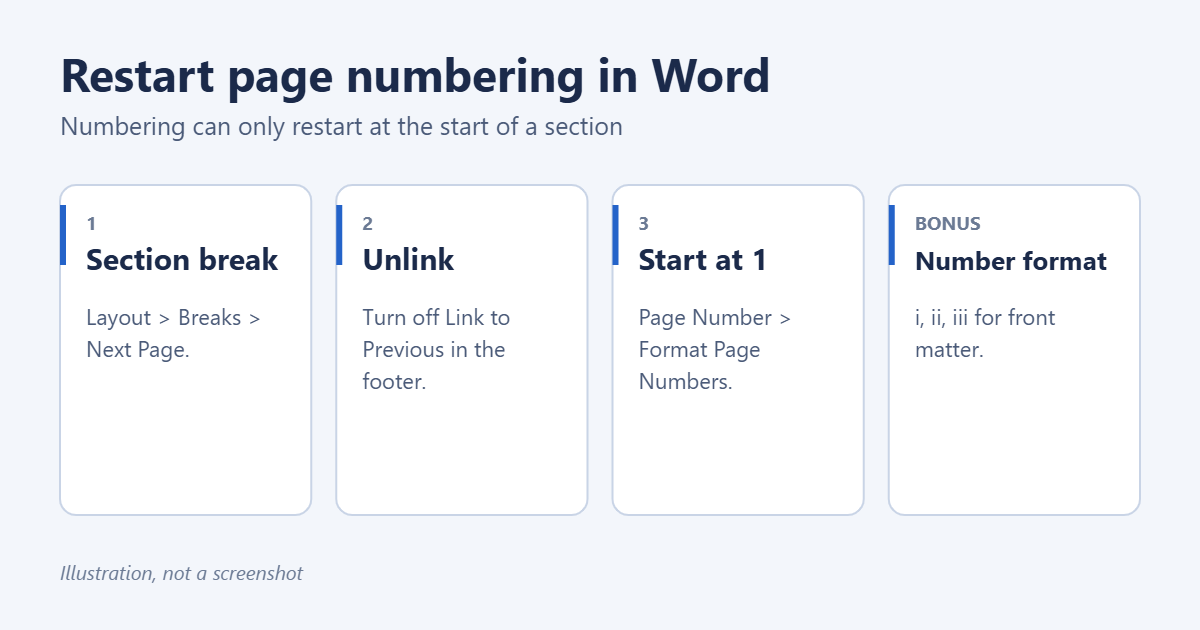
Step 1: Add a section break where numbering restarts
- Select Home > Show/Hide (¶) so you can see breaks.
- Click at the very beginning of the first page that should be numbered 1, for example the start of chapter 1.
- If there’s a manual Page Break just before it, delete it.
- Select Layout > Breaks > Next Page.
A Section Break (Next Page) line appears, and the text after it starts a new section. For more on sections, see how to create sections in Word.
This step is only needed if the two sections should look different, for example no numbers or Roman numerals before the break.
- Double-click the footer (or header, wherever your page numbers are) on the first page of the new section.
- On the Header & Footer tab, select Link to Previous to turn it off.
Step 3: Restart the numbers
- With the footer still open in the new section, select Page Number > Format Page Numbers.
- Under Page numbering, choose Start at and type 1.
- Choose a Number format if you want a different style.
- Select OK.
If there’s no page number yet, add one first with Page Number > Bottom of Page and a style, then format it.
Example: Roman numerals before the main text
Theses and reports often number the front matter i, ii, iii and the main text 1, 2, 3.
- Add a Next Page section break before chapter 1, as in Step 1.
- In the front matter’s footer, select Page Number > Format Page Numbers, choose i, ii, iii and Start at i.
- In chapter 1’s footer, turn off Link to Previous, open Format Page Numbers, choose 1, 2, 3 and Start at 1.
To leave the title page unnumbered as well, double-click its footer and tick Different First Page. See how to remove the page number from the first page in Word.
Continue numbering instead
If a section restarted at 1 by mistake, open Format Page Numbers in that section and choose Continue from previous section.
Update the table of contents
A table of contents uses the numbers shown on each page, so update it after changing numbering: click in it and select Update Table > Update page numbers only. See how to add a table of contents in Word.
Troubleshooting
Numbering restarts on every section
Each section is set to Start at 1. Open Format Page Numbers in the sections that should carry on and choose Continue from previous section.
Changing numbers in one section changes them all
Changing the number format in a linked footer can affect the others. Turn off Link to Previous first, then change the format.
Page numbers disappeared after adding a section break
The new section has Different First Page ticked, or its footer was unlinked and is empty. Double-click the footer and check both.
The number shows {PAGE} instead of a number
Word is showing field codes. Press Alt + F9 to switch back.
Frequently asked questions
Can I restart numbering without a section break?
No. Word stores page numbering per section, so a restart always needs a new section.
Can each chapter have its own headers too?
Yes. See how to make different headers in Word.
Related: How to auto number in Word.
Related: How to start page numbers on page 3 in Word.
Related: how to number pages in Word.
Related: How to Fix Numbering in Word.
Related: how to stop page numbering in Word.
Related: how to change the font of page numbers in Word.

Matt Jacobs has been working as an IT consultant for small businesses since receiving his Master’s degree in 2003. While he still does some consulting work, his primary focus now is on creating technology support content for SupportYourTech.com.
His work can be found on many websites and focuses on topics such as Microsoft Office, Apple devices, Android devices, Photoshop, and more.