Last updated on November 9th, 2026 at 01:42 pm
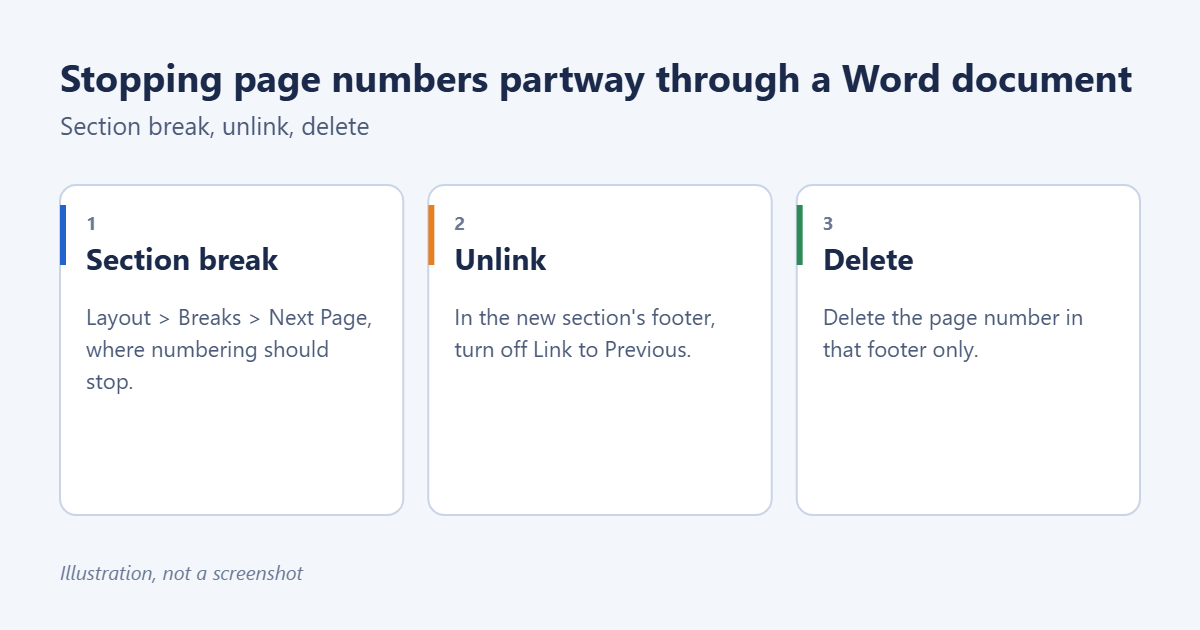
To stop page numbering partway through a Word document, for example before an appendix, split the document into sections and remove the numbers from the section you don’t want numbered. Put a Next Page section break where numbering should stop, open the footer of the new section, turn off Link to Previous, and delete the page number there. To remove page numbers from the whole document instead, use Insert > Page Number > Remove Page Numbers. Both are covered below, along with the first-page case and the most common mistake.
Remove page numbers from the whole document
- Go to the Insert tab.
- Click Page Number in the Header & Footer group.
- Choose Remove Page Numbers.
If a number is still showing, it was typed in or added as part of a footer design. Double-click the footer, select the number, and press Delete, then click Close Header and Footer.
Stop page numbering at a certain page
Word numbers pages per section, so you need the unnumbered pages in their own section.
Step 1: Add a section break
- Click at the very end of the last page that should keep its number.
- Go to Layout > Breaks.
- Under Section Breaks, choose Next Page.
The following page now starts a new section. Click Home > Show/Hide ¶ (or press Ctrl + Shift + 8) to see the break as a dotted line labeled Section Break (Next Page). If there’s already a manual page break at that spot, delete it so you don’t get a blank page.
Step 2: Unlink the new section’s footer
- Double-click the footer (or header, wherever your page numbers are) on the first page of the new section.
- On the Header & Footer tab, click Link to Previous so it’s no longer highlighted. The “Same as Previous” label on the footer disappears.
This is the step most people miss. While the footer is linked, anything you delete in it is deleted from the previous section too.
Step 3: Delete the page number
- Select the page number in the new section’s footer and press Delete.
- Click Close Header and Footer.
Pages before the break keep their numbers, and pages after it have none.
Does this work in Word for Mac?
Yes. The steps are the same: Layout > Breaks > Next Page, then Link to Previous on the Header & Footer tab.
Number some pages, skip some, then number again
For a layout like numbered chapters, an unnumbered insert, then more numbered chapters, use two section breaks: one before the insert and one after it. Unlink and delete the number in the middle section. Then, in the section after it, turn off Link to Previous, re-insert the page number with Insert > Page Number, and choose Format Page Numbers to either continue from the previous section or start at a specific number. Starting over at a new number is explained in restarting page numbering in Word.
Remove the number from the first page only
For a cover page, you don’t need a section break. Double-click the footer on page 1, tick Different First Page on the Header & Footer tab, and the number disappears from the first page only. Screenshots and variations are in removing the page number from the first page. When the first two pages should both be unnumbered, start page numbers on page 3 in Word instead.
Numbers removed from every page
Deleting the number removed it from every page
Link to Previous was still on. Press Ctrl + Z to undo, click into the new section’s footer, turn off Link to Previous, and delete the number again.
Link to Previous is greyed out
You’re in the first section of the document, which has nothing before it to link to. Check that you added the section break and clicked into the footer after it.
The numbers are in the header and the footer
Headers and footers are linked separately. Turn off Link to Previous in both, then delete the numbers.
A blank page appeared after the section break
There’s an extra page break or empty paragraph next to the section break. Turn on Show/Hide ¶ and delete the extra break or blank paragraph marks.
The numbering after the unnumbered part starts at 1
Click Insert > Page Number > Format Page Numbers in that section and choose Continue from previous section.
Will a section break change my formatting?
No, unless you change something in the new section. Margins, orientation, and columns can be set per section, which is also how you get a single landscape page in a portrait document.

Matt Jacobs writes and maintains the guides on Support Your Tech, which he started in 2017. He spent most of his career keeping small-business PCs running and still takes the occasional consulting job, so the steps here come from fixing the same problems on other people’s computers. Every guide is checked on his own Windows 11, Windows 10, Mac, iPhone and iPad before it goes up.