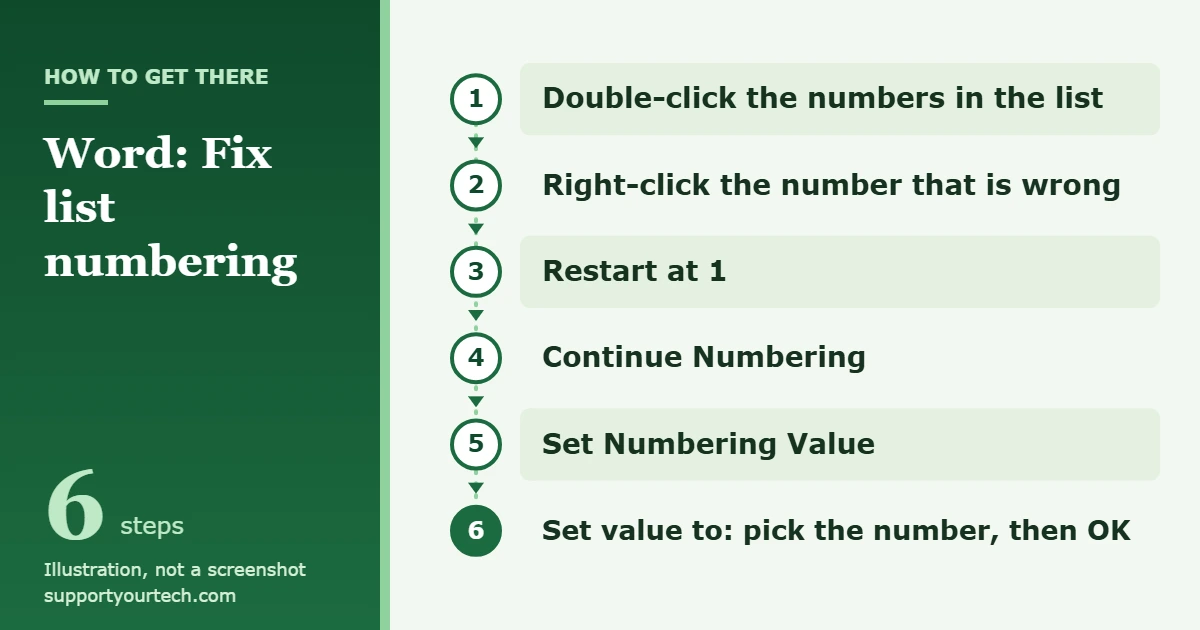
To fix numbering in Word, double-click any number in the list, right-click the number that is wrong, and choose Restart at 1, Continue Numbering, or Set Numbering Value. Use the command that matches the problem rather than typing over the numbers, because Word manages list numbers automatically and loses track of typed changes.
Applies to: Word for Microsoft 365, Word 2024, Word 2021, Word 2019 and Word 2016 on Windows.
Before you start: know which kind of number you are fixing
Word has three kinds of numbers that look alike, and each one is fixed in a different place:
- List numbers are the automatic 1, 2, 3 (or a, b, c) in front of paragraphs. This guide covers them.
- Typed numbers are ordinary characters someone entered by hand. Word cannot renumber them, so they drift out of order when you add or delete items.
- Line numbers run down the left margin and are set on the Layout tab. Page numbers sit in the header or footer and have their own commands.
A quick test: double-click a number. If it is an automatic list number, every number in the list highlights and the paragraph text does not appear selected. If only the digit you clicked gets selected like normal text, the number was typed, and you should rebuild that part as a real list (see “Turn numbering off and on again” below).
Fix a list that restarts, continues or skips the wrong way
This is the main fix for most numbering problems: a new list that keeps counting from the previous one, a list that starts again at 1 after a normal paragraph, or a list that needs to begin at a particular number.
- Select the list numbers. Double-click one of the numbers in the list. The numbers highlight, but the text does not appear selected.
- Right-click the number that is wrong. Right-click the number itself, not the text after it, so that Word shows its list commands on the shortcut menu.
- To start a fresh list, choose Restart at 1. The item you right-clicked becomes 1, and every item after it renumbers from there.
- To join a list that broke in two, choose Continue Numbering. Right-click the first number of the part that restarted. Word picks up the count from the list above, so a list that went 1, 2, 3, then 1, 2 becomes 1 to 5.
- To start at a specific number, choose Set Numbering Value. In the Set value to box, use the arrows to pick the number you want, such as 7, and then select OK. The rest of the list follows on from that value.
- Check the numbers around the change. Read the items just before and after the spot you fixed. If the numbering is still off, press Ctrl+Z to undo and try the other command.
Which command to choose: use Restart at 1 when the items really are a new list (for example, a second set of instructions). Use Continue Numbering when the items belong to the same list but an unnumbered paragraph, note or picture split it. Use Set Numbering Value when the starting number itself has to change. The same advice against retyping list numbers by hand appears on Microsoft’s page on changing the numbering in a numbered list.
Turn numbering off and on again
When a list mixes typed numbers with automatic ones, or keeps behaving oddly after many edits, reapplying the numbering usually clears it up.
- Select only the paragraphs that should be in the list. Leave out any normal paragraph above or below it, or Word will number that paragraph too.
- Delete any numbers that were typed by hand at the start of those paragraphs.
- On the Home tab, in the Paragraph group, select Numbering. If the paragraphs were already numbered, this removes the numbering; select Numbering a second time to apply a fresh list.
- To pick a different style, select the arrow next to Numbering and choose a format from the Numbering Library.
- If the new list carries on from an earlier list, right-click its first number and choose Restart at 1.
Fix numbers that are badly spaced or out of line
A common sign of this problem is text that jumps further right once the list reaches 10, because the wider two-digit number pushes the text past the tab stop that follows it.
- Click a number in the list so the numbers are selected.
- Right-click and choose Adjust List Indents.
- Use the position box at the top to set how far the number sits from the margin, and the Text indent box to set where the text starts.
- In the Follow number with list, choose Tab character, Space or Nothing. Choosing Space keeps the gap the same size whatever the width of the number, which helps when a list runs into double digits.
- Select OK and look at the list again.
The same dialog box is pictured on Microsoft’s bullet indents page. If a number is at the wrong level (it shows 1.1 when you expect 2, for example), changing the spacing will not help. Click in that item’s text, select the arrow next to Multilevel List on the Home tab, point to Change List Level, and choose the level you want.
Fix multilevel and heading numbering
For outlines such as 1, 1.1, 1.1.1, or numbered headings in a report, the settings live in one dialog box.
- Select the list, then select the arrow next to Multilevel List on the Home tab.
- Choose Define New Multilevel List, and select More in the lower-left corner to show every option.
- Click the level you want to fix in the list of levels.
- To make sub-items start again under each new main item, select Restart List After and choose the higher level.
- To number headings automatically, use Link level to style to connect each level to a heading style, such as level 1 to Heading 1.
- Use the number style and Number format settings to control what each number looks like, then select OK.
Linking levels to heading styles is the more reliable choice for long documents: every time you apply the heading style, Word numbers it in the right place.
Fix numbering after copying and pasting
Pasted list items often bring their own numbering with them. Right after you paste, select the Paste Options button that appears next to the pasted text:
- Continue List fits the pasted items into the numbering of the list you pasted into.
- New List keeps the numbering the items had where you copied them.
- Keep Text Only pastes plain text without formatting.
If the button never appears, go to File, then Options, then Advanced, and under Cut, copy, and paste select Show Paste Options button when content is pasted. Every paste option is described on Microsoft’s page about controlling paste formatting.
Troubleshooting
Restart at 1 or Continue Numbering is missing from the menu
You probably right-clicked the text instead of the number, or the number is typed rather than automatic. Double-click the number first, then right-click it. If the number cannot be selected that way, reapply the list with the Numbering button.
Word keeps turning my typing into a numbered list
Word starts a list automatically when you type “1.” followed by a space. To stop it, go to File > Options > Proofing > AutoCorrect Options, open the AutoFormat As You Type tab, clear Automatic numbered lists, and select OK. Select it again later to bring the feature back. The setting also appears on Microsoft’s automatic bullets and numbering page.
I cannot see what is breaking the list
Turn on formatting marks with the Show/Hide button or by pressing Ctrl+Shift+8 (use the 8 on the main keyboard, not the number pad). Extra paragraph marks, tabs and spaces become visible, so you can spot empty paragraphs or stray characters inside the list. Press the shortcut again to hide them.
Numbers in the left margin will not go away
Those are line numbers, not a list. On the Layout tab, in the Page Setup group, select Line Numbers, then choose None for the whole document or Suppress for Current Paragraph for one paragraph.
The document is protected or opened from work or school
If list commands are grayed out, the document may be open in a read-only view or restricted for editing. Save a copy you can edit, or ask the document owner for editing permission, then try again.
Frequently asked questions
Why does my numbered list start at 1 again after a paragraph?
Word sometimes treats the items after an unnumbered paragraph as a new list. Right-click the first number of the second part and choose Continue Numbering.
How do I make a list start at a number other than 1?
Right-click the first number, choose Set Numbering Value, set the number in the Set value to box and select OK.
Can I change 1, 2, 3 to letters or Roman numerals?
Yes. Click a number in the list, select the arrow next to Numbering on the Home tab, and pick a format from the Numbering Library. For a style that is not listed, choose Define New Number Format and set the Number style. If you are starting a list from scratch, auto numbering in Word covers the basics.
How do I change the color or size of the numbers only?
Click a number so all the numbers are selected, but not the text, then change the font, size or color in the Font group on the Home tab. The list text keeps its own formatting.
Do these steps work in Word for the web?
Word for the web handles standard numbered lists, but advanced list customization, such as defining new multilevel lists, needs the desktop app.
How do I fix page numbers instead of list numbers?
Page numbers are part of the header or footer, so the list commands above do not affect them. To change those, restart page numbering in Word instead.

Matt Jacobs has been working as an IT consultant for small businesses since receiving his Master’s degree in 2003. While he still does some consulting work, his primary focus now is on creating technology support content for SupportYourTech.com.
His work can be found on many websites and focuses on topics such as Microsoft Office, Apple devices, Android devices, Photoshop, and more.