In Windows 11, the Recycle Bin is on the desktop, usually in the top-left corner. Double-click it to open it. If it’s missing, go to Settings > Personalization > Themes > Desktop icon settings, check Recycle Bin, and select OK. You can also open it any time by typing Recycle Bin in the File Explorer address bar.
Applies to: Windows 11. Checked against Microsoft Support on September 24, 2026.
Open the Recycle Bin from the desktop
- Press Windows + D to minimize your windows and show the desktop.
- Double-click Recycle Bin. Or right-click it and select Open.
If you see no icons on the desktop at all, right-click an empty area, select View, and make sure Show desktop icons is checked.
Bring back a missing Recycle Bin icon
- Right-click an empty area of the desktop and select Personalize. Or press Windows + I and select Personalization.
- Select Themes.
- Under Related settings, select Desktop icon settings.
- Check Recycle Bin.
- Select OK. The icon appears on the desktop.
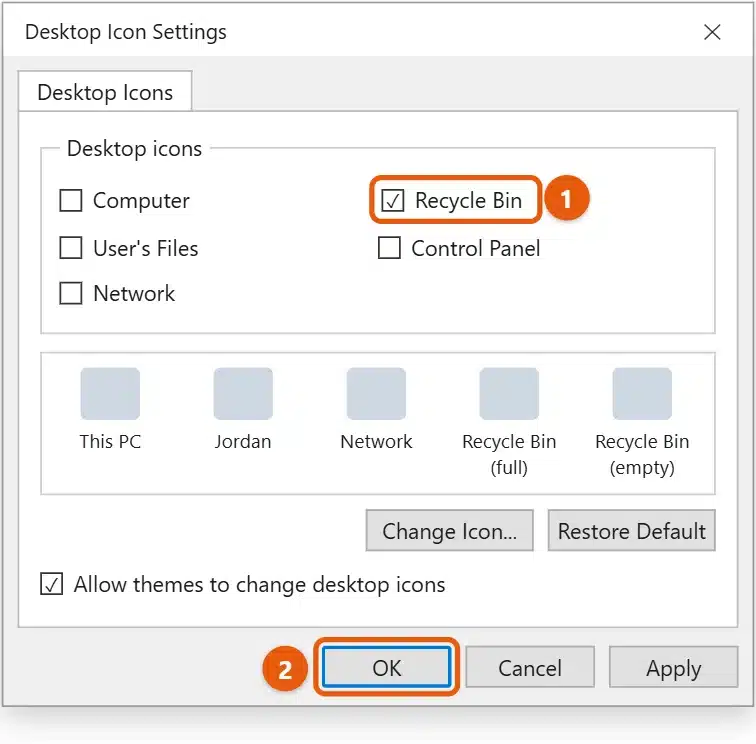
If the icon has the wrong picture, select Recycle Bin (full) or Recycle Bin (empty) in the same window and choose Restore Default.
Other ways to open the Recycle Bin
- File Explorer: press Windows + E, click in the address bar, type
Recycle Bin, and press Enter. - Run box: press Windows + R, type
shell:RecycleBinFolder, and press Enter. - Search: select Start, type
recycle bin, and select it.
Keep the Recycle Bin handy
- Pin it to Start: right-click Recycle Bin on the desktop and select Pin to Start.
- Pin it to Quick access: right-click it and select Pin to Quick access. It then appears in File Explorer’s left pane.
- Show it in File Explorer’s left pane: in File Explorer, select See more (…) > Options. On the View tab, under Navigation pane, check Show all folders, then select OK.
Restore or empty files in the Recycle Bin
- Restore a file: open the Recycle Bin, right-click the file, and select Restore. It goes back to the folder it was deleted from.
- Restore everything: select Restore all items at the top of the window. Only do this if you want every file back.
- Empty it: right-click Recycle Bin on the desktop and select Empty Recycle Bin. This deletes the files for good.
See how to restore items from the Windows 11 Recycle Bin and how to empty the Recycle Bin in Windows 11 for more detail.
If a deleted file isn’t in the Recycle Bin
- Files deleted with Shift + Delete skip the Recycle Bin.
- Files deleted from most USB drives, memory cards, and network folders don’t go to the Recycle Bin.
- Very large files can be too big for the Recycle Bin, and Windows asks to delete them permanently instead.
- Storage Sense may have emptied it. Check Settings > System > Storage > Storage Sense.
If you already emptied it, see how to recover files deleted from the Recycle Bin after emptying it.
Frequently asked questions
Where is the Recycle Bin folder on the drive?
Each drive has a hidden, protected folder named $Recycle.Bin that holds its deleted files. You don’t need to open it. Use the Recycle Bin icon instead, which shows deleted files from all your drives in one place.
Can I change how much space the Recycle Bin uses?
Yes. Right-click Recycle Bin, select Properties, choose a drive, and set Custom size. The Don’t move files to the Recycle Bin option deletes files immediately, so leave it off unless you’re sure.
How do I hide the Recycle Bin from the desktop?
Clear its check box in Desktop icon settings. See how to hide the Recycle Bin from the desktop in Windows 11.
Using Windows 10? See how to access the Recycle Bin in Windows 10. Microsoft’s guide is Find the Recycle Bin in Windows. More help is on our Windows 11 Help & Guides page.
If you already emptied the Recycle Bin, see how to recover deleted files in Windows 11.

Matt Jacobs has been working as an IT consultant for small businesses since receiving his Master’s degree in 2003. While he still does some consulting work, his primary focus now is on creating technology support content for SupportYourTech.com.
His work can be found on many websites and focuses on topics such as Microsoft Office, Apple devices, Android devices, Photoshop, and more.