To restore items from the Recycle Bin in Windows 11, double-click Recycle Bin on your desktop, right-click the file or folder you want back, and select Restore. Windows puts it back in the folder it was deleted from, with its original name.
Applies to: Windows 11. No downloads or administrator rights needed.
If you just deleted it
If you deleted something a moment ago and File Explorer is still open, press Ctrl + Z. Windows undoes the delete and puts the item back where it was. This only works for your most recent actions in that File Explorer window, so for anything older, use the Recycle Bin.
Restore a file or folder
- Double-click Recycle Bin on the desktop. If you don’t see it, open File Explorer, type Recycle Bin in the address bar, and press Enter.
- Find the item you want. If the bin is full, see the next section for quick ways to find it.
- Right-click the item and select Restore.
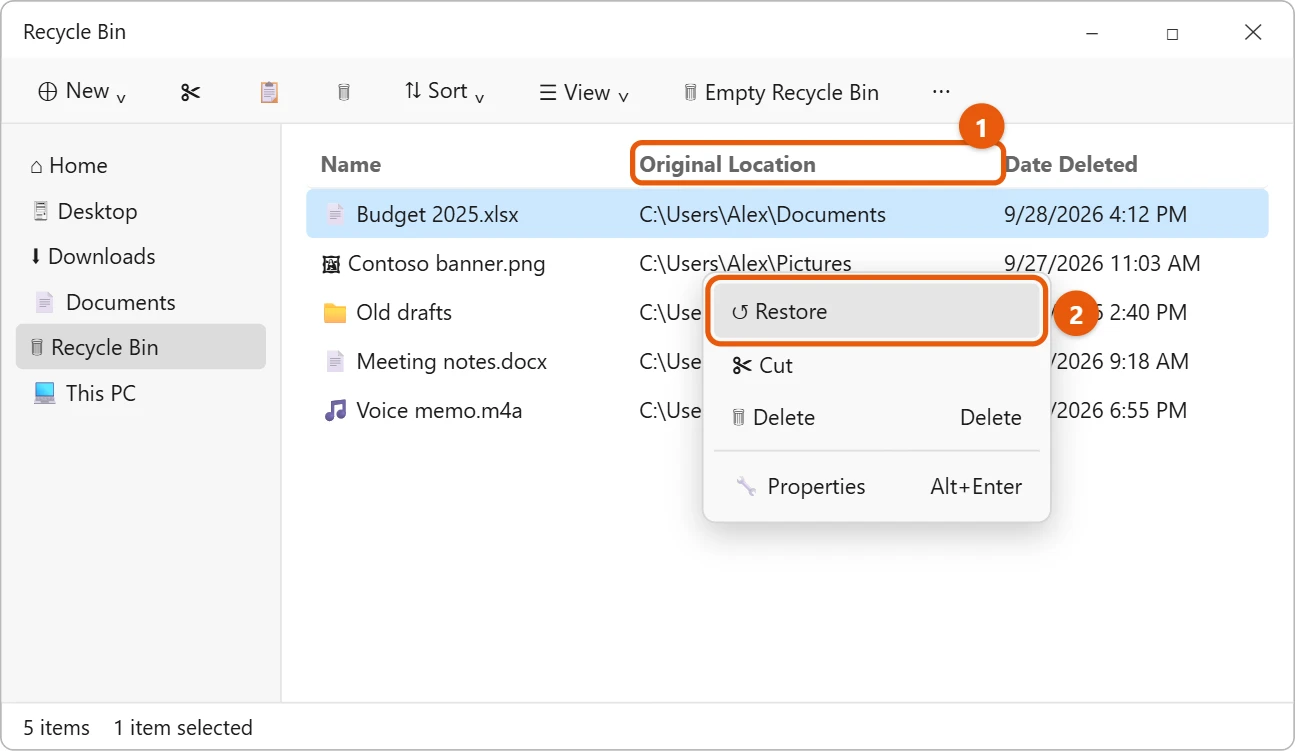
The item disappears from the Recycle Bin and goes back to its Original Location. Open that folder to check it’s there.
To restore several items at once, hold Ctrl and select each one, or hold Shift to select a range. Then right-click any of them and select Restore. You can also use Restore the selected items in the command bar at the top of the window. If you don’t see it, select See more (…).
Find the item you’re looking for
A bin full of old files can be hard to search through. These tips help:
- Switch to Details view. Select View > Details. You’ll see the Name, Original Location and Date Deleted of each item.
- Sort by date. Select the Date Deleted column heading to put the newest deletions at the top. Select it again to reverse the order.
- Search the bin. Type part of the file name in the search box in the top-right corner of the window.
- Check where it came from. Right-click an item and select Properties to see its original folder, size and the date it was deleted.
Restore to a different folder
Restore always puts items back where they came from. To put an item somewhere else instead:
- Open the Recycle Bin and the folder you want to use in two File Explorer windows or tabs.
- Drag the item from the Recycle Bin into the other folder.
The item is restored to the new folder instead of its original location. This is handy if the original folder was on a drive that’s no longer connected, or if you want to keep a restored copy separate from newer files.
Restore everything
To put back every item in the bin:
- Open the Recycle Bin.
- Select Restore all items in the command bar. If you don’t see it, select See more (…).
- Select Yes to confirm.
Be careful with this if you haven’t emptied the bin in a while. It can put back hundreds of old files you meant to get rid of. It’s usually better to select just the items you need.
What happens when you restore
- The original folder is gone. Windows creates it again and puts the item inside.
- A file with the same name is already there. Windows asks what to do. Choose Replace the file in the destination, Skip this file, or Let me decide to compare the two.
- You deleted a whole folder. The Recycle Bin shows the folder, but you can’t open it to pick out single files. Restore the folder, take what you need, and delete the rest again.
Items from an external drive
Files you delete from an external hard drive are kept in a Recycle Bin on that drive, not on your PC. They only show up in the Recycle Bin while the drive is connected. If you’re looking for something you deleted from an external drive, plug it in first, then open the Recycle Bin again. When you restore the item, it goes back to its folder on that drive.
If the item isn’t in the Recycle Bin
Some deletions never go to the bin, and some items leave it:
- You used Shift + Delete. That deletes items permanently, without using the bin.
- It was on a USB flash drive, memory card or network drive. Items deleted from those locations aren’t kept in your Recycle Bin.
- It was too big. Windows deletes very large files permanently if they don’t fit in the space set aside for the bin. It warns you first.
- The bin was emptied. Someone emptied it, or Storage Sense removed old items automatically. To check, go to Settings > System > Storage > Storage Sense and look at Delete files in my recycle bin if they have been there for over.
- Someone else deleted it. Each person on the PC has their own Recycle Bin. If another person deleted the file while signed in to their own account, it’s in their bin, not yours.
Try your backups
If the item isn’t in the bin, you may still have a copy.
OneDrive recycle bin
Files deleted from your OneDrive folder also go to the OneDrive recycle bin online. Personal accounts keep them there for up to 30 days, even after you empty the Windows Recycle Bin. For a missing Word file, Word itself may also hold a copy, and the steps for recovering a Word document show where to look.
- Go to onedrive.com in your browser and sign in.
- Select Recycle bin.
- Select the files and select Restore.
File History and previous versions
If File History was turned on before the file was deleted, you can restore an earlier copy:
- Open File Explorer and go to the folder that used to contain the file.
- Right-click the folder and select Properties, then the Previous Versions tab. You can also right-click and select Show more options > Restore previous versions.
- Choose a version from before the file was deleted and select Open to look inside it.
- Drag the file you need to your desktop or another folder.
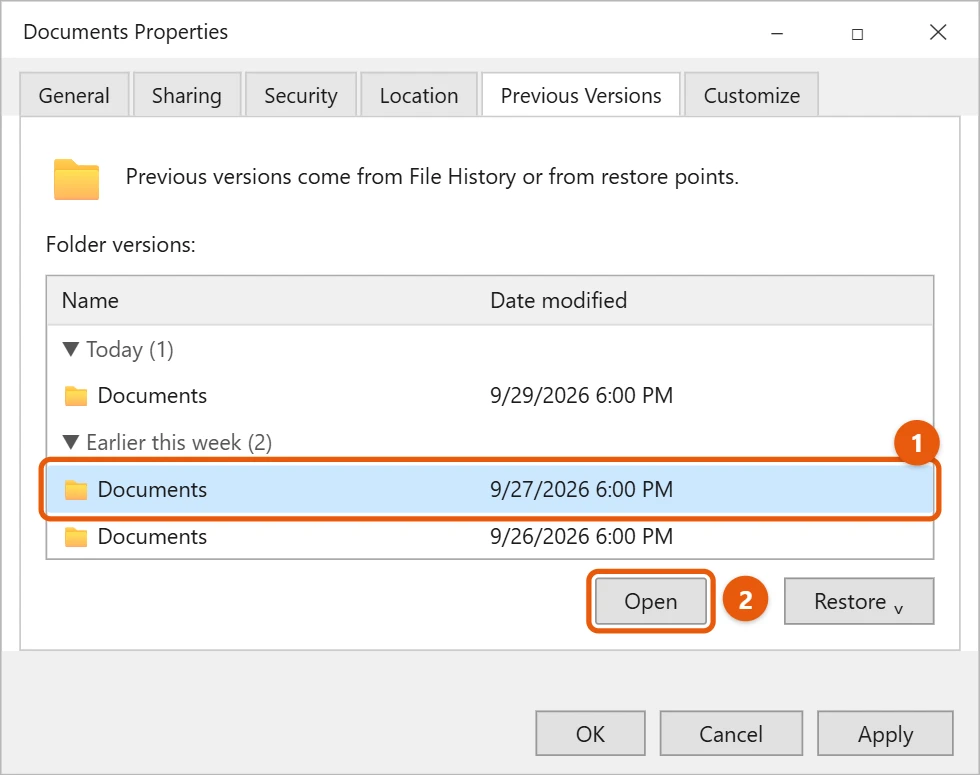
If the list says there are no previous versions, File History wasn’t set up for that folder. Other ways to get it back are in recovering deleted files in Windows 11.
Try Windows File Recovery
If the file isn’t in the Recycle Bin or any backup, Microsoft’s free Windows File Recovery app may still find it. Install it from the Microsoft Store, then open it from the Start menu. It runs as a command. For example, to look for deleted Word files from your Documents folder on C and save what it finds to a USB drive D:
winfr C: D: /regular /n \Users\YourName\Documents\*.docx
A few things improve your chances:
- Stop using the PC for big downloads or installs until you’ve tried, so new data doesn’t overwrite the deleted file.
- Always recover to a different drive from the one the file was deleted from.
- Use /extensive instead of /regular if the file was deleted a while ago or the drive was formatted.
Recovery from SSDs is less likely to work, because they clear deleted data quickly in the background.
Avoid losing files next time
- Turn on delete confirmation. Right-click Recycle Bin, select Properties, and check Display delete confirmation dialog. Windows then asks before moving anything to the bin.
- Give the bin more room. In the same window, raise the Maximum size so large files are less likely to skip the bin.
- Keep deleted files longer. If Storage Sense is on, set the Recycle Bin option to 60 days or Never.
- Back up. Turn on OneDrive folder backup or File History so you have copies outside the Recycle Bin.
- Look before you empty. Check what’s in the bin before you empty the Recycle Bin.
Frequently asked questions
Where do restored files go?
Back to the folder shown in the Original Location column. If that folder no longer exists, Windows creates it again.
How long do files stay in the Recycle Bin?
Until you empty it, unless Storage Sense is set to remove old items or the bin runs out of space. When the bin is full, Windows removes the oldest items first to make room.
Can I restore a file after emptying the Recycle Bin?
Not from the bin. Try the OneDrive recycle bin, File History, or Windows File Recovery, all covered above.
Why can’t I open a deleted folder in the Recycle Bin?
The Recycle Bin shows deleted folders as single items. Restore the folder first, then open it.
Does restoring a file bring back an older version of it?
No. The Recycle Bin gives you the file exactly as it was when you deleted it, with the same name and contents. For an earlier version of a file, use File History instead.
Can I restore items from someone else’s Recycle Bin?
No. Each person only sees their own deleted items. Ask them to sign in and restore it.
Next steps
Can’t find the bin at all? Here’s where the Recycle Bin is in Windows 11, and for a Windows 10 PC, how to open the Recycle Bin in Windows 10. To set up backups before you need them, use Microsoft’s Backup and restore with File History page.

Matt Jacobs writes and maintains the guides on Support Your Tech, which he started in 2017. He spent most of his career keeping small-business PCs running and still takes the occasional consulting job, so the steps here come from fixing the same problems on other people’s computers. Every guide is checked on his own Windows 11, Windows 10, Mac, iPhone and iPad before it goes up.