Last updated on November 9th, 2026 at 02:12 pm
To change a drive letter in Windows 10, right-click Start and select Disk Management. Right-click the drive, select Change Drive Letter and Paths, and then select Change. Pick a new letter, select OK, and then select Yes.
Applies to: Windows 10.
Don’t change the letter of your C: drive, or of any drive where you installed apps. If you do, apps might not run or might not find their files.
Change the letter in Disk Management
- Right-click Start and select Disk Management. If it isn’t in that menu, there are other ways to open Disk Management.
- Right-click the drive you want to change and select Change Drive Letter and Paths.
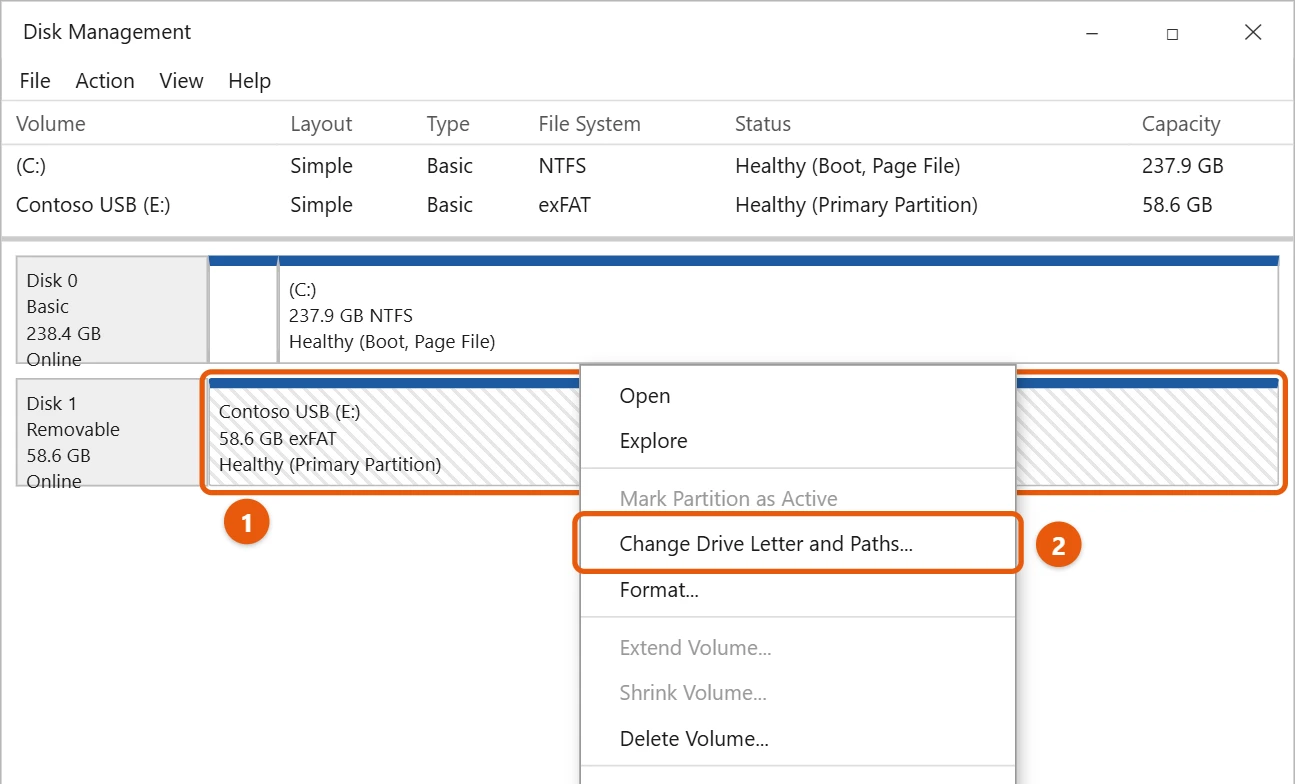
- Select Change.
- Choose a letter from Assign the following drive letter, and select OK.
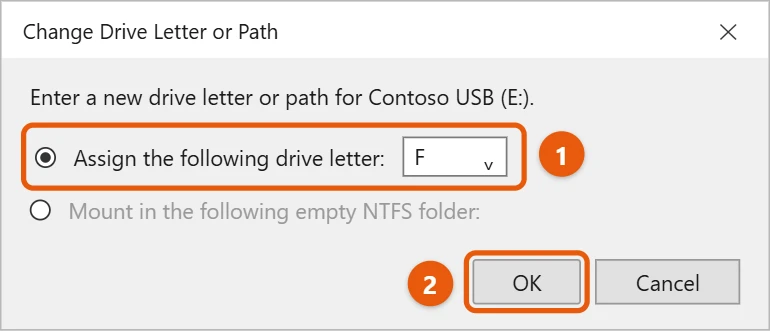
- Windows warns that some programs might not run correctly. Select Yes to continue.
The drive now shows the new letter in File Explorer.
Which letters can I use?
Any free letter from A to Z, except C: for Windows. A: and B: were once kept for floppy drives, but you can use them.
Give a drive a letter
If a drive doesn’t show in File Explorer, it may not have a letter. In Disk Management, right-click it, select Change Drive Letter and Paths, select Add, pick a letter, and select OK.
Change the letter with diskpart
- Right-click Start and select Command Prompt (Admin) or Windows PowerShell (Admin).
- Type
diskpartand press Enter. - Type
list volumeand find your drive by its size and label. - Type
select volume 3, using your volume’s number. - Type
assign letter=Gwith the letter you want, then typeexit.
In PowerShell, one line does the same job: Get-Partition -DriveLetter F | Set-Partition -NewDriveLetter G.
Does the new letter apply to every account?
Yes. Drive letters belong to the PC, so everyone who signs in sees the same letter.
Mounting a drive in a folder has a few more options, all covered in mounting a drive in Windows 10.
The same steps appear in Microsoft’s Change a drive letter article.
Remove a letter or use a folder instead
- Hide a drive: in Change Drive Letter and Paths, select the letter and choose Remove. The drive and its files stay, but it won’t show in File Explorer.
- Open a drive as a folder: select Add, choose Mount in the following empty NTFS folder, and pick an empty folder. This is handy if you run out of letters.
Will changing the letter delete my files?
No. Only the letter changes. Everything on the drive stays where it is. If an app installed on that drive stops working, change the letter back.
Things to know
- You need an administrator account.
- Shortcuts and apps that point to the old letter stop working. Update them to the new letter.
- If Change Drive Letter and Paths is grayed out, the drive may not be formatted yet, or Windows may be using it. A new, empty drive needs to be formatted in Windows 10 first.
If the drive letter won’t change
- The letter you want isn’t listed: another drive, card reader or mapped network drive is using it. Change or disconnect that one first.
- A USB drive gets a different letter each time: give it a letter near the end of the alphabet, such as U:. Windows usually remembers it for that drive.
- A recovery partition suddenly has a letter: Disk Management may not let you remove it. In diskpart, select that volume and type
remove letter=X, using its letter.
Can I split a drive so it gets two letters?
Yes. Partitioning the hard drive creates a second volume that gets its own letter.

Matt Jacobs writes and maintains the guides on Support Your Tech, which he started in 2017. He spent most of his career keeping small-business PCs running and still takes the occasional consulting job, so the steps here come from fixing the same problems on other people’s computers. Every guide is checked on his own Windows 11, Windows 10, Mac, iPhone and iPad before it goes up.