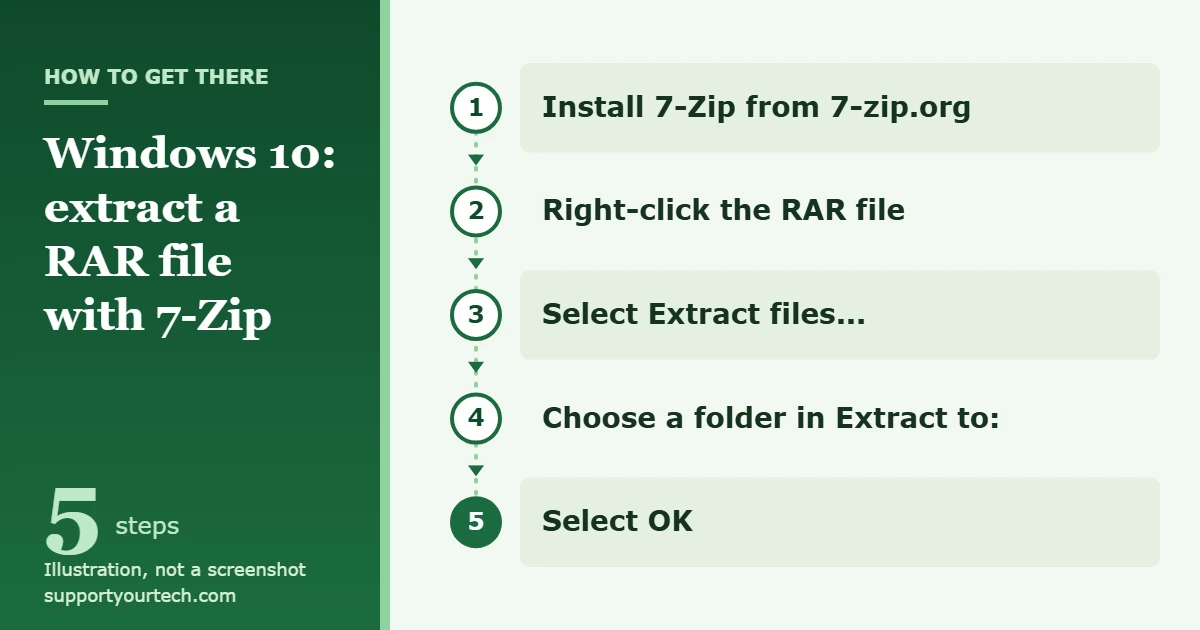
Windows 10 cannot extract a RAR file on its own, so you need an archive app. The shortest reliable route is to install the free 7-Zip, right-click the RAR file, choose Extract files…, pick a folder in the Extract to: box, and select OK.
Applies to: Windows 10 (version 22H2) with 7-Zip or WinRAR. Checked against Microsoft Support, 7-Zip and WinRAR documentation on October 6, 2026.
Why Windows 10 needs an extra app for RAR files
A RAR file is an archive: a single container that holds one or more files in compressed form. RAR is the native format of the WinRAR archiver, which is why it behaves differently from the ZIP files that File Explorer already understands.
Microsoft lists built-in RAR support only for Windows 11, version 24H2, which handles ZIP, RAR, 7z and TAR archives. Windows 10 never received that feature, and version 22H2 is its final release, so the right-click Extract All… command in Windows 10 still works for ZIP files only. If you also work with ZIP files, see our guide on how to zip and unzip files in Windows 10, which needs no extra software.
Before you start
- Know where the RAR file is. Downloaded archives usually land in your Downloads folder. If you cannot locate yours, here is how to find downloads on Windows 10.
- Check that you have enough free space. The extracted files usually take up more room than the archive, because the archive stores them compressed.
- Get the archive app from its own website. 7-Zip is published at 7-zip.org and WinRAR at win-rar.com and rarlab.com. Avoid download mirrors and “free RAR opener” pages that bundle other software.
- Pick an app. 7-Zip is free, open-source software that you do not need to register or pay for, and it can unpack RAR files (it cannot create them). WinRAR is the format’s own program; it is a trial that can be used for up to 40 days at no charge, after which a license must be purchased.
Extract a RAR file with 7-Zip
- Download the installer. Open the 7-Zip download page and choose the .exe installer that matches your PC. Most Windows 10 computers use the 64-bit Windows x64 row; older machines may need 32-bit Windows x86.
- Install 7-Zip. Open the downloaded file and follow the installer’s prompts. 7-Zip adds its commands to the File Explorer right-click menu, so there is nothing to launch afterward.
- Find the RAR file. Open File Explorer and browse to the folder that holds the archive.
- Right-click the RAR file. Look for the 7-Zip commands in the menu that appears; they may be grouped under a 7-Zip entry.
- Select Extract files… A window titled Extract opens so you can decide where the contents go.
- Choose the destination. The Extract to: box shows the folder that will receive the files. Keep the suggested folder, type another path, or use the … button beside the box to browse.
- Enter the password if the archive has one. Type it in the Password field. Turn on Show Password to check your typing.
- Select OK. 7-Zip unpacks the archive. When it finishes, the files are in the folder you chose and the original RAR file is still where it was.
Faster options in the same right-click menu
Once 7-Zip is installed, the same menu offers three other commands that skip the Extract window:
- Extract Here unpacks everything into the folder that contains the RAR file. Use it only when you know the archive holds a few files or a single folder, because a large archive can scatter hundreds of files across that folder.
- Extract to followed by a folder name creates a new folder named after the archive and unpacks into it. This is the tidiest choice for most downloads.
- Open archive shows the contents in 7-Zip File Manager without extracting anything, which is useful when you only need one file or want to see what is inside first.
Extract a RAR file with WinRAR
Use this method if WinRAR is already on the PC, or if 7-Zip fails on an archive that needs WinRAR’s repair features.
- Install WinRAR. Download the Windows trial from the WinRAR website and run the installer. WinRAR supports Windows 10.
- Open the archive. Double-click the RAR file, or right-click it and select Open with WinRAR. The WinRAR window lists the archive’s contents.
- Select what you want. Click the files or folders to extract.
- Click Extract To. The button is in the toolbar at the top of the WinRAR window.
- Choose the destination folder and click OK. WinRAR unpacks the files into that folder. During a long extraction you can choose Background to keep working, or Cancel to stop.
If WinRAR’s shell integration was enabled during installation, the File Explorer right-click menu also offers Extract Here and an Extract to command that creates a folder named after the archive. WinRAR’s own steps are in its guide to opening a RAR file.
Extract a multi-part RAR archive
Large downloads are often split into several RAR files called volumes. Their names end in a part number, such as .part1.rar and .part2.rar (or .part001.rar and .part002.rar).
- Download every part. A missing volume stops the extraction.
- Put all the parts in the same folder. Do not rename them.
- Start the extraction from the first volume. Right-click the file whose name ends in part1 and extract it with either method above. The app reads the remaining volumes automatically, so you do not extract each part separately.
Check that the extraction worked
Open the destination folder in File Explorer. You should see the archive’s files or a single folder containing them, and you should be able to open them normally. Extraction does not change or delete the RAR file, so there is nothing to undo: if the files landed in the wrong place, delete the extracted copies and extract again to a different folder. Once you have confirmed the files open, you can delete the RAR file to free up space.
Scan the files before you open them
Extracting an archive does not make its contents safe. Before opening anything from an archive you did not expect, open the Windows Security app, select Virus & threat protection, choose Scan options, and run a Custom scan on the folder you extracted to. Be especially careful with programs and scripts, and with password-protected archives sent by someone you do not know. Windows 10 reached end of support on October 14, 2025, which makes keeping your archive app updated more important; both 7-Zip and WinRAR advise using the latest version.
Troubleshooting
The right-click menu has no extract commands
If 7-Zip or WinRAR is not installed, Windows 10 shows no extract commands for a RAR file, and Extract All… appears only for ZIP files. Install one of the apps first. If WinRAR is installed but its commands are missing, open WinRAR, go to Options > Settings, select the Integration tab, click Context Menu Items…, check the items you want, such as Open with WinRAR and Extract To, and click OK.
The archive will not open in an old copy of 7-Zip
Old releases such as 7-Zip 9.20 support only the RAR 2, 3 and 4 formats and cannot open the newer RAR5 format. Install the current version from the 7-Zip website and try again.
You are asked for a password you do not have
The person who created the archive set the password, so ask them for it. If you enter the wrong one, the app tells you and the files stay locked. There is no official way around a lost password: WinRAR states that RAR encryption has no backdoor and that not even its author can extract password-protected files without the password.
“CRC failed” or “The file is corrupt”
These messages mean the data in the archive is damaged, usually from an incomplete download or a bad copy. Download the file again first. If the message names a volume, only that part of a multi-part archive is damaged, so replace that one file. WinRAR also has a repair command, which can sometimes fix an archive that was created with a recovery record; the only way to find out is to run the repair and test the result.
“The process cannot access the file because it is being used by another process”
Another program has the archive or one of the destination files open. Wait for the download or sync to finish, close any program that is using those files, and extract again.
You cannot install software on a work or school PC
Managed computers often block app installation. Ask your IT department to install an approved archive app or to extract the file for you, rather than uploading a work file to an online extraction website.
Frequently asked questions
Can Windows 10 open RAR files without extra software?
No. Microsoft documents built-in RAR support for Windows 11, version 24H2, not for Windows 10. On Windows 10 you need an archive app such as 7-Zip or WinRAR.
Is 7-Zip really free?
Yes. 7-Zip is free, open-source software. Its developer states that you can use it on any computer, including in a commercial organization, without registering or paying.
Do I have to pay for WinRAR?
WinRAR is trial software. Its license allows a test period of up to 40 days at no charge, and requires you to buy a license to keep using it after that.
Can 7-Zip create RAR files?
No. 7-Zip can only unpack RAR archives. It can create other formats, including 7z and ZIP. To create a RAR file you need WinRAR.
Which part of a split RAR archive do I extract?
Only the first one. Keep all the parts in one folder and start from the file ending in part1; the rest are read automatically.
Does extracting delete the RAR file?
No. The archive stays in place after extraction. Delete it yourself once you have confirmed the extracted files open correctly.
Will this change if I upgrade to Windows 11?
Yes. Windows 11, version 24H2 can extract RAR files from File Explorer without another app. Microsoft notes that it does not support encrypted archives, so a password-protected RAR file still needs 7-Zip or WinRAR.
With an archive app installed, the same right-click commands work for other formats too. Microsoft’s own instructions for the built-in ZIP tools are in Zip and unzip files.
Related: how to open a .gz file in Windows 10.

Matt Jacobs has been working as an IT consultant for small businesses since receiving his Master’s degree in 2003. While he still does some consulting work, his primary focus now is on creating technology support content for SupportYourTech.com.
His work can be found on many websites and focuses on topics such as Microsoft Office, Apple devices, Android devices, Photoshop, and more.