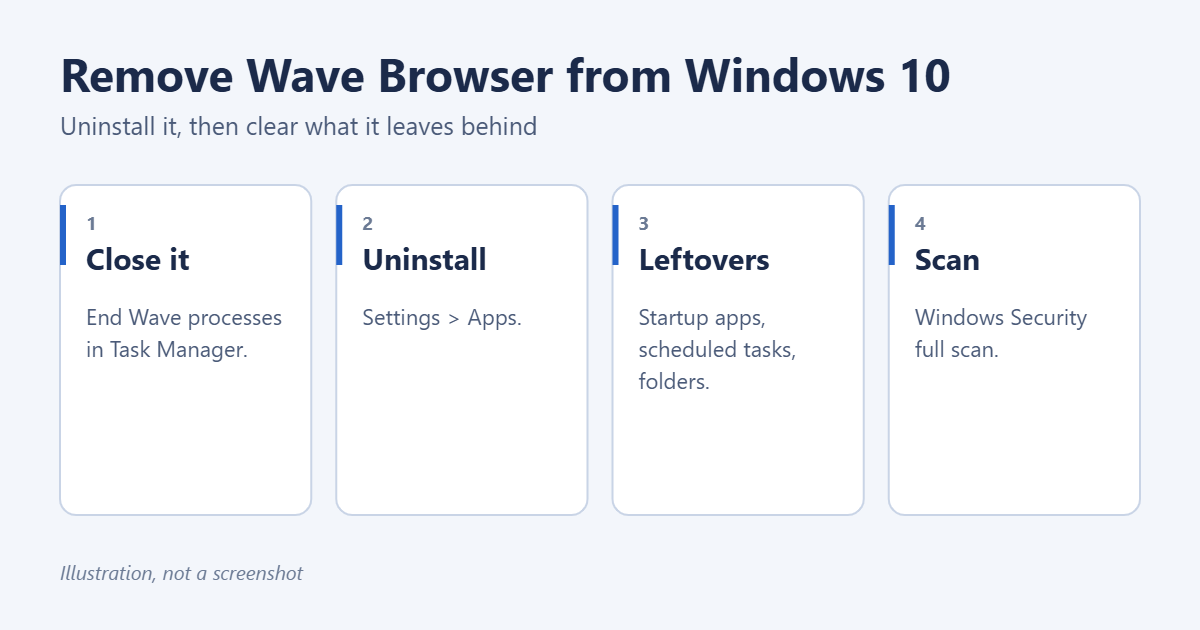
To remove Wave Browser from Windows 10, close it in Task Manager, then uninstall it from Settings > Apps > Apps & features. Because it often comes back, also turn off its startup entries, delete its scheduled tasks and its leftover folder in your AppData, reset your default browser, and run a full scan with Windows Security. Wave Browser is usually installed alongside other free software and is treated by many security tools as a potentially unwanted program.
Applies to: Windows 10, version 22H2. The same steps work on Windows 11, where the uninstall list is under Settings > Apps > Installed apps.
Step 1: Close Wave Browser
- Press Ctrl + Shift + Esc to open Task Manager. Select More details if you see the small view.
- On the Processes tab, find anything named Wave, Wave Browser or Wavesor.
- Select each one and choose End task.
Step 2: Uninstall it
- Open Settings > Apps > Apps & features.
- Search for Wave, select Wave Browser and choose Uninstall.
- Follow the prompts. If it asks why you’re leaving, close the window or choose any option and continue.
- Sort the list by Install date and uninstall any other unfamiliar apps installed on the same day, which often came in the same bundle. Bundled installers sometimes add a search hijacker too, so check whether you also need to remove searching.com on the same PC.
Step 3: Turn off its startup entries
- In Task Manager, open the Startup tab.
- Right-click any Wave or Wavesor entry and choose Disable. Right-click and choose Open file location first if you want to confirm where it lives.
While you’re on that tab, you can disable other startup programs in Windows 10 you don’t need.
Step 4: Delete its scheduled tasks
- Press Windows key + R, type
taskschd.mscand press Enter. - Select Task Scheduler Library.
- Look for tasks with Wave or Wavesor in the name. Select one and check the Actions tab at the bottom: it should point to a Wave file.
- Right-click each Wave task and choose Delete.
These tasks are what usually reinstall or restart Wave after you remove it.
Step 5: Delete leftover folders
- Press Windows key + R, type
%LocalAppData%and press Enter. - Delete any WaveBrowser or Wavesor folder.
- Repeat for
%AppData%and%ProgramFiles%. - Empty the Recycle Bin.
If Windows reports that a file is in use, restart the PC and try again before opening any other apps.
Step 6: Reset your default browser and search
- Open Settings > Apps > Default apps and choose Edge, Chrome or Firefox as your Web browser. The full steps are in changing the default browser in Windows 10.
- In your browser, remove extensions you don’t recognize, and check the search engine and startup page in its settings.
- If unwanted pages keep appearing, use the browser’s reset option: Settings > Reset settings in Edge and Chrome. When a reset doesn’t stop the problem in Chrome, a clean reinstall of Chrome on Windows 10 with a fresh profile removes leftover settings and extensions.
Step 7: Scan the PC
- Open Windows Security > Virus & threat protection > Scan options.
- Choose Full scan and select Scan now. Remove anything it finds.
- For stubborn leftovers, run Microsoft Defender Offline scan from the same page. The PC restarts and scans before Windows loads.
Stop it coming back
- Turn on Potentially unwanted app blocking in Windows Security > App & browser control > Reputation-based protection settings.
- Download software only from the developer’s own website or the Microsoft Store, and choose Custom installs so you can untick bundled offers. If you were trying to save a video when this happened, the YouTube-supported download options for Windows 10 don’t require installing anything.
- Keep Windows updated. Windows 10 is out of support, so consider enrolling in Windows 10 Extended Security Updates.
Troubleshooting
Wave Browser isn’t in the apps list
It was installed for your user only and may be listed as Wavesor, or the uninstall entry is broken. Delete the folders and tasks in Steps 4 and 5, then scan.
It came back after a restart
A scheduled task or startup entry was missed. Repeat Steps 3 and 4, and check other Windows user accounts on the PC.
Is Wave Browser a virus?
It’s generally classed as a potentially unwanted program rather than a virus: it changes browser settings and is hard to remove, but it isn’t designed to destroy files. Removing it is still a good idea.

Matt Jacobs writes and maintains the guides on Support Your Tech, which he started in 2017. He spent most of his career keeping small-business PCs running and still takes the occasional consulting job, so the steps here come from fixing the same problems on other people’s computers. Every guide is checked on his own Windows 11, Windows 10, Mac, iPhone and iPad before it goes up.