To set multiple tabs in Word, select the paragraphs, open the Paragraph dialog from the Home tab, and select Tabs. Type the first position, such as 1″, choose an alignment and select Set; repeat for each tab stop, then select OK. You can also click on the ruler to add tab stops, choosing the type with the tab selector at the left end of the ruler. Then press Tab to jump to each stop.
Applies to: Word for Microsoft 365, Word 2024, 2021, 2019 and 2016 on Windows and Mac. Word for the web has limited tab settings. Last reviewed October 7, 2026.
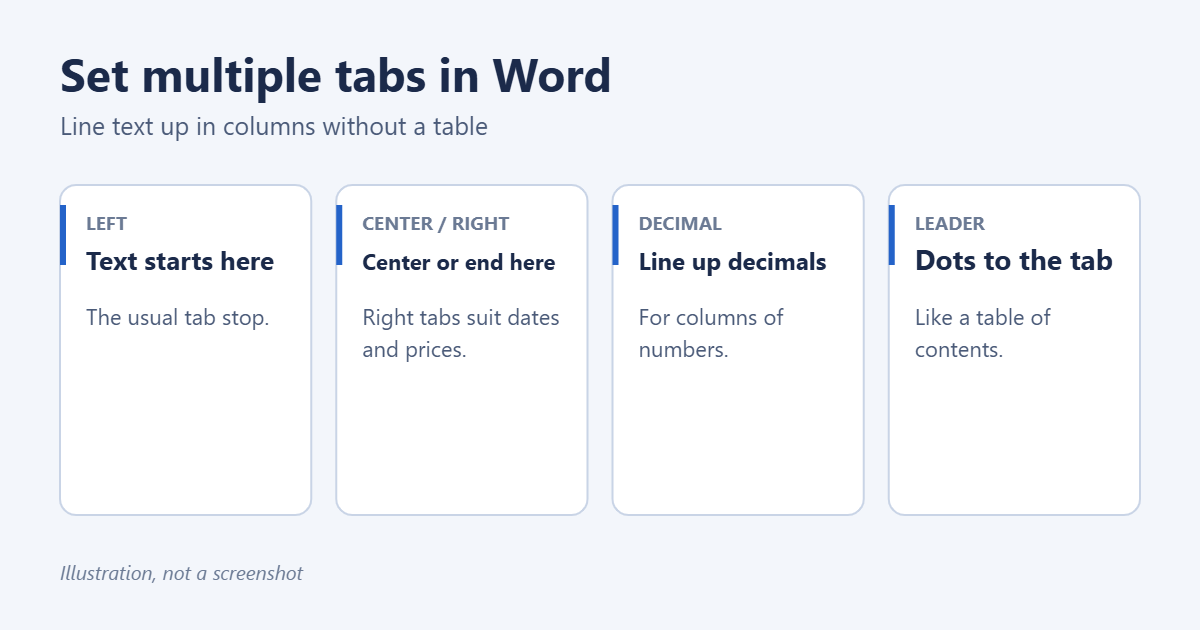
The five kinds of tab stop
- Left: text starts at the tab stop. The default.
- Center: text is centered on the tab stop.
- Right: text ends at the tab stop. Good for dates, page numbers and amounts at the right margin.
- Decimal: numbers line up on their decimal points.
- Bar: draws a vertical line at that position rather than moving text.
Method 1: Set several tabs at once with the Tabs dialog
This is the most precise way, and the best when you need exact positions.
- Select the paragraphs that should use the tabs. For a new list, click the empty line where it will start.
- On the Home tab, select the small arrow in the corner of the Paragraph group, then select Tabs at the bottom of the dialog.
- In Tab stop position, type the first position, for example 1.5″.
- Under Alignment, choose Left, Center, Right, Decimal or Bar.
- Under Leader, choose None, or dots, dashes or a line to fill the gap before the tab.
- Select Set. The tab stop appears in the list.
- Repeat steps 3 to 6 for each additional tab stop, then select OK.
On a Mac, select Format > Tabs.
Method 2: Click on the ruler
- If you can’t see the ruler, select View > Ruler.
- Select the paragraphs.
- Click the tab selector at the far left of the horizontal ruler until it shows the type you want (an L shape for left, an upside-down T for center, a backwards L for right, a T with a dot for decimal).
- Click the ruler where you want each tab stop.
Drag a tab marker along the ruler to move it. Hold Alt while dragging to see exact measurements.
Use the tabs
Type the first item, press Tab to jump to the next stop, type the next item, and so on. Press Enter to start a new line with the same tab stops.
Example: a price list with dot leaders
- Open the Tabs dialog.
- Set a Right tab at 6″ (the right margin on a standard page) with leader 2 (dots).
- Select Set and OK.
- Type Coffee, press Tab and type $3.50. Word fills the space with dots.
The same technique powers tables of contents. For an automatic one, see how to add a table of contents in Word.
Change or remove tab stops
- Remove one: drag its marker off the ruler, or select it in the Tabs dialog and select Clear.
- Remove all: select Clear All in the Tabs dialog.
- Change the default spacing: without custom stops, Word uses a tab every 0.5 inch. Change Default tab stops in the Tabs dialog.
Troubleshooting
Pressing Tab jumps further than expected
The text is already past the tab stop, so Word moves to the next one. Move the tab stop further right, or shorten the text.
The tabs only work on some lines
Tab stops belong to paragraphs. Select all the lines and set the tabs again, or use the Format Painter to copy them.
Pressing Tab in a table moves to the next cell
Press Ctrl + Tab to insert a tab inside a table cell.
Spacing between words looks odd
If the gaps are between words rather than at tab stops, the text is probably justified. See how to fix weird spacing between words in Word, or how to remove extra space in Word.
Frequently asked questions
Should I use tabs or a table?
Tabs are good for one line of text per row. If items wrap onto two lines, a table without borders lines them up more reliably.
Can I save tab settings for later?
Yes. Set them in a paragraph style (Modify > Format > Tabs) and apply the style wherever you need them.
Related: How to convert a table to text in Word.
Related: how to indent in Word.
Related: type on top of a line in Word.

Matt Jacobs has been working as an IT consultant for small businesses since receiving his Master’s degree in 2003. While he still does some consulting work, his primary focus now is on creating technology support content for SupportYourTech.com.
His work can be found on many websites and focuses on topics such as Microsoft Office, Apple devices, Android devices, Photoshop, and more.