To make a Google Doc landscape, go to File > Page setup, make sure the Pages tab is selected, choose Landscape under Orientation, and select OK. To turn only some pages sideways, select the content first and set Apply to to Selected content. On the Google Docs app, tap the three dots > Page setup > Orientation > Landscape.
Applies to: Google Docs in a web browser, and the Google Docs app for Android, iPhone and iPad. Last reviewed October 8, 2026.
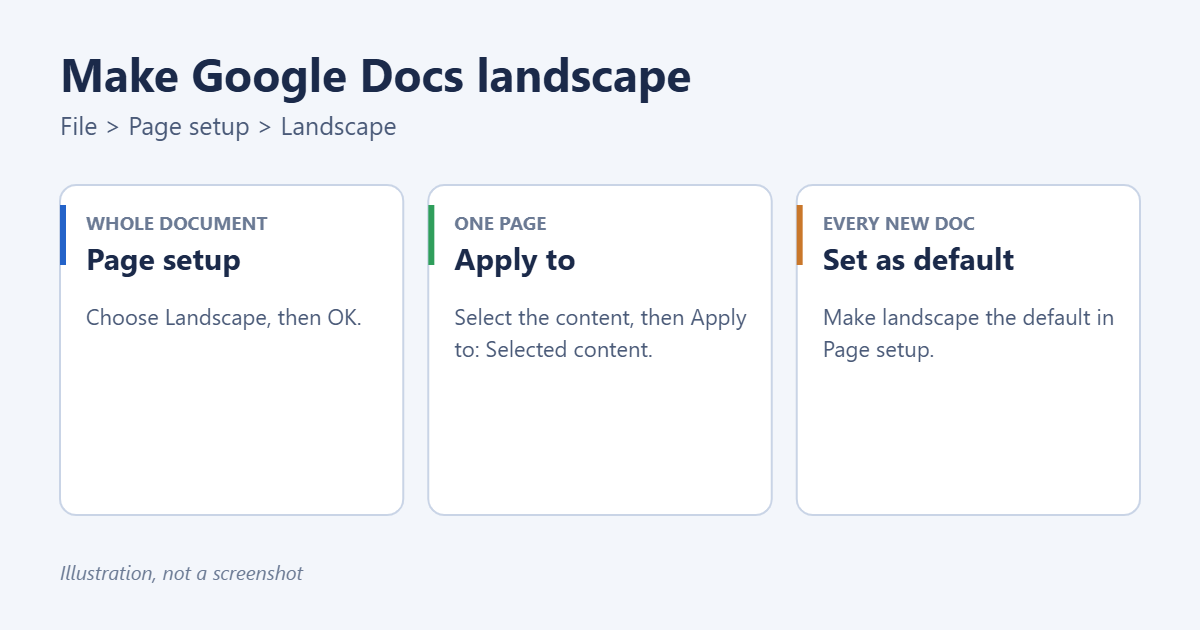
Make the whole document landscape
- Open the document in Google Docs.
- Select File > Page setup.
- At the top of the box, make sure Pages is selected, not Pageless.
- Under Orientation, choose Landscape.
- Check that Apply to says Whole document, and select OK.
Margins switch with the page, so a 1-inch margin stays 1 inch. To change them, use the same box or see how to change margins in Google Docs.
Make only one page or section landscape
- Select the text, table or image that should be on the landscape page.
- Go to File > Page setup.
- Set Apply to to Selected content.
- Choose Landscape and select OK.
Google Docs adds section breaks before and after your selection automatically, so the pages around it stay portrait. If you’ve already added section breaks with Insert > Break > Section break (next page), click inside the section and choose Apply to: This section instead. In Word, the method is similar; see how to make only one page landscape in Word.
How section breaks control orientation
Orientation in Google Docs belongs to a section, not to a single page. A new document has one section, so changing it affects every page. When you add a Section break (next page) from Insert > Break, everything after the break becomes a new section with its own orientation, margins, headers and footers. To see where breaks are, select View > Show section breaks; each appears as a dotted line labeled “Section break”.
That’s useful for a report with a wide table in the middle: portrait pages for the text, one landscape section for the table, then portrait again. Using Apply to: Selected content creates those breaks for you, but you can also add them by hand for more control. To remove a break, click just before the dotted line and press Delete; the two sections merge and take the settings of the first one.
Alternatives to turning the page
- Rotate an image: select it, then use Image options > Size & Rotation to rotate it 90 degrees on a portrait page.
- Shrink a wide table: right-click it, choose Table properties, and reduce column widths and cell padding, or lower the font size of the table.
- Use Pageless: if the document is only read on screen, Pageless format lets wide tables scroll sideways with no page edges at all.
Press Alt + / (Option + / on a Mac) to search the menus, type page setup and press Enter to open the box without going through File.
Make landscape the default for new documents
In File > Page setup, choose Landscape and select Set as default. New blank documents will start in landscape. Existing documents don’t change.
Google Docs app (phone or tablet)
- Open the document and tap Edit (the pencil) if needed.
- Tap the three-dot menu at the top right.
- Tap Page setup > Orientation > Landscape.
On some versions, Print layout must be turned on in the same menu to see the change.
Print or download in landscape
- When the document is landscape, printing with File > Print uses landscape automatically. Check the printer preview’s Layout setting if it doesn’t.
- Download as PDF or Word with File > Download; the orientation is kept.
Troubleshooting
There’s no Orientation option
The document is set to Pageless. Choose Pages at the top of Page setup first. Pageless documents have no page size or orientation.
Every page turned landscape when I wanted one
Undo with Ctrl+Z, select only the content for that page, and use Apply to: Selected content.
Page numbers or headers look wrong on the landscape page
Headers and footers belong to sections and follow the page width. Check the header options for that section; to restart or format numbers, see how to add custom page numbers in Google Docs.
Tables or images still don’t fit
Reduce the margins for that section in Page setup, or resize the table by dragging its edges.
Frequently asked questions
Can I make Google Sheets or Slides landscape?
Sheets sets orientation in the print settings (File > Print > Page orientation). Slides are landscape by default; change the shape in File > Page setup.
Does landscape work with A4 and Letter paper?
Yes. Choose the paper size in Page setup; orientation works with any size.
Why would I use landscape?
Wide tables, timelines, charts, certificates and posters fit better sideways. Most text documents read better in portrait.
Related: show speaker notes in Google Slides.

Matt Jacobs has been working as an IT consultant for small businesses since receiving his Master’s degree in 2003. While he still does some consulting work, his primary focus now is on creating technology support content for SupportYourTech.com.
His work can be found on many websites and focuses on topics such as Microsoft Office, Apple devices, Android devices, Photoshop, and more.