Your logo sits perfectly at the top of the page, then you add one line of text and it slides down, or onto the next page. Most people look for a lock button at this point, but Word has no true lock for pictures. Instead it offers three practical levels: fix the picture’s position on the page, move it into the header or make it a watermark, or protect the document with Restrict Editing. Pick the one that matches your problem.
Pick the level of lock you need
| Your problem | Best option | What it does not do |
|---|---|---|
| The picture jumps when you type or delete text above it | Fix position on page (plus Lock anchor) | Anyone can still drag, resize or delete it |
| A logo should stay in the same spot on every page | Put it in the header or footer | It can still be edited by opening the header |
| A faded image should sit behind all the text | Picture watermark | Not suited to a sharp, small logo in a set spot |
| Other people keep moving or deleting it | Restrict Editing (optionally with a picture content control) | Restricts the whole document, not only the picture |
The steps below are for Word in Microsoft 365 on Windows, in Print Layout view. Mac and web differences are near the end.
Pin the picture to a spot on the page
New pictures are placed In Line with Text, which means Word treats the picture like one big character in a sentence. Any text you add before it pushes it along. To pin it, first give it a text wrapping style, then fix its position.
- Click the picture. A small Layout Options button appears beside its top-right corner.
- Click Layout Options and choose any style under With Text Wrapping, such as Square, Tight, Behind Text or In Front of Text. Square is a good default for a photo beside a paragraph.
- In the same box, select Fix position on page instead of Move with text.
- Drag the picture to where it belongs, then click outside it. Type a few lines above it to check that it stays put.
Microsoft describes these options on its wrap text and move pictures in Word page. If the Fix position option is missing or greyed out, the picture is probably still In Line with Text; go back to step 2.
For an exact spot, click See more at the bottom of the Layout Options box and open the Position tab. There you can set an Absolute position in inches for both Horizontal and Vertical, measured from the page or the margin, so the picture sits at the same measured spot no matter what the text does.
Add Lock anchor so it stays on the right page
Every wrapped picture is attached to a paragraph, called its anchor. Fix position on page keeps the picture at the same spot on its page, but the picture still belongs to its anchor paragraph, and if that paragraph is pushed onto another page the picture can move with it. Ticking Lock anchor on the same Position tab keeps the anchor in place even if the text around it is deleted. Anchors do not apply to In Line with Text pictures.
To see where a picture is anchored, turn on File > Options > Display > Object anchors; a small anchor icon appears in the margin when you select the picture. Moving, hiding and locking the anchor itself is covered in removing the anchor in Word.
Example: Fix Position on Page in Layout Options
In Word for Microsoft 365 on a Windows 11 laptop, the Layout Options button next to a newly inserted picture showed In Line with Text selected, and Move with text and Fix position on page were both dimmed.
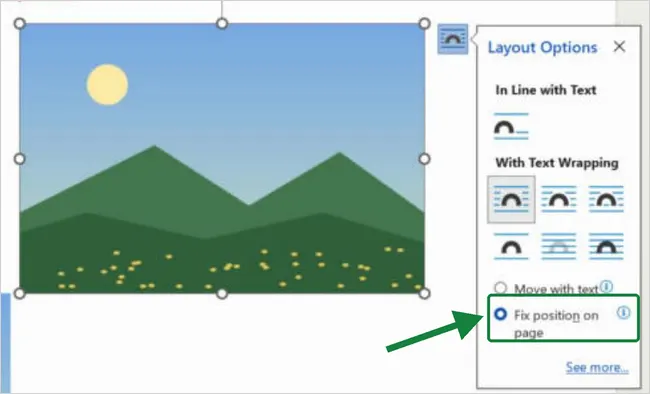
After I picked Square under With Text Wrapping, both options became available and an anchor icon appeared in the margin. Choosing Fix position on page keeps the picture where it is on the page while the text around it moves.
Move a logo or photo into the header
Anything in the header or footer sits outside the body text, so typing in the document cannot push it. This is the most reliable way to keep a logo in one spot, and it repeats the picture on every page automatically.
- If the picture is already in the body, select it and press Ctrl+X to cut it.
- Double-click in the top margin of the page to open the header.
- Press Ctrl+V to paste the picture, or use Insert > Pictures to add a new one.
- Use Layout Options to set the wrapping to Behind Text or In Front of Text, then drag it into position.
- Double-click in the body text (or click Close Header and Footer) to return to the document.
If the logo belongs on the first page only, tick Different First Page on the Header & Footer tab while the header is open, and place the picture in the First Page Header. Back in the body, the picture looks slightly faded on screen. That only signals that it belongs to the header; it prints at full strength.
Alex, for example, keeps a company letterhead with a logo in the top-right corner and an address block in the footer. Because both live in the header and footer, colleagues can type a full page of text, paste tables and delete paragraphs without the logo ever moving.
Use a picture watermark for a background image
If the picture should sit faintly behind the text, such as a seal or a “Draft” graphic, a watermark is easier than positioning a picture by hand. Word places it behind the text on every page and nobody can drag it by accident in the body.
- Go to Design and, in the Page Background group, click Watermark.
- Choose Custom Watermark.
- Select Picture watermark, click Select Picture, pick the file and click Insert.
- Leave Washout ticked for a faded look, or clear it for full color, then click OK.
These steps follow Microsoft’s insert a picture watermark instructions, which apply to Word for Windows and Mac. Text watermarks and removal are explained in adding a watermark in Word.
Stop other people moving or deleting it
Position settings only protect against accidents. If a shared document keeps coming back with the picture moved, resized or gone, you need protection, and in Word that applies to the document rather than to one picture.
- Go to Review > Protect > Restrict Editing.
- Under Editing restrictions, tick Allow only this type of editing in the document and leave it on No changes (Read only).
- To let people edit the text but not the picture, select the paragraphs they may change and tick Everyone under Exceptions. Repeat for each editable area. Keep the picture’s paragraph outside every exception.
- Click Yes, Start Enforcing Protection and, if you want, set a password.
Microsoft’s page on allowing changes to parts of a protected document explains exceptions in more detail, and locking a Word document from editing covers the other protection choices. Restrict Editing stops casual changes; a password is not strong security, so do not rely on it for sensitive files.
In forms and templates, another option is a picture content control. With the Developer tab showing, click where the picture goes, insert a picture content control from the Controls group, and add the image. Then click Properties and tick Content control cannot be deleted (and Contents cannot be edited if the image should not be swapped). These boxes stop accidental removal but anyone can clear them, so pair them with Restrict Editing if it matters.
Undo a lock when you need to move the picture
- Fixed position: select the picture, open Layout Options and choose Move with text, or simply drag it to the new spot.
- Lock anchor: clear the box on the Position tab, then drag the picture (or its anchor) to the new paragraph.
- Header picture: double-click the header to edit it, then move or delete the picture.
- Watermark: Design > Watermark > Remove Watermark.
- Restrict Editing: open the Restrict Editing pane and click Stop Protection, entering the password if one was set.
Word for Mac and Word for the web
Word for Mac has the same wrapping choices, the header approach and picture watermarks (Microsoft’s watermark steps cover Mac). Select the picture and use Picture Format > Wrap Text > Fix Position on Page, or Position > More Layout Options for exact position settings. Word for the web has far fewer picture layout and document protection tools, so open the file in the Word desktop app for these methods.
Common snags with locked pictures
Why does the picture still jump to another page after I fixed its position?
Its anchor paragraph moved to that page. Drag the anchor to a paragraph that stays put (for example, the first paragraph on the page) and tick Lock anchor, or move the picture into the header.
Does Lock aspect ratio stop the picture from being resized?
No. It only keeps the width and height in proportion when someone resizes it. Sizing options are explained in resizing an image in Word; to stop resizing by other people, use Restrict Editing.
Can I make every new picture wrap instead of sitting in line?
Yes. Go to File > Options > Advanced and, under Cut, copy, and paste, change Insert/paste pictures as to a wrapping style such as Square. New pictures then accept Fix position on page right away.
Will a fixed picture stay put when the file is opened on another computer?
The position settings are saved in the document, so they travel with it. Different fonts or page sizes on another computer can still shift text, which is another reason the header is the safest home for a logo.
For most documents, a wrapping style plus Fix position on page solves the drifting picture. Use the header for logos, a watermark for backgrounds, and Restrict Editing only when other people are the problem.

Matt Jacobs writes and maintains the guides on Support Your Tech, which he started in 2017. He spent most of his career keeping small-business PCs running and still takes the occasional consulting job, so the steps here come from fixing the same problems on other people’s computers. Every guide is checked on his own Windows 11, Windows 10, Mac, iPhone and iPad before it goes up.