Last updated on November 17th, 2026 at 03:08 pm
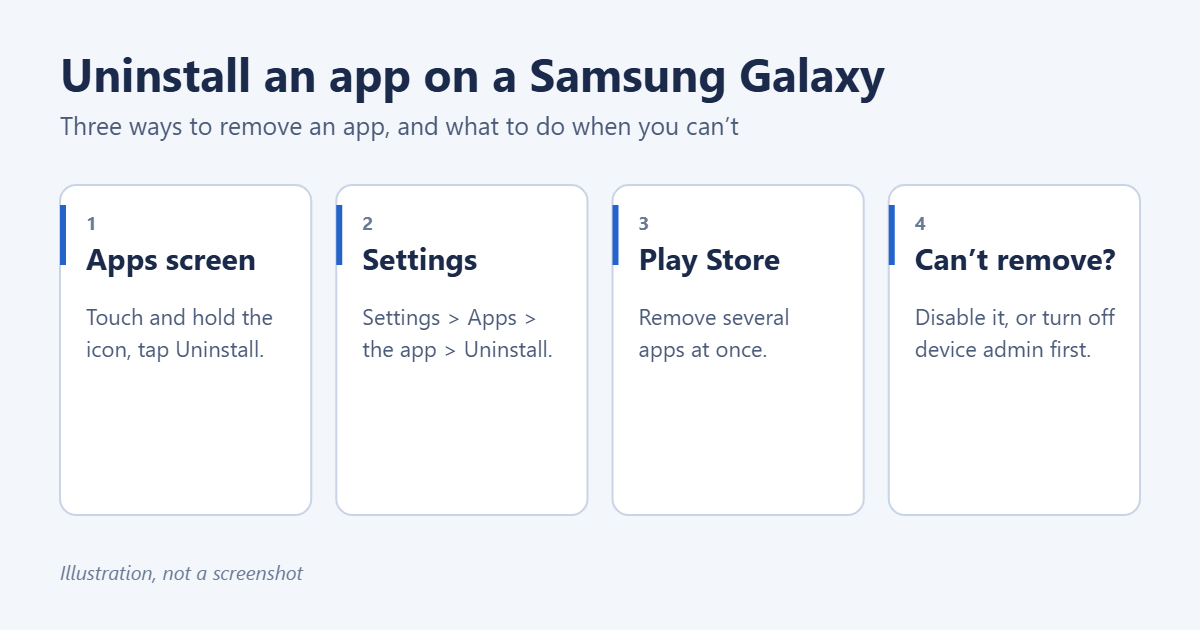
On a Samsung Galaxy phone or tablet with One UI, swipe up to open the Apps screen, touch and hold the app’s icon, then tap Uninstall and OK. Another route is Settings > Apps, where you choose the app and tap Uninstall. Many apps Samsung or your carrier installed can’t be removed, but you can disable them so they stop running and leave the Apps screen. Menu names vary slightly by model and software version.
Method 1: Uninstall from the Apps screen
- Swipe up from the middle of the Home screen to open the Apps screen.
- Touch and hold the app’s icon until a menu appears.
- Tap Uninstall.
- Tap OK to confirm.
If you do this on the Home screen instead, you may only see Remove, which takes the shortcut off the Home screen but leaves the app installed. The difference is explained in removing apps from the home screen in Android.
Does uninstalling an app delete my account with that service?
No. Your account stays active until you delete it through the app or the company’s website.
On other Android phones, the steps for deleting an app on Android are much the same. To clear a widget rather than an app, try removing the weather widget on Android.
Method 2: Uninstall from Settings
Use this when you can’t find the icon or want to check how much space an app uses first.
- Open Settings and tap Apps.
- Scroll to the app or tap the search icon and type its name.
- Tap the app. Under Storage, you can see how much space it takes up.
- Tap Uninstall at the bottom of the screen, then OK.
To sort the list by size, tap the sort icon next to Your apps and choose Size. This shows which apps free up the most space.
Method 3: Remove several apps at once from the Play Store
- Open the Play Store and tap your profile picture in the top-right corner.
- Tap Manage apps & device, then the Manage tab.
- Tick the box next to each app you want to remove.
- Tap the trash icon at the top, then Uninstall.
Apps you got from the Galaxy Store can be removed the same way from Methods 1 and 2. The Clock app is one to keep, since it’s where you set an alarm on a Samsung Galaxy.
Will uninstalling an app cancel my subscription?
No. Cancel it in the Play Store under your profile picture > Payments & subscriptions > Subscriptions, or with the company you pay.
Can I get an uninstalled app back?
Yes. Open the Play Store, tap your profile picture > Manage apps & device > Manage, and switch the filter from Installed to Not installed. Paid apps don’t need to be bought again. Your data comes back only if the app saved it to your account or a backup.
Apps you can’t uninstall: disable them instead
Preinstalled apps from Samsung, Google or your carrier often show Disable instead of Uninstall. Disabling stops the app from running, removes it from the Apps screen and removes its updates, so it takes up less space.
- Go to Settings > Apps and tap the app.
- Tap Disable, then Disable app to confirm.
To turn it back on, find it in Settings > Apps and tap Enable. Avoid disabling apps you don’t recognize, such as system services, because other parts of the phone may rely on them.
If Disable is greyed out, the app is a core part of the phone. You can still hide it: pinch the Home screen, tap Settings > Hide apps on Home and Apps screens, select the app and tap Done.
Uninstall updates for a preinstalled app
If a built-in app started misbehaving after an update, open it in Settings > Apps, tap the three-dot menu in the top-right corner and choose Uninstall updates. The app goes back to the version that came with the phone.
Uninstall greyed out or an app that returns
Uninstall is greyed out
The app may have device administrator permission, which some security, parental control and work apps use. Go to Settings > Security and privacy > More security settings > Device admin apps, turn the app off, then uninstall it. If the phone is managed by your work or school, only its IT department can remove those apps.
The app came back after you deleted it
Check whether it’s installed in Secure Folder or in a work profile, which keep their own copies of apps. Preinstalled apps that you disabled can also come back after a software update. Disable them again in Settings > Apps.
Uninstalling didn’t free up much space
Some apps store files, such as downloaded videos or WhatsApp media, in the phone’s shared storage, which uninstalling doesn’t delete. Open My Files and check the Download folder and the app’s own folder.

Matt Jacobs writes and maintains the guides on Support Your Tech, which he started in 2017. He spent most of his career keeping small-business PCs running and still takes the occasional consulting job, so the steps here come from fixing the same problems on other people’s computers. Every guide is checked on his own Windows 11, Windows 10, Mac, iPhone and iPad before it goes up.