Windows 10 doesn’t have a phone-style home screen. The closest equivalents are the desktop, the tile area of the Start menu, and the taskbar at the bottom of the screen. The fastest way to put an app on the desktop is to select Start, find the app in the alphabetical list, and drag it onto an empty part of the desktop. To add it to Start or the taskbar instead, right-click the app in that list and choose Pin to Start, or More > Pin to taskbar.
Applies to: Windows 10 version 22H2, Home and Pro. Windows 10 reached end of support on October 14, 2025, and PCs enrolled in Extended Security Updates get security fixes through October 12, 2027. These steps work the same with or without ESU.
Desktop, Start or taskbar: which should you use?
All three keep an app one or two clicks away, but they behave differently. Many people use more than one, for example a taskbar pin for the browser and Start tiles for everything else.
- Desktop shortcut: an icon on the background behind your windows. It’s easy to see when nothing is open, but open windows cover it. Press Windows key + D to show the desktop and press it again to bring your windows back.
- Start tile: a square or rectangle on the right side of the Start menu. Tiles can be resized, grouped under names and, for some apps, show live information such as the weather. Good for 10 to 30 apps you use regularly.
- Taskbar pin: an icon on the bar at the bottom of the screen that is visible even when windows are open. Best for the handful of apps you open every day, because space is limited.
Whichever you pick, you’re adding a shortcut, not moving the app. Removing a shortcut, tile or pin never uninstalls anything.
Put an app on the desktop
This is what most people mean by “home screen.” It works for regular desktop programs (such as Word or Chrome) and for Microsoft Store apps (such as Calculator or Weather).
- Minimize or close open windows so you can see some empty desktop. Pressing Windows key + D does this in one step.
- Select the Start button (the Windows logo in the lower-left corner) or press the Windows key. The app list appears on the left side of Start, sorted A to Z.
- Scroll to the app. To jump ahead, click any letter heading, such as A, and then click the letter you want.
- Click and hold the app’s name, then drag it out of the Start menu onto the desktop. Start closes as you drag.
- Release the mouse button when a small Link label appears next to the pointer. A new icon appears where you dropped it.
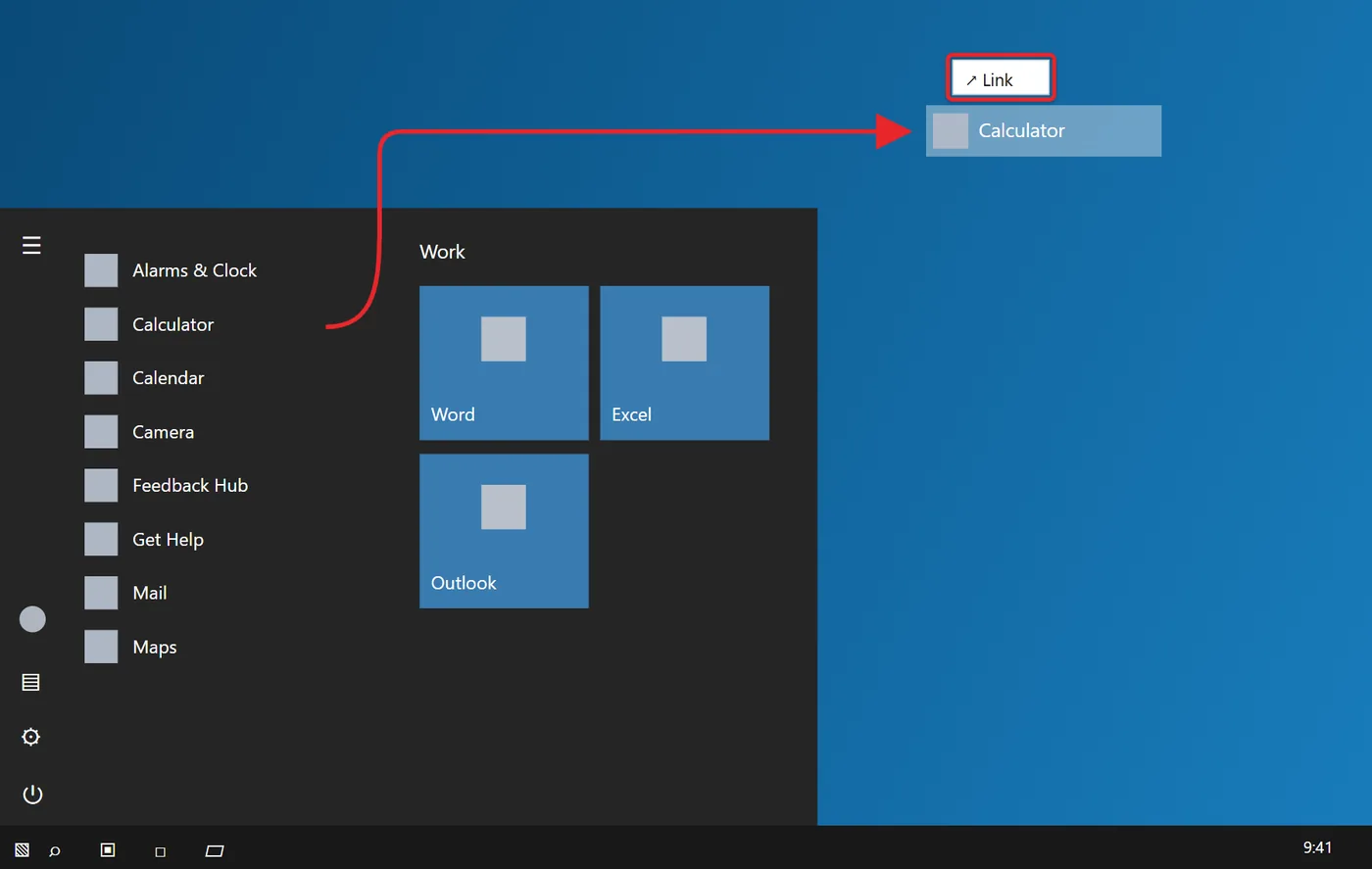
To check that it worked, look for a small curved arrow in the lower-left corner of the new icon. That arrow marks a shortcut. Double-click it and the app should open.
Dragging from the tiles on the right side of Start also works: drag a tile onto the desktop to get a shortcut for that app, and the tile stays where it was. For files, folders and custom shortcuts, see how to create a desktop shortcut in Windows 10.
If dragging doesn’t work: use the Applications folder
On a touchscreen, with a touchpad that makes dragging awkward, or when the drag just snaps back, use the hidden Applications folder. It lists every installed app, including Store apps, and can make shortcuts directly.
- Press Windows key + R to open the Run box.
- Type
shell:AppsFolderand press Enter. A File Explorer window opens named Applications. - Right-click the app and choose Create shortcut.
- Windows says it can’t create the shortcut in that folder and asks whether to put it on the desktop instead. Select Yes.
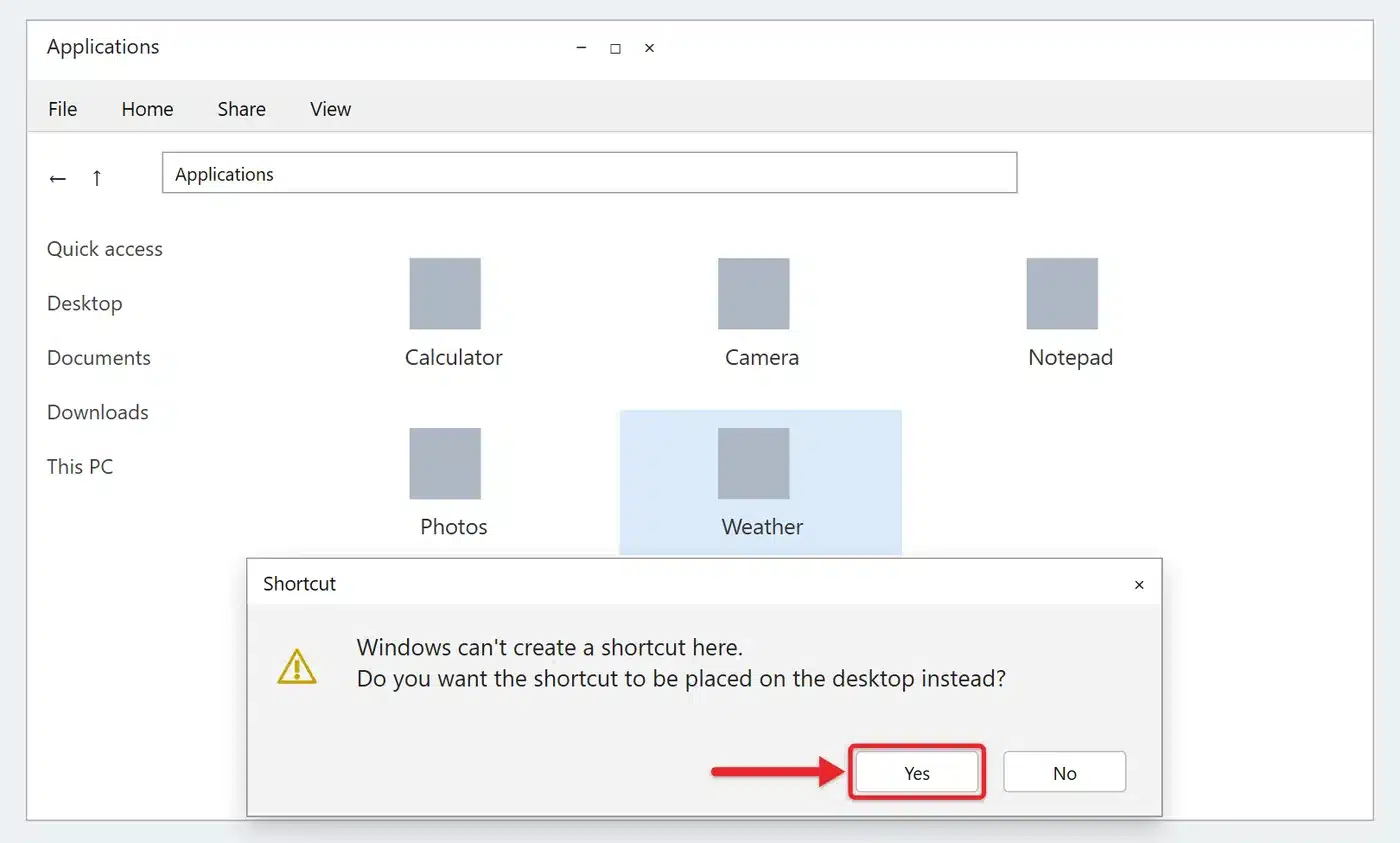
You can select several apps with Ctrl + click before step 3 to create several shortcuts at once.
For desktop programs: Send to Desktop
Traditional programs installed from a website or disc can also be sent to the desktop from their file location. Store apps don’t offer this option.
- Open Start, right-click the program and choose More > Open file location. File Explorer opens with the program’s Start menu shortcut selected.
- Right-click the selected shortcut and choose Send to > Desktop (create shortcut).
If Open file location isn’t in the menu, the app is a Store app; use one of the two methods above instead.
If you want a grid of app icons that feels like a tablet home screen, use Start tiles. Microsoft’s Customize the Windows Start menu page (Windows 10 tab) covers the same pinning, folder and full-screen options.
- Open Start and find the app in the list on the left, or type its name right after opening Start to search for it.
- Right-click the app and choose Pin to Start. A tile for the app appears on the right side of Start, usually at the bottom of the existing tiles.
- Drag the tile to where you want it. Other tiles move out of the way.
- To change its size, right-click the tile and choose Resize, then pick Small, Medium, Wide or Large. Some apps, especially older desktop programs, offer only Small and Medium.
The pin options are available from search results too. In the search panel, right-click the app (or use the options on the right side of the results) and choose Pin to Start.
Organize tiles into groups and folders
- Make a group: drag a tile into an empty area below or beside the existing tiles until a bar appears, then drop it. Point just above the new group and click Name group to give it a label such as “Work” or “Games.”
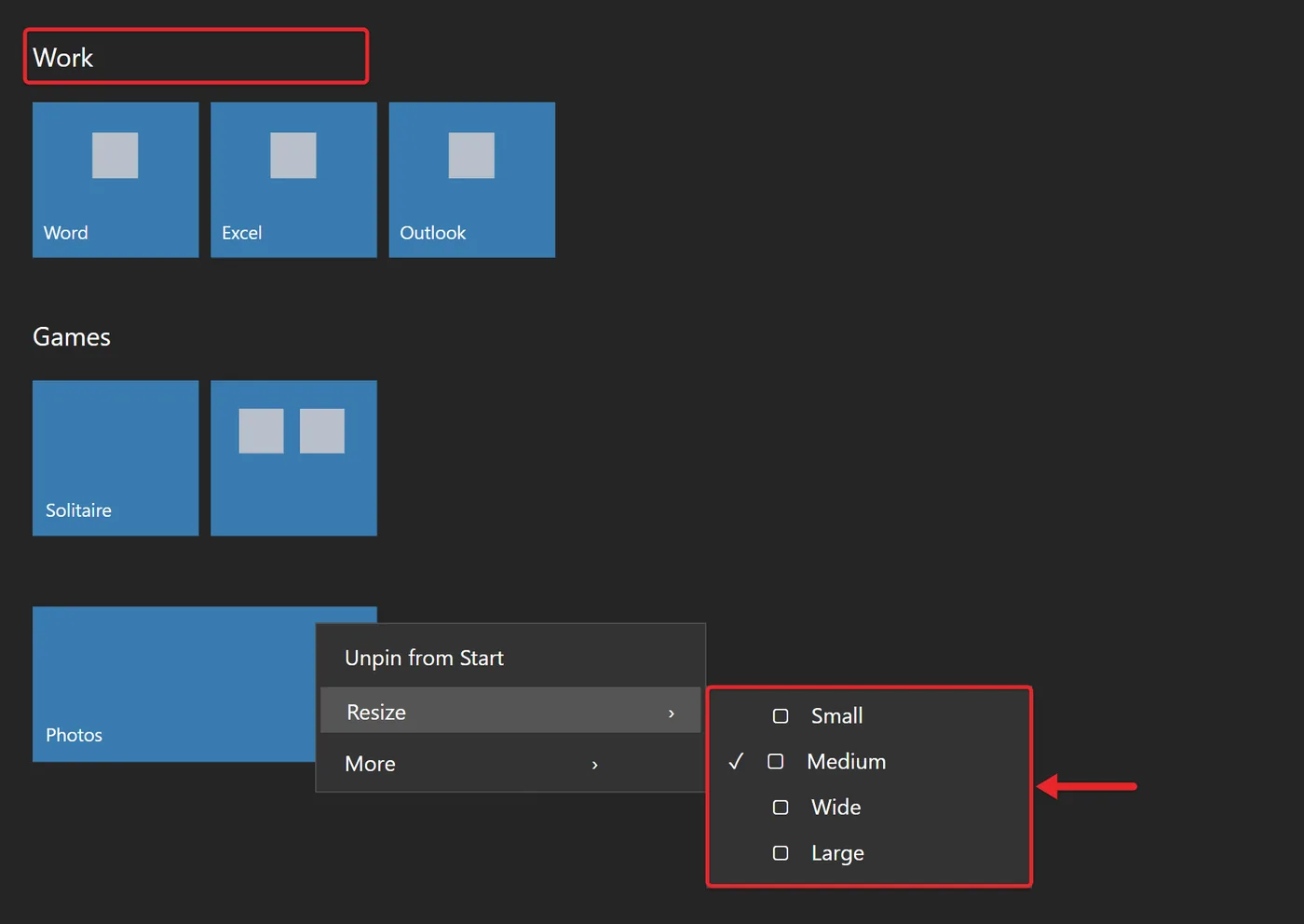
- Make a folder: drag one tile directly on top of another and hold it there for a moment before releasing. The two apps share one tile; click it to expand the folder, and drag tiles out to remove them.
- Stop moving tiles: some tiles show live information that changes every few seconds. To keep a tile static, right-click it and choose More > Turn Live Tile off.
- Make Start bigger: point at the top or right edge of the Start menu until you see a double-headed arrow, then drag to give the tiles more room.
Make Start full screen
For a layout that fills the whole screen, like a tablet home screen, select Start > Settings (the gear icon) > Personalization > Start and turn on Use Start full screen. Pressing the Windows key then shows your tiles across the screen. To show the full app list in this view, click the list icon in the upper-left corner. Turn the setting off to go back to the normal menu.
Pin apps to the taskbar
The taskbar stays visible over your open windows, so it’s the quickest launch spot for apps you use all day.
- Open Start and find the app in the list.
- Right-click it and point to More.
- Choose Pin to taskbar. The app’s icon appears on the taskbar right away, to the right of the icons already pinned there.
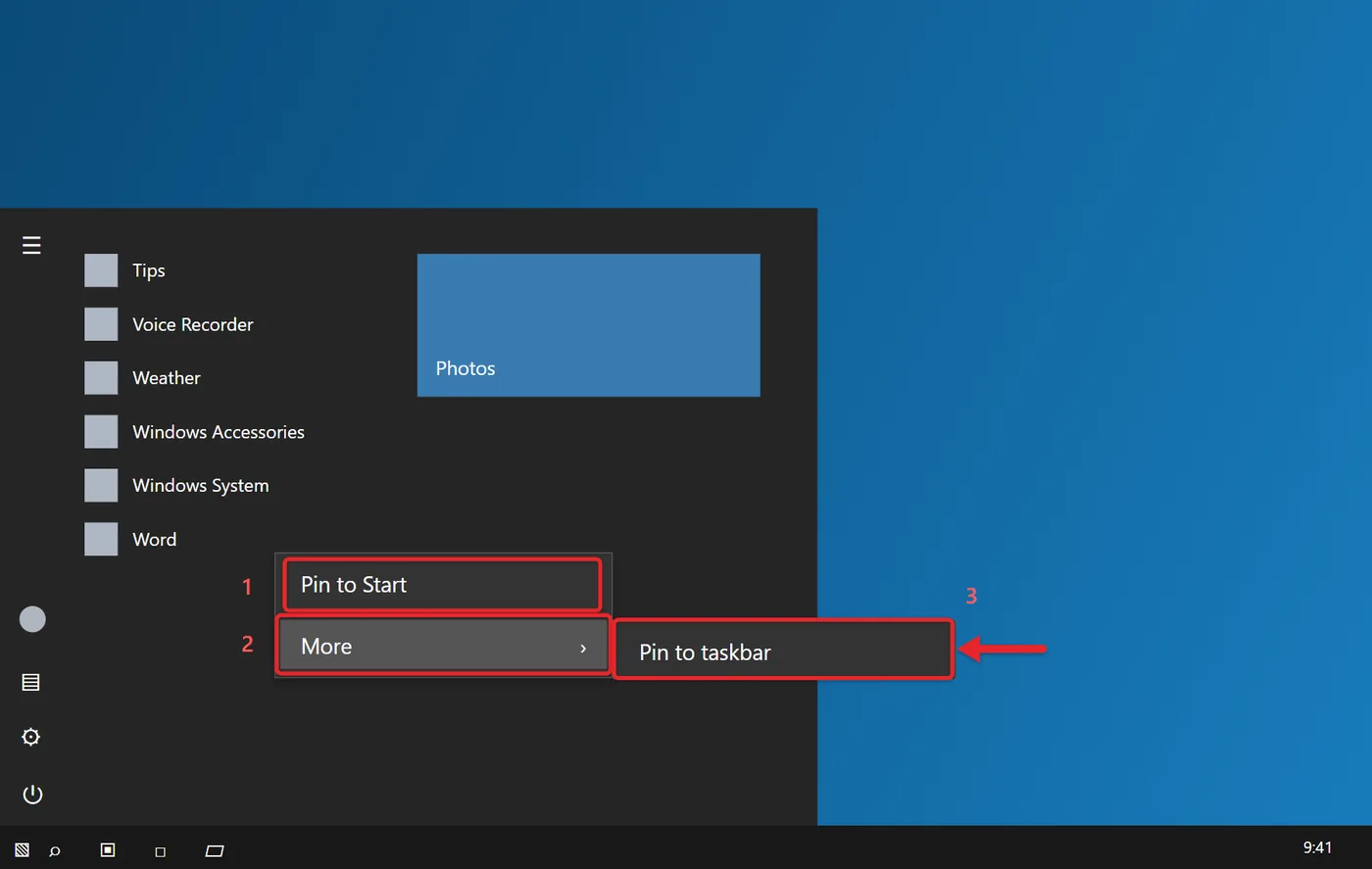
If the app is already running, right-click its icon on the taskbar and choose Pin to taskbar. The icon then stays after you close the app. Drag pinned icons left or right to change their order.
The order matters for keyboard users. According to Microsoft’s keyboard shortcuts list, Windows key + a number opens the app pinned in that position, counting from the left, or switches to it if it’s already open. So if Alex pins Outlook first and Excel second, Windows key + 2 always opens Excel. A worked example for a browser is pinning Google Chrome to the taskbar in Windows 10.
Put a website on the desktop, Start or taskbar
Sites you use like apps, such as webmail or a work portal, can get their own icons too.
Microsoft Edge: open the site, select the three-dot menu (Settings and more) in the upper-right corner, and choose Apps > Install this site as an app. The site then opens in its own window without browser tabs. To place it, go to edge://apps, select Details on the app, and choose Pin to taskbar, Pin to Start or Create Desktop shortcut. Microsoft explains this on Install, manage, or uninstall apps in Microsoft Edge. For a plain tile without installing anything, use Settings and more > More tools > Pin to Start.
Google Chrome: open the site, select the three-dot menu, and choose Cast, save, and share > Create shortcut, then select Create. The steps are on Google’s Create shortcuts for websites in Chrome page.
The taskbar version of this, including other browsers, is covered in how to pin a website to the taskbar in Windows 10.
Keep the desktop tidy
- Right-click an empty part of the desktop and choose View > Auto arrange icons to line shortcuts up in columns, or turn it off to place them anywhere.
- Use View > Large icons, Medium icons or Small icons to change their size.
- Right-click the desktop and choose Sort by > Name to put them in alphabetical order.
- To group shortcuts, right-click the desktop, choose New > Folder, name it (for example “Jordan’s school apps”), and drag shortcuts into it.
Troubleshooting
The desktop shortcut doesn’t appear
Desktop icons may be turned off. Right-click the desktop and make sure View > Show desktop icons is checked. More fixes are in show, hide, or restore desktop icons in Windows 10. If you have more than one monitor, the shortcut may be on the other screen.
Pin to Start or Pin to taskbar is missing
Check whether Tablet mode is on: open the Action Center (the speech-bubble icon at the right end of the taskbar, or Windows key + A) and look at the Tablet mode button. Tablet mode replaces the desktop with a full-screen Start and can hide taskbar app icons, so turn it off to use the steps above. On a work or school PC, an administrator can lock the Start and taskbar layout; in that case, ask your IT team.
Dragging moves the app instead of creating a shortcut
If you drag a file out of a File Explorer window rather than from Start, Windows may move or copy it instead. Press Ctrl + Z right away to undo. To be safe in File Explorer, drag with the right mouse button and choose Create shortcuts here when you release.
The shortcut shows a blank icon or does nothing
The app may have been updated, moved or uninstalled. Delete the shortcut and create it again from Start. If the app isn’t in Start at all, reinstall it from the Microsoft Store or the developer’s site.
A Start tile shows a download arrow
The app is still installing, updating or was removed. Wait a few minutes, or open Microsoft Store > Library to check for updates. If the tile stays broken, right-click it, choose Unpin from Start, reinstall the app and pin it again.
Remove an app from the home screen
- Desktop: right-click the shortcut and choose Delete, or drag it to the Recycle Bin.
- Start: right-click the tile and choose Unpin from Start.
- Taskbar: right-click the icon and choose Unpin from taskbar.
In each case the app stays installed and remains in the Start app list. To remove the app itself, uninstall it from Settings > Apps.
Frequently asked questions
Can I put an app on the lock screen like a phone?
No. The Windows 10 lock screen shows a picture, the time and status from a few chosen apps (set in Settings > Personalization > Lock screen), but it can’t hold app shortcuts. Use the desktop, Start or taskbar instead.
Does this work the same in Windows 11?
Partly. Windows 11 drops live tiles for a plain grid of pinned icons and no longer offers tile groups or sizes. Right-clicking an app and choosing Pin to Start or Pin to taskbar still works, and dragging from the All apps list to the desktop still creates a shortcut.
Can I have the same app in more than one place?
Yes. A desktop shortcut, a Start tile and a taskbar pin are independent, so you can have all three. Removing one doesn’t affect the others.
Can I rename a desktop shortcut?
Yes. Right-click it, choose Rename, type a new name and press Enter. If a shortcut ended up with ” – Shortcut” at the end of its name, renaming is how to remove it. This changes only the label, not the app.
How do I change how the Start menu looks overall?
Beyond tiles, you can choose whether Start shows recently added apps, most used apps and the app list. Those settings are covered in how to change the Start menu in Windows 10.
Start with the two or three apps you open most: pin them to the taskbar, then put the rest on Start tiles or the desktop, whichever you see first when you sit down at the PC.

Matt Jacobs writes and maintains the guides on Support Your Tech, which he started in 2017. He spent most of his career keeping small-business PCs running and still takes the occasional consulting job, so the steps here come from fixing the same problems on other people’s computers. Every guide is checked on his own Windows 11, Windows 10, Mac, iPhone and iPad before it goes up.