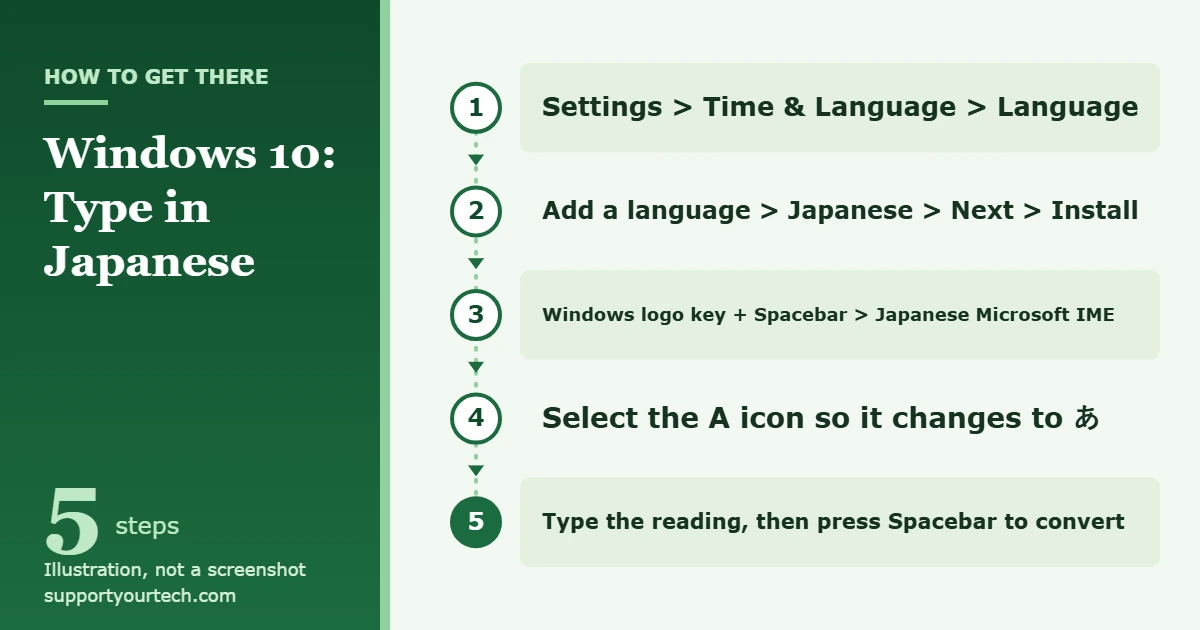
To type in Japanese on Windows 10, open Settings, go to Time & Language > Language, select Add a language, and install Japanese. Then press the Windows logo key + Spacebar to switch to Japanese Microsoft IME, change the A icon on the taskbar to あ, type a word the way it sounds, and press the Spacebar to convert it to kanji.
Applies to: Windows 10 (version 22H2). Checked against Microsoft Support and Microsoft Learn on October 7, 2026.
What you need before you start
- An ordinary keyboard. Microsoft’s Japanese Input Method Editor (IME) is the part of Windows that turns keystrokes on a regular keyboard into Japanese characters. Microsoft documents it as working with a typical 101 to 105-key keyboard, so you do not need a keyboard with Japanese keys.
- An internet connection. Windows downloads the Japanese language files when you add the language.
- No change to your display language. According to Microsoft, using the IME does not require changing the Windows display language. Your menus and apps can stay in English.
- Some knowledge of how Japanese words are pronounced. You type the reading of a word in Latin letters (romaji), and the IME turns it into hiragana and then offers kanji.
Add Japanese and start typing
- Open the Language page. Select Start, then Settings, then Time & Language > Language. You should see your current language under Preferred languages.
- Add Japanese. Select Add a language, choose Japanese from the list, and select Next.
- Choose the optional features and install. Windows shows a list of Optional language features. Microsoft notes that none of them are necessary if you only want to type Japanese and keep your current display language. Select Install and wait for the download to finish. Japanese then appears in your list of languages.
- Switch to the Japanese keyboard. Click in the document or text box where you want to type, then press the Windows logo key + Spacebar and choose Japanese Microsoft IME. You can also select the language abbreviation (for example, ENG) near the clock on the taskbar and pick it from the list. A new icon showing A appears next to the language indicator.
- Turn on Japanese input. Select the A icon so that it changes to あ, or press Alt + ` (the back quote key). A means the IME is typing plain English letters; あ means it is typing hiragana.
- Type the word the way it sounds. For example, type haru with no spaces. The letters turn into the hiragana はる as you type, and a candidate window opens with matching words.
- Convert and confirm. Press the Spacebar to convert the hiragana to kanji (はる becomes 春, the word for spring). Press Enter to accept the text. If you press Enter without pressing the Spacebar first, the word stays in hiragana.
Microsoft’s own walkthrough, Japanese IME on Microsoft Learn, uses the newer page name Language & region. On Windows 10 the same page is called Language. If you want a general overview of adding and switching keyboards, see our guide on how to change the keyboard language in Windows 10.
Pick the right kanji from the candidate window
Many Japanese words share the same reading, so the first conversion is not always the one you want. The conversion candidate window lists the alternatives. Microsoft documents these controls:
- Spacebar or the Down and Up arrow keys: move to the next or previous candidate.
- Tab: expand the list into a larger table that you can move around with the arrow keys.
- Number keys: pick the candidate with that number.
- Enter: accept the highlighted candidate.
- Esc: close the window without choosing anything.
The IME can also learn from what you type to improve its suggestions, and you can adjust that behavior in the Microsoft IME settings. If you also use a Windows 11 PC, see how to add the Japanese keyboard in Windows 11 for that version’s settings path.
Switch between hiragana, katakana, and English letters
Right-click the A or あ icon on the taskbar to open the IME menu. It lists five input modes:
| Mode | What it types |
|---|---|
| Hiragana | Japanese text that you can convert to kanji. Use this mode most of the time. |
| Full-width Katakana | Katakana, the script used mainly for words borrowed from other languages. |
| Full-width Alphanumeric | Latin letters and numbers that take up the same width as a Japanese character. |
| Half-width Katakana | Narrow katakana. |
| Half-width Alphanumeric | Normal English letters and numbers. This is the A mode. |
You rarely need to change modes just to type one katakana word. Stay in Hiragana mode, type the word, and press a function key before you press Enter:
- F6: convert what you typed to hiragana.
- F7: convert it to full-width katakana.
- F8: convert it to half-width katakana.
- F9: convert it to full-width alphanumeric.
- F10: convert it to half-width alphanumeric.
Useful Japanese IME keyboard shortcuts
These shortcuts come from Microsoft’s documentation for a standard (non-Japanese) keyboard.
| Shortcut | What it does |
|---|---|
| Windows logo key + Spacebar | Switches between your installed keyboards, such as English and Japanese. |
| Alt + ` (back quote) | Turns Japanese input on or off while the Japanese keyboard is selected. |
| Ctrl + Caps lock | Acts like the Hiragana key on a Japanese keyboard. |
| Alt + Caps lock | Acts like Shift + the Hiragana key, which enters katakana mode. |
| Shift + Caps lock | Acts like the Eisu (alphanumeric) key on a Japanese keyboard. |
| Ctrl + Delete | Removes the selected suggestion from the prediction candidate window. |
| Ctrl + B | Searches for the selected prediction candidate. |
| Ctrl + Shift + F10 | Turns IME private mode on or off. |
| Windows logo key + period (.) | Opens the emoji picker. |
Enter a character you cannot spell with the IME Pad
If you can see a kanji but do not know how it is read, right-click the A or あ icon and select IME Pad. In Hand Writing (JA) mode you draw the character with the mouse in the box on the left, then select the matching character from the box on the right to insert it. The IME Pad also has a Character List (JA) mode for browsing every character in a font and a Soft Keyboard (JA) mode with an on-screen keyboard.
The same right-click menu has an IME toolbar option. The toolbar gives you buttons for changing the input mode, opening the IME Pad, opening the user dictionary, and switching between kana and romaji input.
How to go back to English or remove Japanese
To type English again, press the Windows logo key + Spacebar and choose your English keyboard. If you only need a few English words in the middle of Japanese text, it is quicker to stay on the Japanese keyboard and press Alt + ` so the icon shows A.
Adding Japanese does not change anything permanently. If you stop using it, return to Settings > Time & Language > Language, select Japanese in the list of languages, and remove it.
Troubleshooting Japanese input on Windows 10
English letters appear instead of Japanese
The Japanese keyboard is selected, but the IME is in English input mode. Look at the icon next to the language indicator. If it shows A, select it or press Alt + ` so that it shows あ.
The letters look wide and spaced out
The IME is in Full-width Alphanumeric mode. Right-click the mode icon and choose Hiragana for Japanese or Half-width Alphanumeric for normal English letters.
Japanese Microsoft IME is not in the list
The list that opens with the Windows logo key + Spacebar only shows keyboards for the languages under Preferred languages. Go back to Settings > Time & Language > Language and confirm that Japanese is listed and has finished installing. If it is missing, add it again while connected to the internet. If you just added it and an app that was already open does not offer it, close and reopen that app.
You cannot add a language on a work or school PC
Computers managed by an organization can have language settings restricted. If Add a language is unavailable or the download fails on a managed PC, ask your IT administrator to add Japanese for you.
The IME behaves strangely in one program
Microsoft includes a compatibility option for this. Right-click the IME icon on the taskbar and select Settings to open the Microsoft IME settings, then go to General and turn on Use previous version of Microsoft IME. Turn it off again if it does not help. Microsoft describes this and the other IME options on its Microsoft Japanese IME support page.
The wrong kanji keeps coming up
Press the Spacebar again to move through the other candidates, or press Tab to see more of them at once. To stop an unwanted suggestion from appearing in the prediction window, highlight it and press Ctrl + Delete.
Frequently asked questions
Do I need a Japanese keyboard to type Japanese on Windows 10?
No. The Microsoft Japanese IME is designed to work with a typical 101 to 105-key keyboard. You type the sounds in Latin letters and the IME converts them.
Will adding Japanese change the language of Windows?
No. Microsoft states that using the IME does not require changing your Windows display language, and the optional language features are not needed just for typing.
How do I type katakana?
Type the word in Hiragana mode and press F7 before you press Enter. To type a long passage in katakana, right-click the mode icon and choose Full-width Katakana.
What is the difference between full-width and half-width?
Full-width characters occupy the same space as a kanji or kana character, so they line up in Japanese text. Half-width characters are the narrower forms; half-width alphanumeric is the same as ordinary English typing.
Can I type kana directly instead of romaji?
Yes. The IME supports both romaji input and kana input, and the IME toolbar has a control for switching between them. Romaji input is the easier choice on a keyboard without kana printed on the keys.
Is it still safe to use Windows 10 for this?
The Japanese IME still works, but Microsoft ended support for Windows 10 on October 14, 2025, and version 22H2 is the final version. If your PC can run Windows 11, the same feature is there; see how to type in Japanese on Windows 11.
Once Japanese is installed, practice the two shortcuts you will use most: Windows logo key + Spacebar to switch keyboards and Alt + ` to switch between A and あ.

Matt Jacobs has been working as an IT consultant for small businesses since receiving his Master’s degree in 2003. While he still does some consulting work, his primary focus now is on creating technology support content for SupportYourTech.com.
His work can be found on many websites and focuses on topics such as Microsoft Office, Apple devices, Android devices, Photoshop, and more.